100+ Products Across 5 Categories: How a Bengaluru Startup is Transforming India's Medical OEM Market
Most original equipment manufacturers for the health sector focus on one or two departments in hospitals. This Bengaluru startup, however, is working with five.
Updated on: 30 September 2026

Sector

Solution
Diagnostics

Technology

State of Origin
Disclaimer:
Features ‘as is’ submissions and neither constitutes endorsement, certification, recommendation, or validation by NITI Aayog nor makes NITI Aayog liable in any manner.
Impact Metrics
80+ dealers supplied
with medical equipment across India.
Horizontal market targeted,
involving critical care, renal care, cardiac health, aesthetics, and rehabilitation.
India has both a rapidly developing manufacturing sector as well as one of the largest healthcare markets in the world. However, to this day, a significant proportion of the medical equipment used in its hospitals is imported. This means that beyond a certain point, access to quality healthcare is dependent upon global supply chains rather than demand from the public.
But what is the reason for this reliance on imported equipment? Perhaps part of the answer lies in the business models of Indian equipment manufacturers—specializing in one medical category instead of building a reputation across departments.
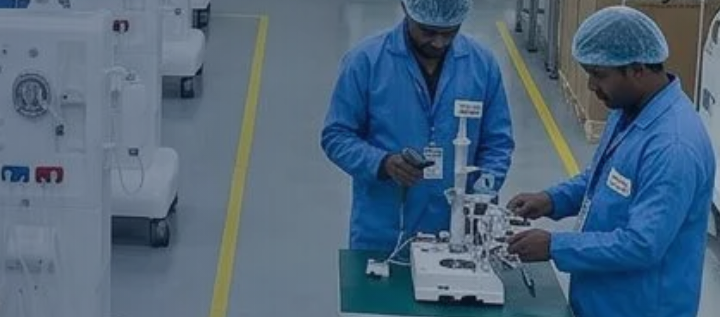
Pulse, founded by Anshul Sharma and Nishant Goel in 2026, aims to do things differently. By producing medical equipment for multiple medical departments, this Bengaluru startup hopes to one day compete with global healthcare brands in the Indian market. Simultaneously adapting foreign technology and building its own from scratch, it has developed 100+ branded products tailored for Indian patients and hospitals.
What categories of healthcare are covered?
Pulse offers products that can be classified into five categories based on the kinds of patients they serve.
The first category, critical care, includes products for intensive care units (ICUs) and occupational medicine—ECV devices, monitors, ventilators, NAC serving stations, laparoscopy tools, and so on. The second, renal care, includes products such as blood tubing sets and dialysers, with Pulse currently designing its own dialysis machine.
Next is cardiac medicine, which includes instruments such as stents, balloons, and guide wires that help in treating heart-related medical interventions. The fourth category, aesthetics, encapsulates dermatological laser machines used to treat acne, remove scars, reduce pigmentation, and remove hair.
Finally, Pulse’s products from the rehabilitation line include electric wheelchairs and other mechanical systems that support patients working on lifestyle recovery after illness or injury.
In addition to these categories, Pulse is poised to release products in two or three more.
Development journey
In December 2025, founders Anshul Sharma and Nishant Goel announced their intention to start a medtech startup and gathered financial resources amounting to $4 million through equity funding and seed funding. The primary investors were 3one4 Capital and Incubate Fund Asia. Pulse was officially launched in January 2026—approximately nine months prior to the publication of this report.
Today, Pulse has a research and development hub in the Andhra Pradesh MedTech Zone, a dedicated industrial park near Visakhapatnam.
The startup’s product development model is a mix of adaptation and unique conceptualization—while it is in talks with foreign manufacturers to see which medical technologies can be indigenized in the Indian context, it is also working on new product lines from scratch.
Pulse supplies 80+ dealers of medical equipment, spread across different regions of the country. Under its own brand name, it sells over a hundred unique products. One of its main objectives going forward is to partner directly with mid-sized hospitals, thus building trust in the medical community.
Building supply independence in healthcare
In the long run, Pulse hopes to supply not 5 but 10–15 categories within the field of medicine, with 100% of its revenues coming from its own branded products. While the majority of this revenue will be Indian in origin, it is hoped that 35–40% will be from foreign markets, with Pulse having emerged as a global supplier in its own right.
For these goals to be actualized, the startup will need strong support from not only its partners but also policymakers that align with its goals. Developing an Indian supplier base for medical equipment will take years of investment, and state governments can make this process easier by lending legitimacy to initiatives such as Pulse.
By conducting quality surveys of Indian medical equipment, they can help establish standards for future manufacturers. They can also spread awareness regarding public funding schemes that support medtech startups. Through such efforts, supply independence in medical technology may well become a reality.
Share Your Story Today, Shape Viksit Bharat Tomorrow
Got an idea, innovation, or experience that's making a difference? Share your story now and ignite India's transformation because your voice can drive the future forward!
Disclaimer:
Features ‘as is’ submissions and neither constitutes endorsement, certification, recommendation, or validation by NITI Aayog nor makes NITI Aayog liable in any manner.
Resources to Replicate This Idea
BUILD YOUR OWN INTERVENTION
Handpicked stories tailored just for you
Explore stories that inspire, inform, and ignite new ideas across tech, innovation, and real-world impact


Pilotless Cargo Flights with Zero Failures: Reimagining Diagnostic Logistics in Indian Cities
An energy-efficient autonomous aircraft combining vertical take-off with fixed-wing cruise has completed over 1,000 flights carrying diagnostic samples between hospitals,...
Read More