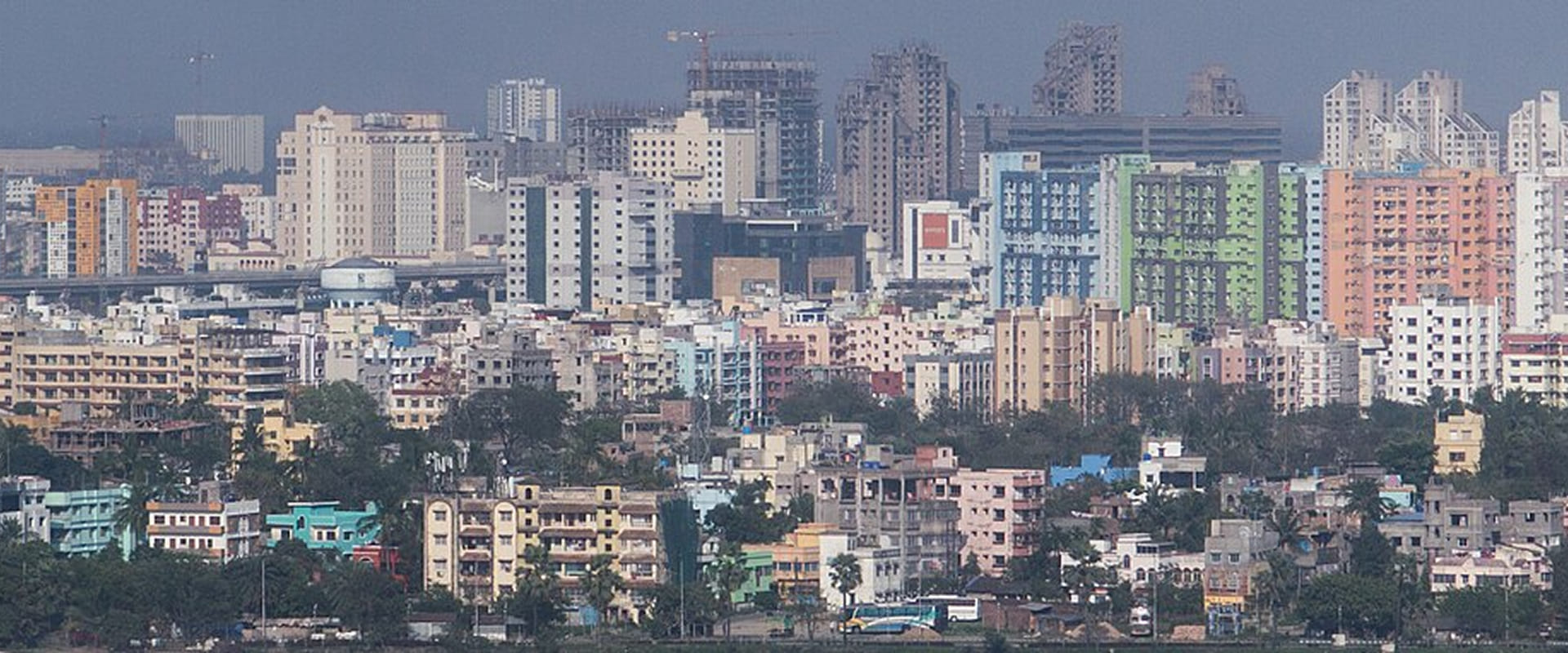
1.64 Million kWh Generated: A Bold Renewable Push in the Heart of Kolkata’s Urban Satellite
New Town’s canal-top solar plant turns urban water infrastructure into renewable energy assets, generating 1.64 million kWh annually without using ground space. By integrating solar with canals, the project cut land costs, reduced water loss, and improved grid efficiency, offering a smart, climate-resilient model for cities facing space constraints.
Updated on: 19 March 2023

Sector

Solution

Technology

State of Origin
Impact Metrics
1.64 million kWh
solar power generated annually.
Reduces land use
water evaporation, and algae growth.
Rajarhat New Town, a fast-growing township on the outskirts of Kolkata, was selected under the Smart City Mission (SCM) with a mandate to improve the ‘Quality of Living’. As part of its solar energy roadmap under the National Solar Mission (NSM), the New Town Kolkata Development Authority (NKDA) introduced an innovative solution — harnessing solar power through canal-top photovoltaic (PV) systems.
Faced with limited land availability and high urban land costs, NKDA identified the Bagjola canal as a suitable site for solar installations. The structure would provide renewable energy without occupying ground space, while also reducing water evaporation and algae growth in the canal. This vision aligned with national priorities and climate goals, while addressing local energy needs in an environmentally sustainable way.
Designing for innovation and efficiency
The pilot project involved installing a 1 MW solar PV plant over a 1.7 km stretch of the Bagjola canal, generating electricity for evacuation into the 33 kV power grid. The project site — between Biswa Bangla Convention Centre and Major Arterial Road — was chosen based on solar potential and proximity to the consumer.
The PV system was designed with bifacial polycrystalline panels, grid connectivity, and real-time monitoring. A total of two 500 kW units were erected using a mild-steel support structure elevated 4.5 m above the canal. The unique canal-top design allowed for better air circulation around the panels, improving efficiency. Remote monitoring enabled continuous data collection on irradiation, temperature, and energy generation.
To ensure durability and low maintenance, the panels were coated to resist dust and bird droppings, with periodic cleaning using automated sprinklers. The modular design allowed for ease of installation, repairs, and scalability.
Implementation amid challenges
The project was planned and executed by NKDA, in collaboration with Agni Power and Electronics Pvt Ltd. Construction began in October 2020 after a competitive bidding process but faced delays due to Covid-19. The first unit was completed by April 2021, and the second unit reached 50% completion before the lockdown stalled further progress.
Despite these setbacks, the canal-top structure was lauded as India’s widest at 45 m, with a panel array spanning 20–30 m and supported at both ends to preserve the canal’s flow. The estimated budget was ₹15.95 crore.
A key innovation was the use of intelligent software PvSyst for system simulation and output prediction. Based on actual performance, the project achieved a generation capacity of 1.64 million kWh per year, with a 79.7% performance ratio. This output helped meet the peak demand of Biswa Bangla Convention Centre and demonstrated the viability of grid-connected solar in dense urban settings.
Stakeholders and institutional support
The Ministry of Housing and Urban Affairs (MoHUA) selected New Town as one of 20 pilot Smart Cities, while NKDA led project execution. WBREDA supported the implementation as the state nodal agency, and HIDCO served as the infrastructure development partner. The Centre for Green Energy and Sensor Systems (CEGESS) at IIEST Shibpur acted as technical advisor and research partner, providing system design and performance analysis.
On the ground, power was supplied to Biswa Bangla Convention Centre (BBCC), with the New Town Electricity Supply Company Ltd (NTESCL) managing distribution. Public engagement and awareness campaigns ensured citizen support for renewable initiatives.
Benefits and future replication
This project demonstrated several benefits beyond clean energy generation. It reduced the cost of support structures (compared to land-based installations), limited canal water evaporation, and helped curb algal growth and mosquito breeding. With solar modules elevated over water, ambient temperatures remained lower—boosting panel performance in the region’s hot summers.
New Town’s success has inspired interest in replicating the model across India. Similar projects have already emerged on canals in Gujarat, Andhra Pradesh, and Madhya Pradesh. NKDA itself has explored replication on a second canal-top project at Eco Park, though it remains under evaluation.
If just 15–20 m widths of India’s canal network (covering 212,965 sq. m) were used for such installations, the potential generation capacity could reach 10 GW—saving water, emissions, and land costs. New Town’s approach exemplifies how smart cities can align renewable energy with climate resilience, public infrastructure, and urban planning.
Share Your Story Today, Shape Viksit Bharat Tomorrow
Got an idea, innovation, or experience that's making a difference? Share your story now and ignite India's transformation because your voice can drive the future forward!
BUILD YOUR OWN

BUILD YOUR OWN
How can I implement this innovation effectively?
How is this innovation being adopted around the world?
Where else could this innovation make an impact?
Who has seen real results from using this innovation?
What insights do experts share about this innovation?
What policies support or influence this innovation?
How could this innovation evolve in the future?
Is this innovation accessible and inclusive for everyone?
How can I contribute to or participate in this innovation?
What resources can help me explore this innovation further?
If you would like to know more about this innovation, fill this form to contact the innovator.
Handpicked stories tailored just for you
Explore stories that inspire, inform, and ignite new ideas across tech, innovation, and real-world impact


AI-Enabled Gynaecological Care Expands Access to 400,000+ Women Across India
Pinky Promise is a chat-first, AI-assisted women’s healthcare platform delivering affordable, confidential gynaecological care at scale. Founded in 2022, it...
Read More