
96% Accurate AI Sorting Enables Indian FPOs to Double Daily Shipments
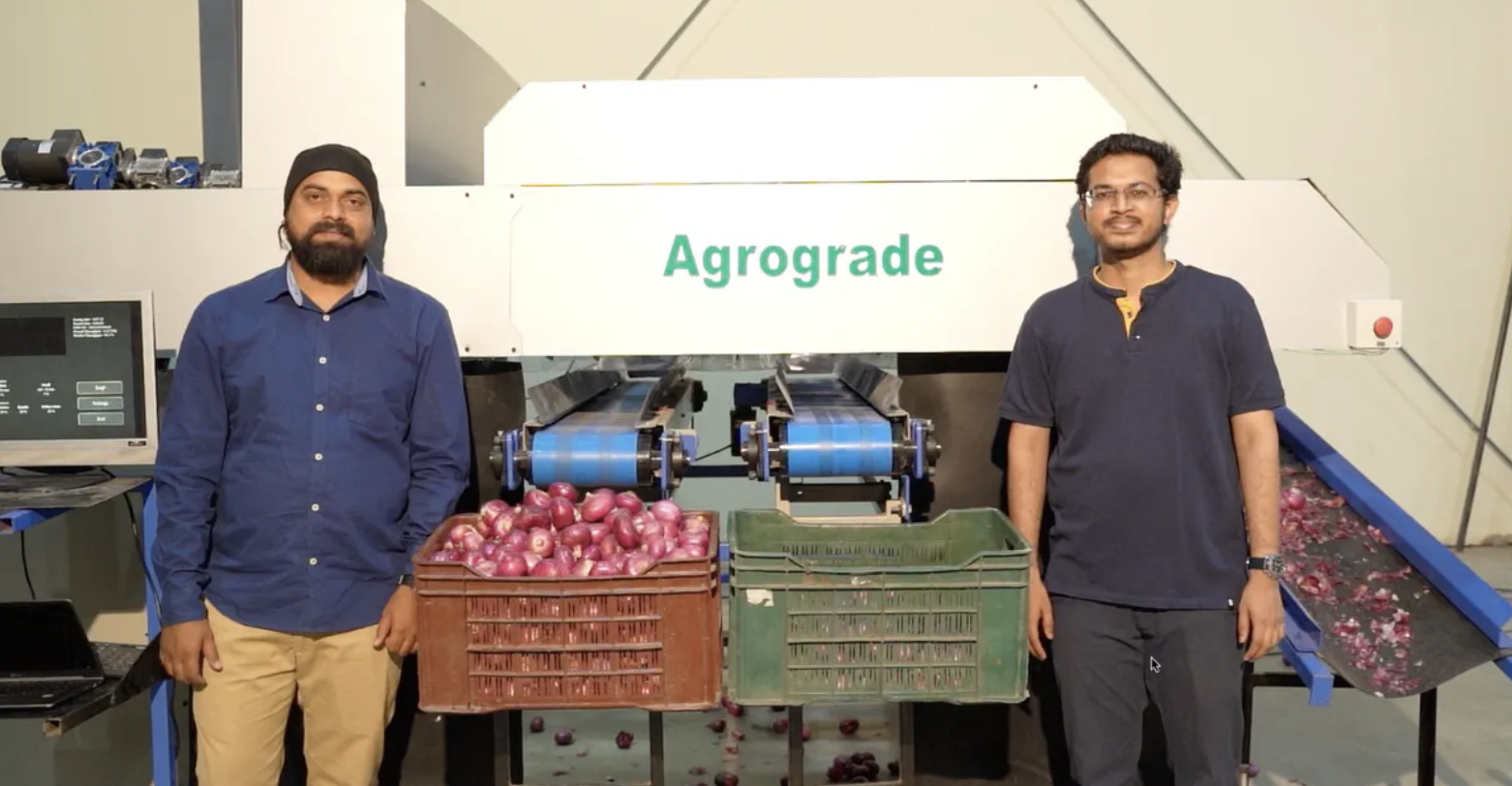
Agrograde has developed an AI-powered grading system that combines computer vision with precision handling to standardise post-harvest crop sorting. Operating across 12 states and grading 24,000 quintals daily, the technology delivers over 96 percent defect detection accuracy, reduces losses by up to 90 percent, cuts grading costs significantly, and enables FPOs to access premium domestic and export markets.
Updated on: 06 February 2026

Sector

Solution

Technology

State of Origin
Impact Metrics
96+ % accuracy
in defect detection with AI-based visual inspection.
24000 quintals/day
processed in over 70 AI grading units deployed across 12 Indian states.
~90% reduction
in post-harvest losses through early defect detection and removal of damaged produce.
Agrograde is an artificial intelligence (AI)-enabled crop grading and sorting system founded in 2018 by Kshitij Thakur, a mechanical engineer with farming roots in Maharashtra, and Rakesh Barai, an electronics and instrumentation engineer. The enterprise was established to address a persistent structural challenge in Indian agriculture: the lack of reliable, standardised post-harvest grading systems that result in rejected shipments, post-harvest losses, price disputes, and diminished farmer incomes—particularly in onion value chains.
India is one of the world’s largest producers of onions, yet grading and sorting remain largely manual, labour-intensive, and subjective. Inconsistent quality assessments frequently lead to rejected export consignments and domestic price penalties. Rising labour costs, shortages of skilled workers, and the absence of transparent quality benchmarks further exacerbate inefficiencies. For Farmer Producer Organisations (FPOs), a single rejected shipment can eliminate the profit margin of an entire trading cycle.
Drawing from lived agricultural experience and professional expertise in industrial automation and computer vision, the founders designed a system that combines mechanical precision with AI-based visual inspection. After six iterative prototypes developed between 2019 and 2022, Agrograde deployed a commercially viable machine capable of high-speed grading with over 96 percent defect detection accuracy while ensuring gentle handling to prevent peeling or bruising.
Technology Architecture and Operational Model
The Agrograde machine integrates calibrated conveyors, soft-handling rollers, and industrial-grade multi-angle camera systems. As onions pass through the system, high-resolution images are captured and processed using AI models trained on hundreds of thousands of crop samples collected across states and seasons. The system identifies size variations and detects defects such as rot, black smut, sprouting, sunburn, and skin damage.
Based on algorithmic classification, produce is automatically sorted into standardised grades. This ensures uniformity within each batch, enabling FPOs to confidently supply domestic and export markets with quality assurance. The company operates primarily through rental and partnership models to ensure accessibility for smallholder-linked FPOs, reducing capital barriers to adoption.
While initially focused on onions due to their variability and susceptibility to damage, Agrograde has expanded its technology to crops such as potatoes, tomatoes, arecanut, and apples. As of current operations, over 70 units have been deployed across 12 states, collectively grading approximately 24,000 quintals per day.
Impact on Farmer Producer Organisations and Market Access
The deployment of Agrograde’s systems has demonstrated measurable economic and operational outcomes across multiple FPOs:
- At Astitva Agro FPC (Sangamner), shipment timelines improved from one container over two days to two containers per day; grading costs reduced from ₹20,000 to ₹7,000 per order; and premium grades secured an additional ₹1 per kilogram.
- At Hortimax FPC (Solapur), operational costs declined by ₹0.30–₹0.40 per kilogram, with enhanced consistency enabling entry into export markets.
- At Mitraya FPC (Amravati), weekly shipments increased from 10 tonnes to 40–50 tonnes; grading costs reduced from ₹4 per kilogram to ₹0.5 per kilogram; and 30–40 percent of produce began fetching premium pricing.
- Across deployment sites, post-harvest losses have been reduced by up to 90 percent, and revenue realisations have increased by approximately 10 percent per kilogram due to quality-linked pricing.
Beyond cost savings, the technology has strengthened buyer trust by enabling traceable, standardised grading. FPOs report reduced disputes, fewer shipment rejections, and improved negotiating power with institutional buyers and exporters. By removing subjectivity from grading, the system reduces dependency on intermediaries and creates greater transparency within the supply chain.
Recognition and Institutional Integration
Agrograde has been recognised through national innovation platforms, including NITI Aayog’s Agri Entrepreneur initiatives, Mahindra Startup Leap, MANAGE Samunnati Agri Startup Awards, and incubation support from institutions such as ICAR-DOGR, Social Alpha, Villgro, and CIBA. These recognitions reflect the technology’s alignment with national priorities on post-harvest management, digital agriculture, and farmer income enhancement.
Strengthening India’s Agricultural Competitiveness
Technologies such as Agrograde represent a critical intervention in India’s agri-value chains by addressing inefficiencies beyond the farm gate. While productivity improvements at the cultivation stage remain important, post-harvest losses and quality variability continue to erode farmer earnings and export credibility. AI-enabled grading systems introduce standardisation, transparency, and data-driven decision-making into agricultural markets.
At scale, such technologies can strengthen India’s export competitiveness, reduce food waste, enable quality-linked pricing frameworks, and support FPO-led aggregation models. By embedding precision automation into rural supply chains, India can transition from volume-driven agriculture to value-driven agriculture—where quality assurance, traceability, and trust underpin market access. In doing so, AI-powered post-harvest infrastructure can play a pivotal role in advancing income security for farmers, enhancing agri-logistics efficiency, and reinforcing India’s position as a reliable global supplier of high-quality agricultural produce.
Share Your Story Today, Shape Viksit Bharat Tomorrow
Got an idea, innovation, or experience that's making a difference? Share your story now and ignite India's transformation because your voice can drive the future forward!
Handpicked stories tailored just for you
Explore stories that inspire, inform, and ignite new ideas across tech, innovation, and real-world impact


AI-Enabled Gynaecological Care Expands Access to 400,000+ Women Across India
Pinky Promise is a chat-first, AI-assisted women’s healthcare platform delivering affordable, confidential gynaecological care at scale. Founded in 2022, it...
Read More