Rewiring India's Recycling Network: AI and Data Are Bringing 1 Million Tonnes of Waste Back Into Circulation
By combining AI, logistics intelligence and digital marketplaces, waste-tech platform Recykal is formalising India’s recycling ecosystem, boosting incomes for scrap dealers, improving waste traceability, and helping bring over one million tonnes of waste back into circulation.
Updated on: 10 June 2026

Sector

Solution

Technology

State of Origin
Impact Metrics
43 million
metric tonnes of waste collected.
4,000+ scrap dealers
connected across India with recyclers, bulk buyers and manufacturers.
36% income growth
reported by participating scrap dealers.
~95% accuracy
in predicting scrap market prices based on historical data, seasonality and demand patterns.
For decades, India’s recycling ecosystem operated almost entirely through informal networks.
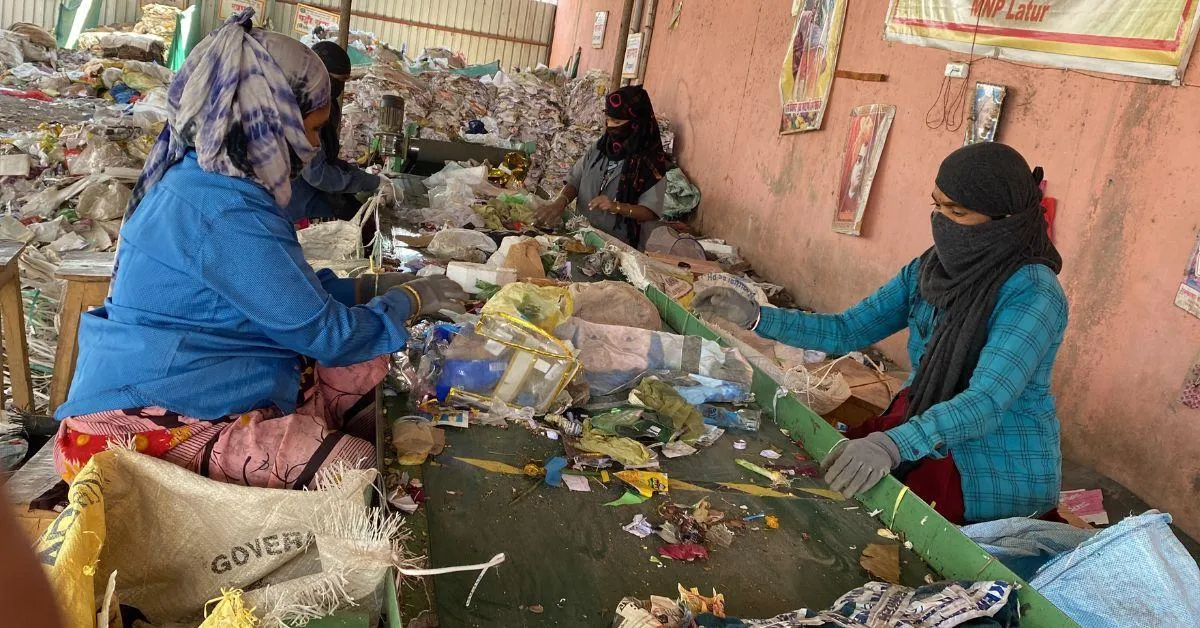
A plastic bottle discarded in a household bin would pass through a complex chain of waste pickers, scrap dealers, traders, aggregators, transporters, and recyclers before eventually being processed—or ending up in a landfill. Transactions were based largely on personal relationships, handwritten records, fragmented information, and limited market access.
This opacity created inefficiencies across the supply chain. Small scrap dealers often depended on a handful of buyers, lacked visibility into market prices, faced delayed payments, and had little bargaining power.
In 2016, Hyderabad-based startup Recykal set out to change this.
Founded by Abhay Deshpande, Vikram Prabakar, Abhishek Deshpande, Anirudha Jalan, and Ekta Narain, the company began with a simple objective: digitise India’s waste value chain and connect every stakeholder in the recycling ecosystem through technology.
Today, Recykal has evolved into one of India’s largest digital circular-economy platforms, facilitating waste transactions across multiple categories including plastics, paper, metals, tyres, batteries and e-waste. The company has crossed Rs 1,200 crore in annual recurring revenue (ARR), channelised over one million metric tonnes of waste into recycling streams, and is now using artificial intelligence to optimise every stage of the waste supply chain.
Digitising an Informal Industry
When Recykal entered the market, founders quickly realised that the biggest challenge was not waste itself—it was information.
“The entire recycling ecosystem ran on human memory, personal relationships and notebooks,” recalls co-founder Abhishek Deshpande.
India’s waste supply chain involves multiple intermediaries, each operating with limited visibility into the broader market. Scrap dealers typically knew only the buyer immediately above them and the supplier below them.
This fragmentation prevented waste from reaching the most suitable recycler and limited income opportunities for stakeholders at the grassroots.
To address this, Recykal built a managed digital marketplace that connected waste generators, scrap dealers, aggregators, recyclers, manufacturers and logistics providers on a single platform.
Through the mobile application, scrap dealers can list available waste, receive quality assessments, access buyers across India, arrange logistics and receive payments digitally.
The platform expanded market access beyond local networks and enabled users to compare prices across regions and categories.
For dealers such as Hyderabad-based scrap trader Rajvardhan Reddy, the change was transformative.
Earlier, he sold waste through middlemen and often faced delayed payments and lower prices. Through Recykal’s marketplace, he gained direct access to recyclers and bulk buyers, improving both margins and reliability.
The company estimates that digital access and improved market visibility have increased incomes of participating scrap dealers by up to 36 percent.
Building India’s Waste Intelligence Layer
While the marketplace solved an immediate problem, it also generated something far more valuable: data.
Over nearly a decade, Recykal collected transaction-level information across waste categories, geographies, logistics networks, recycling facilities, seasonal demand cycles and pricing patterns.
This growing data infrastructure became the foundation for the company’s next phase.
“We always wanted the industry to run on data instead of individual memory,” says Abhishek.
Today, Recykal’s systems track how different materials move across the country, where demand is concentrated, how seasonal consumption affects waste generation, and how market prices fluctuate over time.
For example, increased beverage consumption during summer months can drive higher PET bottle generation in specific regions, while tourism cycles influence waste availability in destinations such as Goa.
Using these historical datasets, Recykal has developed price forecasting systems that predict market rates with up to 95 percent accuracy.
This enables waste sellers to make informed decisions about when and where to sell material while helping recyclers plan procurement more efficiently.
Applying AI Across the Waste Supply Chain
Unlike many companies that have recently begun experimenting with artificial intelligence, Recykal’s AI journey started years before the current wave of generative AI.
Around five years ago, the company began building image-recognition systems capable of identifying different waste materials.
Teams manually labelled thousands of images to train machine-learning models that could distinguish between plastics, metals, packaging formats and other recyclable materials.
This capability is particularly important in India, where waste streams are often contaminated with soil, moisture and mixed materials.
According to the company, waste generated in developing economies presents significantly different challenges from those found in many Western countries.
As a result, Recykal focused on creating AI systems specifically trained on Indian waste conditions rather than adapting existing foreign solutions.
Today, AI is being integrated into multiple parts of the platform:
Intelligent Logistics
Transportation is one of the largest costs in waste management.
Recykal combines historical transaction data, vehicle databases and logistics information to optimise transportation decisions.
Its systems can assess whether a particular truck is suitable for a shipment, recommend vehicle types based on material volume, and reduce transportation inefficiencies that directly affect margins for waste traders.
Material Identification and Sorting
AI-powered image recognition assists in identifying and classifying waste materials.
Better sorting improves material quality, which in turn increases recycling value and reduces rejection rates.
Price Prediction
Machine-learning models analyse seasonality, regional demand patterns, industrial consumption trends and historical transactions to forecast market prices.
This creates greater transparency in a market traditionally characterised by information asymmetry.
Multilingual Communication
The company is also developing AI-driven communication systems that can automatically translate conversations between stakeholders operating in different regional languages.
This could help overcome one of India’s most persistent barriers to digital adoption: linguistic diversity.
From Marketplace to Open Ecosystem
For most of its existence, Recykal operated as a managed marketplace, actively facilitating transactions and onboarding users.
This approach was necessary because digital adoption within the waste sector was initially very low.
However, the company is now transitioning toward a more open platform model.
Having established trust and built digital infrastructure across the ecosystem, Recykal plans to allow broader participation from waste generators, recyclers, logistics providers and institutional buyers.
The shift reflects a larger ambition: bringing 10 percent of India’s waste into a traceable circular economy network.
Rather than functioning solely as a marketplace operator, Recykal increasingly sees itself as a digital infrastructure provider for the waste sector.
Reinventing Recycling Through Deposit Return Systems
One of Recykal’s most ambitious initiatives is its work on Deposit Refund Systems (DRS), a model widely used internationally to improve recycling rates.
Under DRS, consumers pay a small deposit when purchasing a packaged product and receive the money back upon returning the empty container for recycling.
Recognising that many global models were not designed for Indian conditions, Recykal developed an indigenous version tailored to local realities.
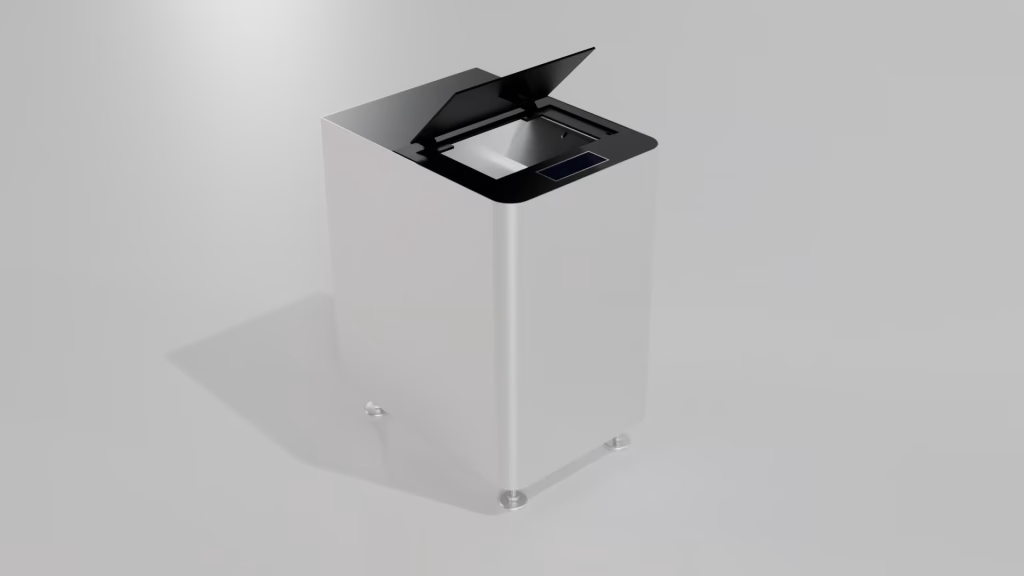
The company created AI-enabled reverse collection systems capable of recognising Indian packaging formats and material types.
Its machines are significantly smaller than conventional Western reverse-vending machines, making them suitable for India’s dense urban environments and small retail outlets.
A pilot deployment in Kedarnath received national recognition and earned a President’s Award.
Building on that success, Recykal is now supporting large-scale DRS implementation in Goa, where hundreds of collection points are being established across the state.
The company describes it as one of the world’s first QR-code-driven deposit refund systems, enabling real-time traceability and digital refund processing.
Technology for a Circular Future
India generates millions of tonnes of waste annually, yet recycling rates remain constrained by fragmented supply chains, limited traceability and inadequate source segregation.
Recykal’s experience demonstrates that waste management is not merely an environmental challenge—it is fundamentally a data and infrastructure challenge.
By digitising transactions, building market transparency, applying AI to logistics and sorting, and creating traceable recycling systems, the company is attempting to formalise one of the world’s largest informal industries.
Its long-term goal remains ambitious: channelising 10 percent of India’s waste into a circular economy.
If achieved, the impact would extend far beyond recycling. It would reduce landfill dependence, improve resource recovery, increase incomes for thousands of workers, and provide cities with a more efficient and sustainable waste management system.
In doing so, Recykal is positioning technology not as an add-on to waste management, but as the infrastructure that makes a circular economy possible.
Share Your Story Today, Shape Viksit Bharat Tomorrow
Got an idea, innovation, or experience that's making a difference? Share your story now and ignite India's transformation because your voice can drive the future forward!
Resources to Replicate This Idea
BUILD YOUR OWN INTERVENTION
Handpicked stories tailored just for you
Explore stories that inspire, inform, and ignite new ideas across tech, innovation, and real-world impact

How AI Diagnostics Are Reaching India’s Frontline Health Workers
AffEx equips rural health workers with an AI-powered point-of-care screening kit — testing hemoglobin, blood pressure, ECG, and cardiac and...
Read More