AI-Enabled Water Recovery at Scale: 65 Crore Litres Saved, 55 Lakh Tankers Eliminated
Boson Whitewater uses an AI- and IoT-enabled 11-stage filtration system to convert sewage-treated water into potable-quality supply for urban India. With 65+ crore litres of water recovered, 55+ lakh tankers avoided, and zero maintenance burden for clients, the decentralised model strengthens city-scale water security while reducing pollution, groundwater dependence and public-health risks.
Updated on: 05 December 2025

Sector

Solution

Technology
IoT

State of Origin
Impact Metrics
65+ crore litres saved
through Boson Whitewater installations.
55+ lakh tankers eliminated
reducing extraction and diesel emissions.
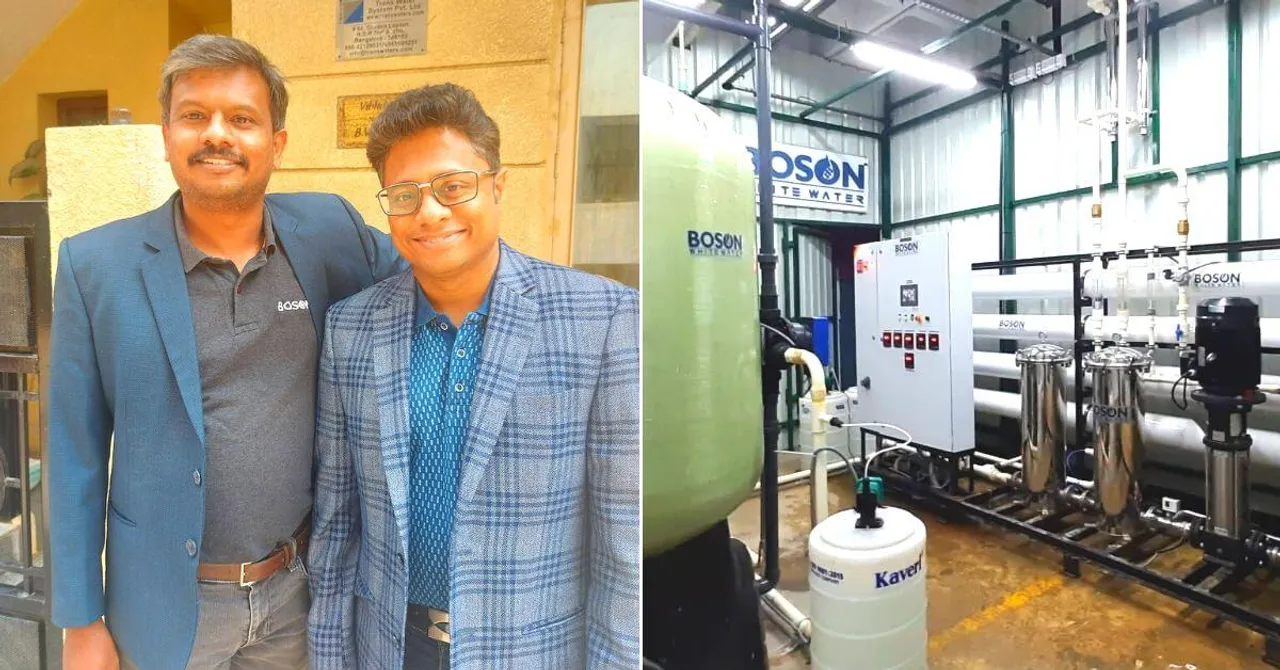
Boson Whitewater, a Bengaluru-based water utility startup founded by engineer Vikas Brahmavar, is pioneering an advanced model of decentralised wastewater recovery in Indian cities. Building on over a decade of experience in non-chemical water treatment through his earlier venture, Trans Water System, Vikas and co-founder Gowthaman Desingh introduced the Boson Whitewater (BWW) system in 2019 to convert sewage-treatment-plant (STP) water into potable, high-quality drinking water. The innovation addresses one of India’s most persistent barriers in urban water management: the massive under-utilisation of treated wastewater despite severe water stress.
A survey conducted by the founders across 200 apartment complexes revealed that only 20% of treated water is reused, while 80%—a predictable, year-round water stream—is discharged into drains. This inefficiency directly contributes to lake pollution, dependence on borewells, rising tanker water demand, and vulnerability to climate-induced rainfall variation. The BWW system reframes wastewater as a stable input resource, enabling water-secure cities built on circularity rather than extraction.
An 11-Stage Filtration Architecture Built for Reliability
At the core of Boson Whitewater’s model is a state-of-the-art, AI- and IoT-enabled 11-stage filtration systemengineered to remove turbidity, organics, chemicals, heavy metals, viruses and dissolved salts.
- Specialised materials for superior pre-treatment
The first four stages deploy unique aluminosilicate and manganese dioxide-based filter media that significantly outperform conventional sand filters. These media deliver 80% higher turbidity reduction, do not foul easily, and require replacement only every 5–6 years—an order-of-magnitude improvement over six-monthly sand media replacement. Additional clinoptilolite-based filters remove total suspended solids (TSS) down to 5 microns, and impregnated activated carbon enhances total organic contaminant (TOC) removal.
- Precision dosing and advanced micron filtration
Two stages of organic oxidation dosing reduce biological oxygen demand (BOD) without chlorine-based disinfection or secondary contamination such as chloramine formation. The subsequent micron cartridges achieve 1-micron particle filtration, setting the stage for high-efficiency membrane treatment.
- High-recovery membranes for potable-grade output
BWW’s proprietary high-recovery, low-fouling membrane system filters particles down to 0.001 microns, removing viruses, dissolved salts and metal ions. Unlike conventional membranes that waste large volumes of water, the BWW system recovers over 75% in the first cycle, recirculating the remaining 25% with controlled dilution and pH balancing. The final disinfection stages employ dual UV systems using 254 nm rays to neutralise any residual pathogens.
- Zero-manpower, IoT-driven operations
Boson Whitewater runs entirely on a remote-monitored IoT platform that collects real-time system parameters—including pressure, flow rates, filtration efficiency and water quality—across all 11 stages. AI algorithms identify anomalies such as declining membrane performance, pump failures, or shifts in filter life, allowing predictive maintenance with minimal downtime. With no manpower required for daily operation, the system offers unprecedented reliability for decentralised installations.

A Scalable, Circular, and Economically Viable Business Model
Boson Whitewater operates on an OPEX model, installing and maintaining systems at no upfront cost to clients. Water is sold on a per-litre basis at ₹0.08–₹0.10, significantly lower than tanker water. A 100 KLD installation costs the company ₹35–37 lakh but yields commercially viable returns even at minimum volumes of 30,000 litres per day. Today, the startup serves industries, IT parks, malls and large apartment complexes in Bengaluru and Hyderabad, with expansion to Chennai underway.
The company’s decentralised recovery infrastructure supports some of India’s largest water consumers. One major mall alone generates 1,50,000 litres of potable water daily through the BWW system. Communities like SJR Verity Apartments use 70,000 litres per day for gardening and non-potable needs, while the excess potable-grade water is supplied to hospitals, laundries and industries, reducing pressure on local groundwater.
Boson Whitewater was also selected among the 76 national winners of MoHUA’s India Water Pitch-Pilot-Scale Start-Up Challenge, giving it a platform for urban-scale deployments.
Quantified Impact: Water Security at Scale
From the updated metrics provided:
- 65+ crore litres of water saved through Boson Whitewater installations.
- 55+ lakh water tankers eliminated, reducing extraction and diesel emissions.
- 80+ lakh lives touched, demonstrating wide public relevance.
- 0 maintenance cost to clients due to the OPEX model and IoT-enabled operations.
- Plans to establish systems in 10 additional large apartments, saving another 50 crore litres in this financial year.
- A long-term vision to recover 500 crore litres of potable water from treated wastewater across India.
Implications for Public Health
The public health implications of Boson Whitewater’s model are profound. By rigorously removing E. coli, coliforms, pesticides, herbicides, heavy metals, and viruses, the system provides an alternative potable water stream that is reliably free of pathogenic and chemical contaminants. This reduces dependence on unpredictable and often compromised municipal or tanker water supplies, especially in communities where groundwater contamination—fluoride, nitrates, pathogens—is common.
Moreover, reducing tanker dependence lowers particulate emissions from diesel vehicles, indirectly improving urban air quality. By transforming wastewater into safe, decentralised potable water, Boson Whitewater offers a blueprint for resilient, emission-reducing, contamination-free urban water systems—central to safeguarding public health in an era of intensifying climate stress.
Share Your Story Today, Shape Viksit Bharat Tomorrow
Got an idea, innovation, or experience that's making a difference? Share your story now and ignite India's transformation because your voice can drive the future forward!
Resources to Replicate This Idea

BUILD YOUR OWN
Do you want to know how this innovator scaled their idea, how much it cost them, and what resources/partnerships they deployed?
Click here.
Handpicked stories tailored just for you
Explore stories that inspire, inform, and ignite new ideas across tech, innovation, and real-world impact

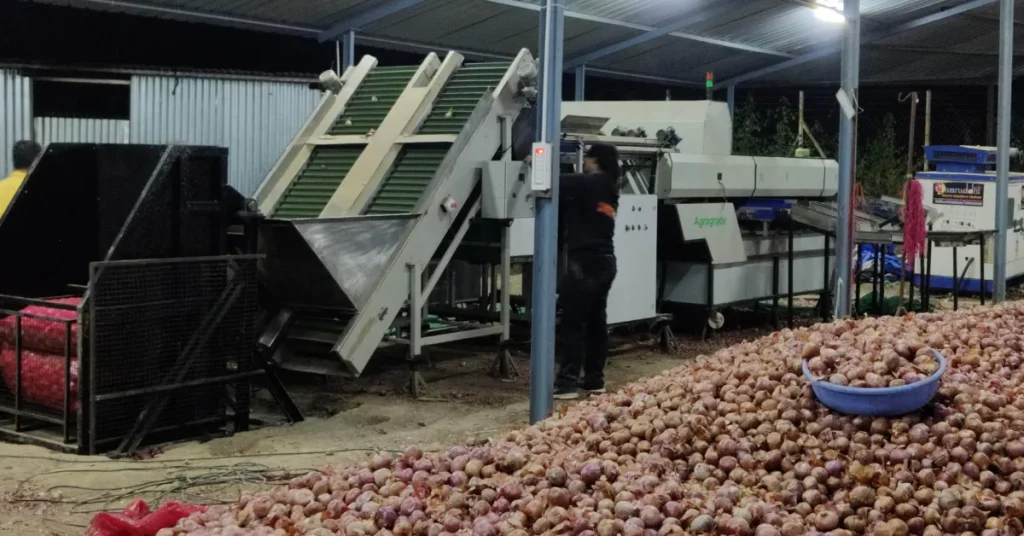
How AI is Cutting Post-Harvest Losses and Strengthen Agricultural Markets Across India
Agrograde uses artificial intelligence to address post-harvest quality assessment gaps in India’s agricultural markets. It deploys AI-based apps and sorting...
Read More