AI Meets Neuroscience: Decoding Motor Intent to Reverse Paralysis
An Ahmedabad-based neurotech startup is using an EEG headset, AI, and a robotic glove to help stroke and paralysis patients regain hand movement through neurofeedback-driven rehabilitation, delivered at home instead of expensive clinic-based robotic therapy.
Updated on: 23 September 2026

Sector

Solution

Technology

State of Origin
Disclaimer:
Features ‘as is’ submissions and neither constitutes endorsement, certification, recommendation, or validation by NITI Aayog nor makes NITI Aayog liable in any manner.
Impact Metrics
1,000+
patients treated across India
90% efficacy rate
reported among device users
3–4 months
of average recovery time per patient
Over 40,000 sessions
of brain activity data collected
The Problem
During a routine conversation with a neurologist in Ahmedabad, the founders of RehabVeda, Shyam Paramar and Neel Patel, watched a patient walk out after a check-up. The doctor mentioned, almost as an aside, that the man had suffered a stroke ten years earlier. His shoulders, elbows and legs had recovered enough for him to walk again, but his hand had stayed still through a decade of physiotherapy. The doctor’s question, whether the brain-computer interface technology they were already building could help such patients, became the starting point for what RehabVeda would eventually do.
The scale of the problem, according to Parmar, is stark. India records an estimated 20 lakh new stroke cases every year, and by his account, roughly 80% of survivors never regain functional movement in their upper limbs. Compounding this is a severe shortage of rehabilitation professionals: India has just 0.6 physiotherapists for every 10,000 people, against the World Health Organization’s recommended minimum of 1.0.
How the Technology Works
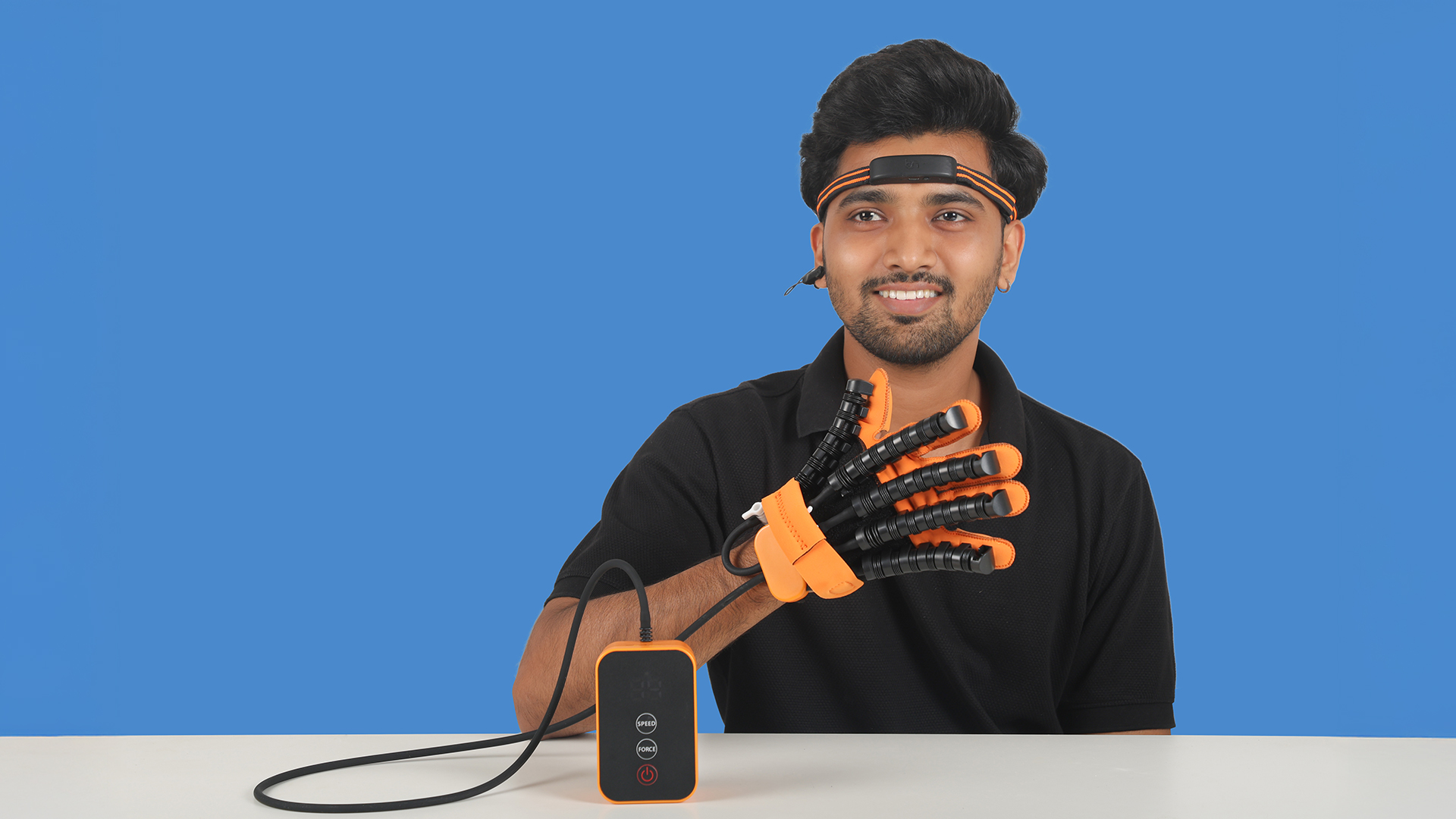
RehabVeda’s answer is a system called the R1, built around an EEG headset, a robotic glove, and an AI layer that sits between the two. When a patient imagines closing their fist, the brain generates the corresponding electrical signal, called motor intent, even if the hand itself doesn’t move. The AI decodes that signal in real time and sends it to the glove, which physically closes the patient’s hand. The visual and tactile feedback loops back to the brain, reinforcing the pathway associated with the movement, a process known as neurofeedback.
The underlying premise is that stroke rarely damages the limb itself. It damages the motor cortex, the brain region that issues movement commands, cutting off the signal to an otherwise functioning limb. Conventional physiotherapy relies on repetitive physical movement to try to restore this pathway, which works reasonably well for gross movements like standing or walking but struggles with the fine motor control needed for grasping or writing. By working directly with the brain’s own electrical activity instead of the muscle, RehabVeda’s approach targets the signal loss at its source, aiming to rewire those pathways faster than repetition-based training alone.
Why It’s Cheaper Than the Alternative
RehabVeda stands out because the existing alternative is expensive. Robotic-assisted rehabilitation centres in India, such as one Ahmedabad-based chain cited by Parmar, charge between Rs 2 lakh and Rs 10 lakh a month. For patients with limited mobility, the cost of a caregiver to accompany them to a centre, or a therapist to visit home for manual sessions is also added. RehabVeda’s device, by contrast, is designed for home use: patients are assessed virtually by an in-house physiotherapy team, scored against standard clinical scales, and shipped an internet-connected kit. The company sells the kit outright for around Rs 2 lakh, while also offering it on a rental model starting at Rs 15,000 a month. Solving the affordability problem is exactly where RehabVeda sets itself apart.
The Origin Story
RehabVeda’s current form is itself the product of an earlier pivot. Parmar’s interest in brain-computer interfaces began while teaching a large batch of students, wondering whether tracking their cognitive load could help him adapt his teaching in real time. That curiosity led him and his co-founder to first build EEG-based neurofeedback tools for children with attention deficit disorders, testing prototypes with special schools and neurologists. But rising chip prices during the pandemic made the original hardware model unsustainable, and the founders also found parents reluctant to have young children wear a sensor band for a condition many were unwilling to acknowledge in the first place. They redirected the same underlying technology toward stroke rehabilitation after the conversation with the Ahmedabad neurologist. The company was registered in 2022, and the current product was refined through an incubation period at IIT Roorkee.
Traction and Recognition
RehabVeda has treated over 1,000 patients across India, most referred through neurologists, neurosurgeons, physiotherapists and rehabilitation centres, alongside a smaller direct-to-consumer (D2C) channel built around social media and a patient community it runs as the Recovery Warrior series. On average, the company says patients recover functional hand movement within three to four months of consistent use, with founders reporting a 90% efficacy rate among device users. RehabVeda holds a CDSCO license for the Indian market and is preparing for FDA approval to enter the US. It has drawn early funding from IIT Roorkee’s pre-seed programme and secured a deal on Shark Tank India Season 5, and was more recently selected among India’s top 100 deep-tech startups under the Bharat Innovates initiative. Two patent applications, one national and one international under the Patent Cooperation Treaty, have been filed but not yet granted.
Impact Beyond the Patient
One case from RehabVeda’s patient base points to a dimension of stroke rehabilitation that rarely shows up in clinical outcome data. A patient in Vadodara, in the advanced stages of a terminal illness, was also the primary caregiver for an adult son living with both a developmental disability and stroke-related paralysis. Her stated concern was less about her own prognosis than about whether her son could manage basic tasks independently once she could no longer care for him. The case illustrates how functional recovery, even partial, can bear directly on a household’s capacity to sustain a dependent member’s independence over the long term, extending the stakes of rehabilitation from the individual patient to the family structure around them.
Policy and Support Needed
Parmar argues that government attention to rehabilitation lags behind other areas of health policy, even as an estimated one crore people in India live with some form of paralysis. While government-run physiotherapy centres exist and have expanded reach, he believes frontier technologies working in this space would benefit from a dedicated policy framework or expert panel, given the scale of disability that could, in his view, be addressed rather than managed indefinitely.
What’s Next
Looking ahead, RehabVeda is also building a longitudinal dataset from the brain activity it collects during therapy sessions, betting that a sufficiently large repository could eventually help predict the onset of other neurological conditions.
Share Your Story Today, Shape Viksit Bharat Tomorrow
Got an idea, innovation, or experience that's making a difference? Share your story now and ignite India's transformation because your voice can drive the future forward!
Disclaimer:
Features ‘as is’ submissions and neither constitutes endorsement, certification, recommendation, or validation by NITI Aayog nor makes NITI Aayog liable in any manner.
Resources to Replicate This Idea
BUILD YOUR OWN INTERVENTION
Handpicked stories tailored just for you
Explore stories that inspire, inform, and ignite new ideas across tech, innovation, and real-world impact

Pilotless Cargo Flights with Zero Failures: Reimagining Diagnostic Logistics in Indian Cities
An energy-efficient autonomous aircraft combining vertical take-off with fixed-wing cruise has completed over 1,000 flights carrying diagnostic samples between hospitals,...
Read More