The Dual-Use Technology of Agrivoltaics That's Powering India’s Farms Without Taking Away Farmland
By integrating elevated solar infrastructure with crop cultivation, Anand Jain has created a scalable agrivoltaic model that maximises land productivity. His innovation illustrates how technology can simultaneously improve energy generation, agricultural resilience, and rural livelihoods.
Updated on: 26 June 2026

Sector

Solution

Technology

State of Origin
Disclaimer:
Impact Metrics
25,000 units of electricity daily
generated from the farm, with surplus power supplied to the grid.
117.74 GW potential capacity
could be unlocked by deploying agrivoltaics on just India's fallow and uncultivated land.
Multiple farm revenue streams
enabled through crop cultivation, electricity generation, land leasing, and livestock integration.
Dual-use farmland
enabling crops and clean energy to be produced simultaneously without competing for land.
Farmers across India are keen to give in to sustainability — think integrating solar power on their lands — but not at the cost of losing their arable land. And, within this dichotomy, a solution has emerged: agrivoltaics. Farmer Anand Jain’s 16-acre farm in Sagar, Madhya Pradesh, is an exemplar.
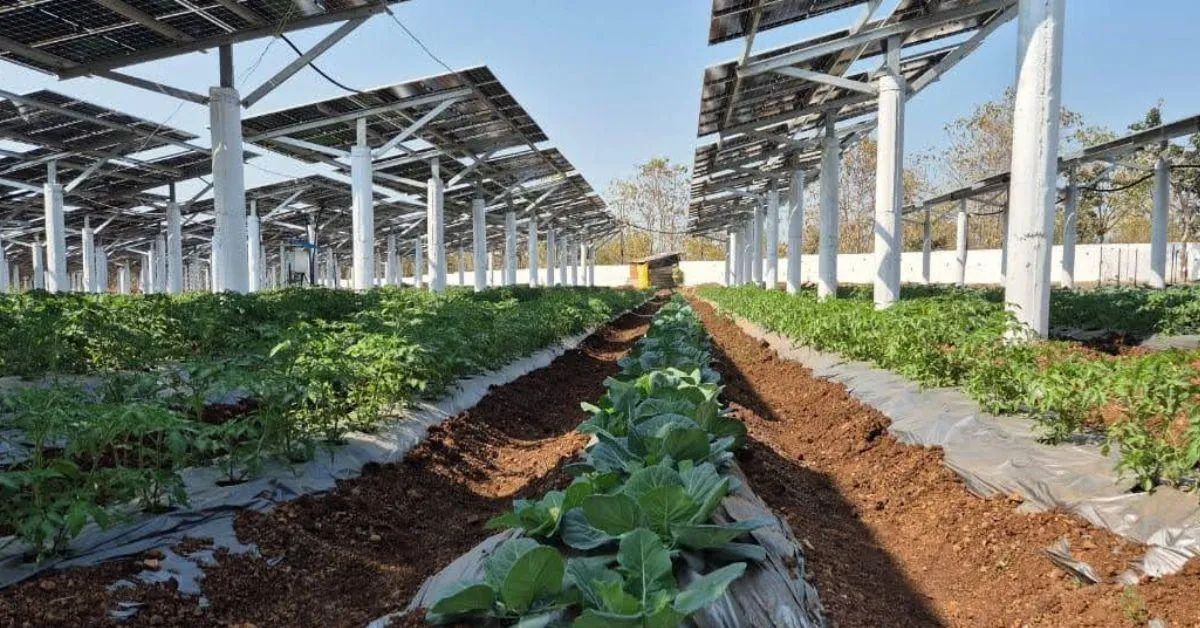
Here, Anand has pioneered one of India’s most ambitious agrivoltaic projects, proving that solar energy and agriculture can thrive together on the same land. Rather than sacrificing fertile farmland for solar installations, he designed a system of elevated solar panels that allows crops such as strawberries, lettuce, broccoli, tomatoes, and cabbage to be cultivated underneath while electricity is generated above.
His innovation addresses a major challenge in India’s renewable-energy expansion: how to increase solar capacity without displacing farmers or reducing agricultural productivity.
An IIT Roorkee graduate, Anand transformed previously rocky, uncultivable land into a productive farm and later integrated a 4.5 MW agrivoltaic solar plant. The panels, mounted 11–13 feet high and spaced widely enough for tractors to pass through, create a microclimate that reduces soil evaporation, conserves water, and protects crops from extreme heat.
Today, the farm generates up to 25,000 units of electricity daily, with surplus power sold to the grid under a long-term agreement with the state government.
Supported by bank financing and the PM-KUSUM scheme, the project demonstrates that large-scale agrivoltaics can be financially viable in rural India.
Agrivoltaics: the practice of combining solar power generation with agricultural cultivation
Beyond his own farm, Anand has become a strong advocate for agrivoltaics as a sustainable alternative to conventional solar parks, arguing that it can help farmers secure additional income, preserve their land, and contribute to India’s clean-energy goals simultaneously.
The technique seems to hold significant promise for India’s transition towards sustainable agriculture and renewable energy. As the country works towards its target of 500 GW of renewable energy capacity by 2030, agrivoltaics offers an innovative solution to one of the biggest challenges in solar expansion: land availability.

Research suggests that conventional ground-mounted solar photovoltaic (PV) installations require nearly two hectares of land for every megawatt (MW) of electricity generated. To achieve India’s target of 280 GW of solar PV capacity by 2030, a sizeable amount of land would be required. Such large-scale land allocation creates a significant challenge, particularly in a country where preserving agricultural land is essential for ensuring food security.
Agrivoltaic systems present an effective solution by enabling simultaneous agricultural production and solar energy generation on the same parcel of land. Instead of competing for land, farming and renewable energy can coexist, helping address the interconnected challenges of energy security, food production, and environmental sustainability.
Globally, agrivoltaics has gained momentum through supportive policies and successful implementation in countries such as Japan, Germany, the United States, China, and South Korea.
Research has demonstrated the technical, environmental, and economic viability of these systems, highlighting benefits such as improved crop selection under partial shade, healthier soils, optimised solar panel performance, greater energy efficiency, and stronger policy support.
India has also begun adopting agrivoltaics, with several pilot projects producing encouraging results. According to a report by the Indo-German Energy Forum and the National Solar Energy Federation, as of 31 January 2023, India’s solar capacity reached 63 GW, making it the fifth largest country in the world in terms of installed solar capacity, demonstrating the technology’s practical potential.
To accelerate adoption, experts recommend setting phased deployment targets. Even allocating one percent of agricultural, barren, fallow, and uncultivated land to agrivoltaics could unlock substantial solar capacity, with fallow and uncultivated land alone capable of contributing an estimated 117.74 GW.
Beginning with a modest annual deployment target and gradually scaling to 15 GW by 2030 would allow India to expand renewable energy generation while safeguarding productive farmland.
Instead of converting fertile farmland into exclusive solar parks, elevated or strategically placed solar panels allow crops and clean energy to coexist, ensuring that productive agricultural land continues to generate food while also producing electricity.
Several pilot projects across India demonstrate the versatility of this approach. Elevated panel systems in Maharashtra allow crops such as ginger, turmeric, green gram and vegetables to thrive beneath the structures, while also creating favourable microclimates that reduce heat stress and water loss. Other models include ground-mounted panels with interspace farming, slightly elevated installations, and vertical bifacial solar panels that preserve over 90 percent of land for cultivation while producing electricity during peak demand periods.
Beyond efficient land use, agrivoltaics opens multiple income streams for farmers. They can earn lease income from solar developers while continuing cultivation, benefit from lower electricity costs, and reduce dependence on unreliable grid power. The solar structures can also support horticultural crops like grapes, eliminating the need for separate support systems. In some models, the land beneath panels can be used for livestock grazing, further diversifying farm income.
The technology also addresses broader rural development challenges by improving energy access, supporting decentralised power generation, and enabling applications such as solar-powered irrigation and processing equipment.
While concerns remain about farmers losing control of their land and adapting to new farming practices, ongoing pilot projects indicate that collaborative models, farmer participation, and climate-responsive designs can overcome these barriers. With continued investment, research, and policy support, agrivoltaics has the potential to strengthen India’s food, energy, and water security while creating a more resilient and profitable agricultural sector.

Share Your Story Today, Shape Viksit Bharat Tomorrow
Got an idea, innovation, or experience that's making a difference? Share your story now and ignite India's transformation because your voice can drive the future forward!
Disclaimer:
Resources to Replicate This Idea
BUILD YOUR OWN INTERVENTION
Handpicked stories tailored just for you
Explore stories that inspire, inform, and ignite new ideas across tech, innovation, and real-world impact


How AI Diagnostics Are Reaching India’s Frontline Health Workers
AffEx equips rural health workers with an AI-powered point-of-care screening kit — testing hemoglobin, blood pressure, ECG, and cardiac and...
Read More