At One-Tenth the Global Cost, an Indian-Built Bionic Arm Is Reversing Disability-Linked Income Loss
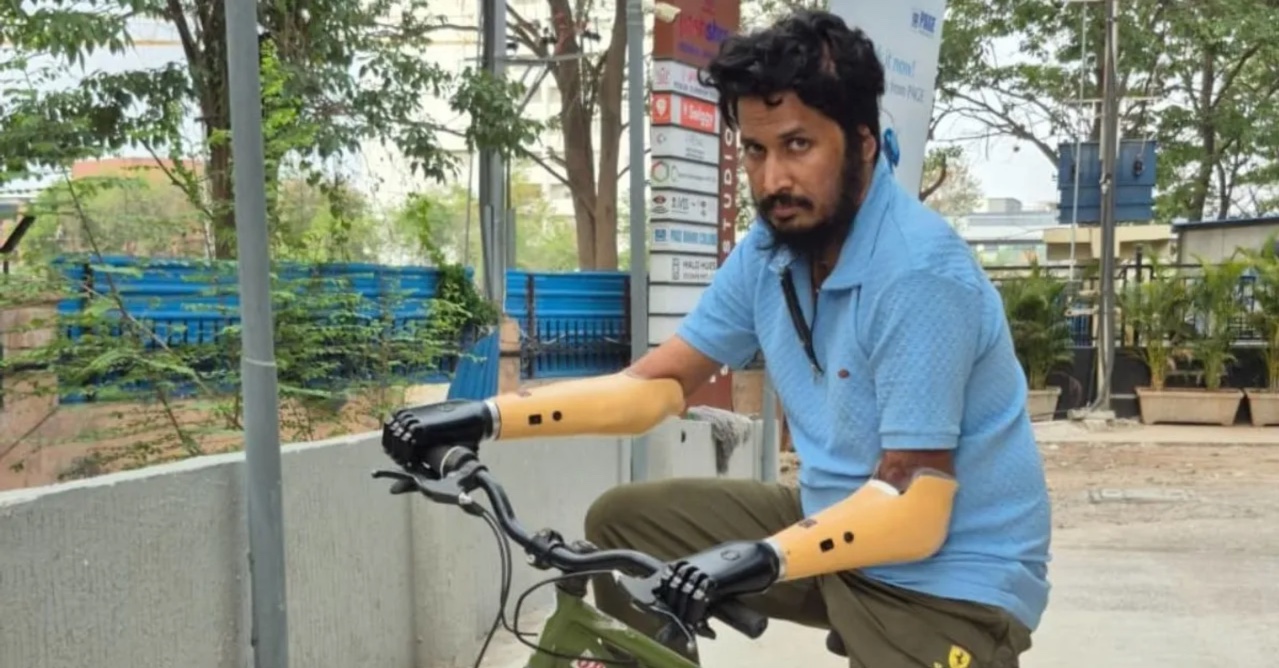
KalArm is an indigenously developed myoelectric bionic arm that delivers advanced prosthetic functionality at one-tenth the global cost. By combining domestic manufacturing, modular design, and structured rehabilitation, the technology has enabled persons with upper-limb loss to regain daily independence and transition from welfare dependence to sustained livelihoods, demonstrating a scalable model for inclusive assistive healthcare in India.
Updated on: 09 January 2026

Sector

Solution

Technology

State of Origin
Impact Metrics
One-tenth
the cost of comparable global prosthetic devices.
Independent income
of up to ₹30,000, transitioning from dependence on disability pensions.
Reduced long-term maintenance
and repair costs by enabling component-level replacement rather than full device substitution.
85+ individuals
with upper-limb loss benefitted.
KalArm is an advanced myoelectric bionic prosthetic arm developed in India to restore functional independence among persons with upper-limb loss. The technology has been developed by Makers Hive, a Hyderabad-based deep-technology start-up founded in 2018 by Pranav Vempati, with Chanakya Gone joining later as Chief Technology Officer. Conceived at the intersection of robotics, artificial intelligence, and additive manufacturing, KalArm was designed to address a persistent gap in prosthetic care: the lack of affordable, high-functionality bionic limbs accessible to amputees in low- and middle-income settings.
The founding motivation behind KalArm was rooted in both personal conviction and systemic need. Despite rapid advances in global prosthetics, most commercially available bionic arms remain prohibitively expensive, technologically complex to maintain, and poorly adapted to Indian clinical and socioeconomic contexts. Makers Hive sought to build a domestically manufactured, clinically robust, and cost-effective alternative that could restore dignity, livelihoods, and autonomy for people living with limb loss.

Technology design and functionality
KalArm is an AI-enabled, EMG-based bionic arm that interprets muscle signals from the residual limb to enable intuitive, multi-grip hand movements. The prosthetic supports 18 grip patterns, including six that can be customised by the user, allowing it to adapt to a wide range of daily and vocational tasks. With a lifting capacity of up to 8 kilograms and a lightweight design of approximately 950 grams, the device balances strength with comfort and long-term wearability.
The arm is constructed using aerospace-grade aluminium, carbon fibre, and medical-grade materials. Its modular architecture allows individual components to be repaired or replaced without requiring full system substitution, significantly lowering maintenance costs. KalArm also integrates app-based training, software updates, and calibration, enabling continuous performance optimisation post-fitting.
Manufacturing is largely conducted in-house, including the development of proprietary sensors and motors. This approach has enabled Makers Hive to achieve substantial cost reductions while retaining technological sophistication. Compared to global manufacturers that often spend over ₹100–120 crore developing similar devices, Makers Hive reports having developed KalArm with approximately ₹30 crore, using significantly less capital and time.
Implementation and delivery model

KalArm is manufactured at a CDSCO-approved facility in Hyderabad with an annual production capacity of approximately 3,600 units. The cost of the prosthetic ranges between ₹4.5 lakh and ₹6 lakh, depending on the level of customisation required—approximately one-tenth the cost of comparable global bionic arms.
Beyond device provision, Makers Hive follows a rehabilitation-oriented delivery model. Beneficiaries receive structured Activities of Daily Living (ADL) training, typically spanning five days, to support adaptation and functional confidence. This integrated approach ensures that users are not only fitted with advanced technology but are also supported in translating capability into real-world independence.
Impact and outcomes
Since initiating commercial sales, Makers Hive has completed over 85 KalArm fitments, with the number steadily increasing. The impact of the technology is reflected in measurable improvements in users’ economic participation and quality of life. Beneficiaries who were previously dependent on pensions or family support have transitioned into independent livelihoods, with reported monthly incomes increasing from subsistence levels to as much as ₹30,000 in some cases.
Clinically, KalArm has received endorsement from Endolite India Limited, with evaluations highlighting its stable signal control, reliable multi-grip functionality, and rehabilitation-friendly customisation options. The technology currently holds eight granted patents and has been deployed through collaborations with government hospitals and scientific institutions via pilot programmes.
At a broader level, KalArm addresses a significant unmet need. According to the World Health Organisation, only around 10% of the 35–40 million people worldwide requiring prosthetic or orthotic devices currently have access. By localising manufacturing and aligning design with user realities, KalArm demonstrates how indigenous innovation can meaningfully bridge this access gap.
Relevance for India’s inclusive development
KalArm represents more than a medical device; it illustrates how frontier technologies, when developed with contextual sensitivity, can strengthen India’s social and economic fabric. By enabling persons with disabilities to re-enter the workforce, live independently, and participate fully in daily life, such technologies directly contribute to inclusive growth, labour productivity, and social equity.
For India, scaling similar assistive technologies can strengthen healthcare resilience, reduce long-term welfare dependency, and support national commitments under disability inclusion frameworks. The KalArm model underscores the potential of domestic deep-tech enterprises to deliver high-impact solutions aligned with public health priorities, Atmanirbhar Bharat objectives, and the broader goal of technology-led human development.
Share Your Story Today, Shape Viksit Bharat Tomorrow
Got an idea, innovation, or experience that's making a difference? Share your story now and ignite India's transformation because your voice can drive the future forward!
Handpicked stories tailored just for you
Explore stories that inspire, inform, and ignite new ideas across tech, innovation, and real-world impact

AI-Enabled Gynaecological Care Expands Access to 400,000+ Women Across India
Pinky Promise is a chat-first, AI-assisted women’s healthcare platform delivering affordable, confidential gynaecological care at scale. Founded in 2022, it...
Read More