Can Long-Range Electric Scooters Solve India’s Urban Mobility and Pollution Challenges?
With a claimed 240-km range and fast-charging capability, Simple Energy’s EV scooter highlights how electric two-wheelers could reduce fuel dependency, improve urban air quality, and accelerate sustainable mobility adoption across Indian cities.
Updated on: 19 May 2026

Sector

Solution
Climate Action

Technology

State of Origin
Disclaimer:
Features ‘as is’ submissions and neither constitutes endorsement, certification, recommendation, or validation by NITI Aayog nor makes NITI Aayog liable in any manner.
Impact Metrics
240 km claimed range in eco mode
comparable to many petrol-powered scooters and designed to reduce EV range anxiety.
0–100% fast charging
in approximately 40 minutes, improving usability for urban commuters.
Reduced urban transport emissions
through replacement of petrol-powered two-wheelers with electric alternatives
As Indian cities confront rising vehicular pollution, fuel dependency, and traffic congestion, electric two-wheelers are emerging as a critical component of sustainable urban mobility. Bengaluru-based startup Simple Energy is among a new generation of companies attempting to accelerate this transition through high-performance electric scooters designed specifically for Indian commuting conditions.
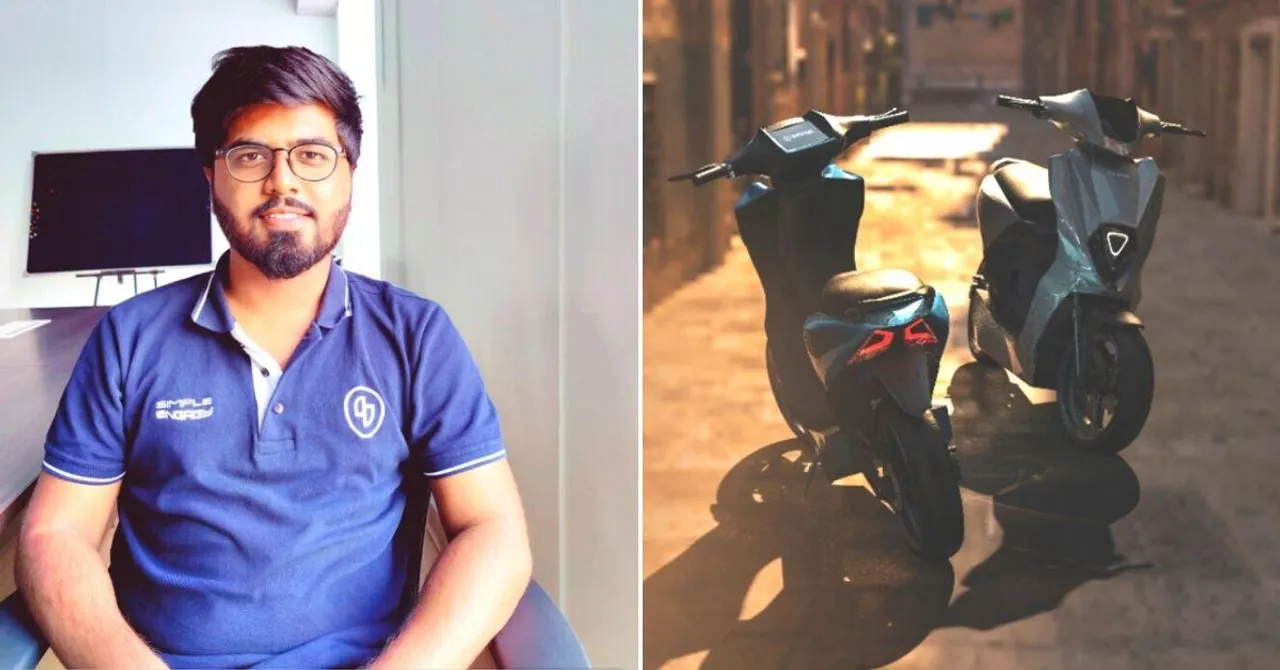
Founded in 2019 by Suhas Rajkumar, the startup focuses on solving one of the biggest barriers to electric vehicle (EV) adoption in India: range anxiety.
The Urban Mobility Context
Two-wheelers form the backbone of mobility in Indian cities, accounting for a significant share of daily commuting trips. However, conventional petrol-powered scooters contribute heavily to urban air pollution and fossil fuel consumption.
While electric scooters have entered the market in recent years, many early models struggled with limited battery range, low performance, and inadequate charging infrastructure support. Simple Energy identified this gap as an opportunity to build electric scooters that could match the practicality of internal combustion engine (ICE) vehicles while remaining environmentally sustainable.
The company’s approach centres on developing long-range EVs capable of functioning as primary commuting vehicles rather than secondary alternatives.
Technology and Product Innovation
Simple Energy claims to develop over 90 percent of its scooter components in-house, including:
- Motors and controllers
- Battery pack design
- Battery management systems (BMS)
- Chassis and surface design
- Dashboard and touchscreen systems
- Inverters and suspension systems
The startup’s upcoming electric scooter, Mark 2, has been designed with features intended to address both performance expectations and user convenience.
Key specifications include:
- 4.8 kWh lithium-ion battery
- Claimed range of up to 240 km in eco mode
- Top speed of 100 kmph
- 0–50 kmph acceleration in 3.6 seconds
- Fast-charging capability from 0–100 percent in approximately 40 minutes
- Removable battery system
- Smart connectivity features such as navigation, Bluetooth integration, and touchscreen controls
The company also emphasises a “Make in India” manufacturing model, with most vehicle engineering and design carried out domestically.
Relevance for Urban Development
Accelerating EV Adoption
Range anxiety remains one of the primary reasons consumers hesitate to shift from petrol-powered vehicles to EVs. By developing longer-range scooters, Simple Energy aims to reduce dependence on extensive charging infrastructure and make EV adoption more practical for everyday urban commuters.
Reducing Urban Emissions
Electric two-wheelers can significantly lower tailpipe emissions in densely populated cities where vehicular pollution is a major public health concern. Wider adoption of electric scooters could contribute to cleaner urban air and lower transport-sector carbon emissions.
Supporting Energy-Efficient Mobility
Two-wheelers already occupy less road and parking space than cars. Electrifying this segment offers a pathway toward lower-energy urban transportation systems without drastically altering existing commuter behaviour patterns.
Strengthening Domestic EV Manufacturing
Simple Energy’s emphasis on in-house engineering and local manufacturing aligns with India’s broader push to build domestic EV supply chains and reduce reliance on imported automotive technologies.
Challenges and Scalability
Despite growing momentum in India’s EV sector, challenges remain around battery supply chains, charging infrastructure deployment, affordability, and consumer trust in newer technologies.
Simple Energy’s ability to scale production, maintain affordability, and compete in an increasingly crowded EV market will determine the long-term viability of its model. However, the company illustrates how Indian startups are attempting to build urban mobility solutions tailored to local infrastructure constraints and commuter expectations rather than replicating global EV models directly.
Why It Matters
India’s urban future will depend heavily on how quickly cities can transition toward cleaner and more efficient mobility systems. Electric scooters are likely to remain central to this transition given the country’s dependence on two-wheelers for daily transport.
Simple Energy’s case demonstrates how frontier technologies in battery systems, smart mobility, and vehicle engineering are being adapted to solve practical urban development challenges — from pollution and fuel dependency to commuter affordability and infrastructure limitations.
Share Your Story Today, Shape Viksit Bharat Tomorrow
Got an idea, innovation, or experience that's making a difference? Share your story now and ignite India's transformation because your voice can drive the future forward!
Disclaimer:
Features ‘as is’ submissions and neither constitutes endorsement, certification, recommendation, or validation by NITI Aayog nor makes NITI Aayog liable in any manner.
Resources to Replicate This Idea
BUILD YOUR OWN INTERVENTION
Handpicked stories tailored just for you
Explore stories that inspire, inform, and ignite new ideas across tech, innovation, and real-world impact


A Startup Has Discovered a New Way To Neutralise Carbon Emissions Through Everyday Choices
Climes leverages climate-tech to calculate carbon footprints and fund verified environmental projects, making everyday purchases and travel more sustainable while...
Read More