This Climate-Tech Solution Recovers 98% of Water Lost During Salt Production
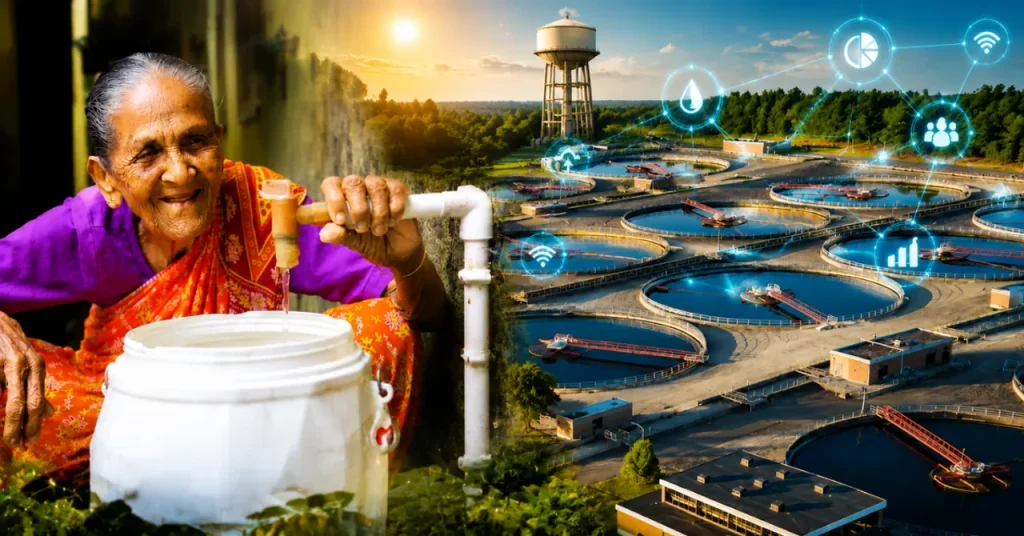
GrantEd, a company based in Uttar Pradesh, offers desalination units that can meet the water needs of ~40 million users. Their technology and model simultaneously empower salt farmers and water consumers nationwide.
Updated on: 16 June 2026

Sector

Solution

Technology

State of Origin
Impact Metrics
98% of water loss during evaporation
recovered by each Oasis unit.
10% operating costs
compared to reverse osmosis desalination.
Water needs of 40 million
estimated to be met using new desalination model.
300–500% income increases
for farmers through sales of salt and water.
India is the third largest producer of salt in the world, yielding 30–39 million tons of salt every year—and during this process, approximately 1.1 billion tons of water are lost to evaporation. At the same time, multiple parts of the country face an era of ‘water bankruptcy’ due to climate change. Thus, saving water losses during salt manufacturing becomes desirable at the national level.
GrantEd, based in Uttar Pradesh, addresses this issue by presenting a decentralized desalination model. Combining refrigeration and solar photovoltaic technology, their solution traps up to 98% of the water lost during traditional salt farming. Unlike centralized desalination plants—which can cost upwards of INR 300–600 crore—this can be adapted to existing salt farms at lower costs.
The results not only demonstrate an increased availability of affordable, clean water but also the empowerment of India’s coastal farming communities.
How does the technology work?
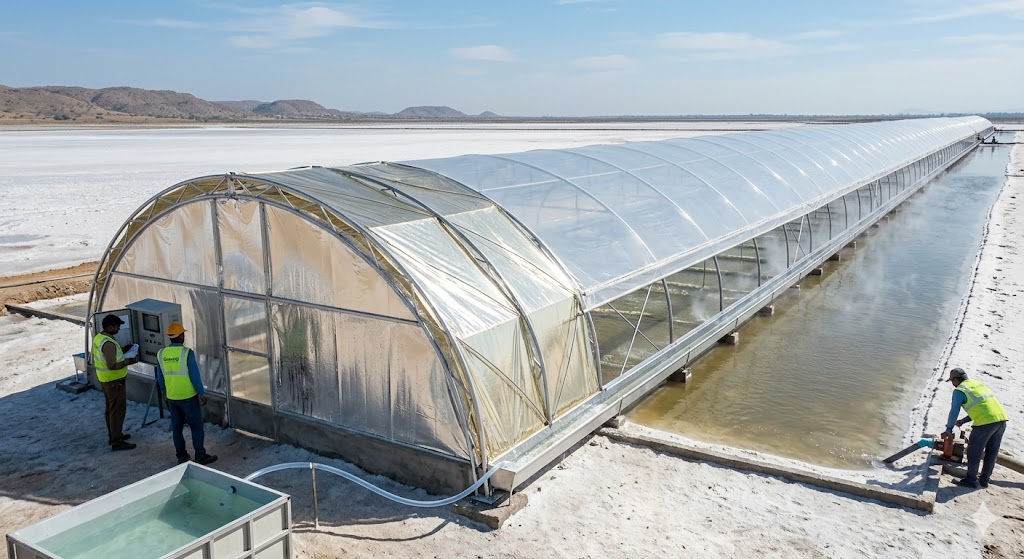
The central concept underlying GrantEd’s desalination unit—called the Oasis—is gas-based phase-change technology, which is commonly used in household cooling appliances. Normally, 30–50 cubic meters of water are lost via evaporation for every 1 ton of salt crystallized during salt production. An Oasis unit traps this water in a containment shell, cools it to dew point using a heat exchange system, and makes it available for human use. Solar photovoltaics ensure that this process can be carried out in off-grid locations.
The energy cost for each Oasis unit is about a tenth of that expended during reverse osmosis. This fact, and the easily replicable nature of the technology, make GrantEd’s product promising for widespread adoption. Additionally, founder Bhuvan Verma suggests that Oasis units have the potential to generate solar-thermal energy in future applications.
Sharing the innovation
Not only the technology but also its diffusion follows the principles of sustainability and empowerment. Seed capital for each Oasis integration comes from NGOs or CBOs, often connected to CSR funding. From the time of material procurement, local youth are trained in maintenance, removing the need for urban engineers from outside the community. Finally, 12 months after setup, ownership of the technology is fully transferred to self-help groups (SHGs) involving direct stakeholders. This model minimizes dependence on intermediaries and gives salt farmers control over all profit generation.
Who benefits from tech adoption?
In a single day, from 100 square meters of brine pond, an Oasis unit can produce 500 liters of high-purity, distilled-grade water (9–50 TDS). Extrapolating from the UN’s water minimum requirements for an adult (50–100 liters/day), GrantEd suggests that their technology can meet the water needs of ~40 million individuals.
First and foremost among the direct beneficiaries of this technology are salt farmers—whether these are coastal or based in deserts—from states such as Gujarat, Tamil Nadu, Rajasthan, Andhra Pradesh, and Maharashtra. While these regions are water-stressed, their brine evaporation is often high: in the Kutch region, for example, it amounts to twice the water requirements of the entire population (~2.1 million). Moreover, wherever seawater can contaminate coastal aquifers during extraction (e.g., in Thoothukudi and Nellore), Oasis units provide an ecosystem-friendly alternative.
Farmers adopting Oasis units shift from survival to entrepreneurship, gaining continuous and dual incomes from seasonal water and salt sales. This can increase their revenues by 300–500% and hence escape cycles of generational debt. At the same time, the clean water they procure from this process can reach consumers at 40% lower costs than private tankers. Thus, alongside climate resilience and social security, decentralized desalination can support other sectors such as public health and agriculture.
On a national level, as salt manufacturing becomes more profitable, India gains more access to high-purity sodium. This resource can bolster India’s reviving sodium-ion battery industry, positioning it as a positive example of sustainable energy expansion in the Global South.
The way forward
Of the challenges remaining, the primary one is awareness building. Traditional salt harvesting methods are thousands of years old and deeply embedded in community practices. Greater collaboration with financial partners would ease the early stages of adopting GrantEd’s technology while policy recognition under Skill India and Startup India can foster more open attitudes towards decentralized desalination among salt farmers.
Share Your Story Today, Shape Viksit Bharat Tomorrow
Got an idea, innovation, or experience that's making a difference? Share your story now and ignite India's transformation because your voice can drive the future forward!
Resources to Replicate This Idea

BUILD YOUR OWN
Do you want to know how this innovator scaled their idea, how much it cost them, and what resources/partnerships they deployed?
Handpicked stories tailored just for you
Explore stories that inspire, inform, and ignite new ideas across tech, innovation, and real-world impact

Maharashtra’s First 3D-Printed School Cuts Construction Time By 6X, Waste By 95%
Cretebots, an Indian startup, uses robotic 3D construction printing to build structures layer by layer on-site — completing buildings 6...
Read More