DeHaat’s AI-Enabled Agriculture Network Driving Market Access and Efficiency for 1.8 Million Farmers
DeHaat is a full-stack agricultural technology platform that integrates input supply, AI-driven advisory, and transparent market linkages for smallholder farmers. Starting in Bihar, it has expanded to serve 1.8 million farmers across 12 states, delivering more than seven million agricultural services. Its data-led model strengthens productivity, reduces risk, and builds a scalable digital backbone for Indian agriculture.
Updated on: 04 December 2025

Sector

Solution

Technology

State of Origin
Impact Metrics
1.8 million+ farmers served
across 12 agrarian states in India.
7 million+ services
delivered, including advisory, inputs, and market linkages.
Over 503 FPOs
integrated into the DeHaat ecosystem.
11,000+ institutional buyers
spanning processors, exporters, and retailers connected to farmers.
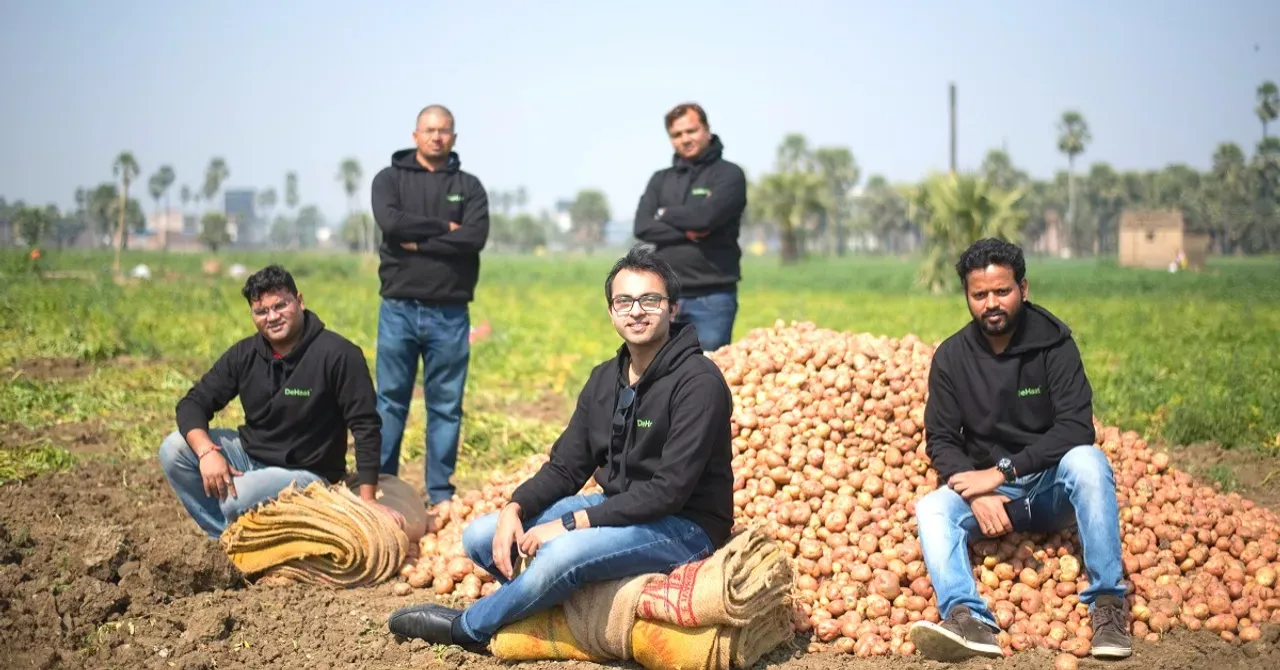
DeHaat is an AI-driven, full-stack agricultural platform founded by IIT and IIM alumni in 2012 with an ambition to solve one of India’s most persistent structural challenges: the fragmentation and inefficiency of smallholder farming. Conceived initially as a research project on improving last-mile input delivery and crop advisory, the founders—Shashank Kumar and Manish Kumar—identified a critical gap in how farmers accessed seeds, fertilisers, credit, and market linkages. Traditional supply chains were long, information was fragmented, and farmers lacked timely, actionable agronomic guidance. DeHaat set out to address this by building a scalable digital ecosystem that integrates AI-enabled advisory, physical service centres, and organised market access into a single, seamless system tailored for India’s agrarian landscape.
From a community experiment to a national agri-tech network
In its early years, the DeHaat model was piloted in Bihar, Odisha, and eastern Uttar Pradesh. These regions, dominated by small and marginal farmers cultivating diverse crops, became the first testing ground for a platform that combined predictive advisory with doorstep service delivery. The early version of DeHaat focused heavily on farmer education and trust-building. Trained extension officers travelled to villages, demonstrating improved input packages while collecting crop-stage data that would eventually form the foundation of the platform’s machine learning models. By 2019, DeHaat had grown to support nearly 65,000 farmers through a network of 168 micro-entrepreneurs who served as DeHaat franchisees.
The platform evolved rapidly as it integrated advanced AI capabilities. DeHaat’s advisory engine began to ingest satellite imagery, pest incidence records, weather data, and soil profiles to generate customised, crop-stage-specific recommendations. The platform also began automating disease detection, warning farmers of pest outbreaks and nutrient deficiencies in real time. Meanwhile, the supply chain layer expanded to include regionally optimised input packages and transparent market-linkage services that enabled farmers to sell produce directly to institutional buyers. The hybrid model—digital intelligence supported by a dense physical network—became the cornerstone of DeHaat’s scale.
Today, DeHaat has grown into one of India’s largest agritech networks, operating across 12 agrarian states through an extensive system of 11,000+ DeHaat Centres and 503 Farmer Producer Organisations (FPOs). The platform now serves 1.8 million+ farmers, offering AI-enabled crop advisory for 30+ crops in multiple regional languages. What began as a localised initiative has matured into a nationwide agricultural backbone capable of supporting production, improving profitability, and reducing risk for smallholder farmers at scale. DeHaat’s rapid growth and grassroots credibility have earned recognition from NASSCOM, NITI Aayog, Forbes, the Bill Gates Foundation, and other national and global institutions. Its organisation-building efforts have also been acknowledged through Great Place to Work certifications in 2022–23 and 2023–24.
The impact of DeHaat’s integrated model is visible across multiple dimensions. Farmers gain access to high-quality inputs at competitive rates, reducing cost of cultivation. AI-driven advisory helps optimise nutrient cycles, mitigate pest attacks, and improve yields. Transparent post-harvest services streamline aggregation and marketing, enabling farmers to secure better price realisation while reducing dependence on intermediaries. The platform also strengthens rural entrepreneurship: thousands of DeHaat Centres are run by local micro-entrepreneurs who earn sustained livelihoods by serving as last-mile agritech service providers in their own villages.
Building scalable systems — digital advisory, input intelligence, and market transparency

Beyond direct farmer benefits, DeHaat is strengthening the broader agricultural ecosystem. Its digital infrastructure offers unprecedented visibility into crop lifecycles, input demand patterns, and procurement flows across states. FPOs integrated into the DeHaat network gain access to institutional markets, financial services, and capacity-building support. This multi-layered system not only improves farm incomes but also makes procurement more predictable for buyers, enhances efficiency for agri-input manufacturers, and reduces wastage across the supply chain.
Looking ahead, platforms like DeHaat can play a foundational role in strengthening Indian agriculture. India’s farming landscape—characterised by small landholdings, climate variability, and fragmented markets—requires integrated systems that combine data, intelligence, and last-mile connectivity. DeHaat’s model demonstrates how technology can bridge long-standing structural gaps by aligning producers, input suppliers, agri-entrepreneurs, and buyers on a shared digital backbone. As climate risks rise and demand for traceable, high-quality produce grows, AI-enabled platforms will be essential for making farming more profitable, sustainable, and resilient. By scaling innovations in advisory, aggregation, risk management, and value-chain integration, solutions like DeHaat offer a pathway to a more efficient and equitable agricultural economy—one where smallholders are empowered participants in national growth rather than vulnerable stakeholders at the margins.
Share Your Story Today, Shape Viksit Bharat Tomorrow
Got an idea, innovation, or experience that's making a difference? Share your story now and ignite India's transformation because your voice can drive the future forward!
Handpicked stories tailored just for you
Explore stories that inspire, inform, and ignite new ideas across tech, innovation, and real-world impact


XR Hardware Company Is Transforming Learning for 200000+ Students Across 19 States
Across India’s classrooms, labs, and training spaces, learning is moving beyond screens and textbooks. Through Indian-built XR hardware developed by...
Read More