Enabling Green Construction: The Zero-Cement Concrete Reducing Carbon Footprints by >80%
Traditionally, construction uses large quantities of Portland cement—which has a heavy carbon footprint and uses large amounts of water—in concrete. Bengaluru-based Ecopath Innovations presents a zero-cement concrete that is both sustainable and effective.
Updated on: 31 July 2026

Sector

Solution

Technology

State of Origin
Impact Metrics
>~715 tons of CO2 emissions avoided
in just two years.
Zero water consumption,
saving 6.3–10.5 lakh liters of water per 1 km road every fortnight.
50,000 bricks and blocks
produced using zero-cement concrete.
As a result of India’s economic development, urbanization has accelerated in the past few decades. This, in turn, has meant an expansion of the country’s construction industry.
Mainstream construction materials rely heavily on cement, using it in a variety of applications—from footpaths to factory floors. Unfortunately, not only does cement increase carbon emissions but, when used in concrete, it also requires high amounts of water for curing. With water scarcity and environmental pollution becoming major challenges in most cities, it is increasingly seen as unsustainable. There is thus a rising need for alternatives to this material.
Ecopath Innovations, founded by Abhishek Chhazed and Sourabh Kumar in 2024, has one such alternative. This Bengaluru-based startup has developed a completely cement-free concrete, known as Eco-Concrete, that can replace Portland cement in nearly all applications. Leveraging the latest research in material science, Eco-Concrete may hold the key to the sustainable expansion of our city spaces.
What makes Eco-Concrete unique?
Most alternative concretes minimize cement usage to some degree. However, Eco-Concrete eliminates it altogether, instead incorporating reactive silica, alumina, and calcium. As these materials are industrial byproducts, they are easily and cheaply available.
Bringing them together, Ecopath has created a polymer, controlling production conditions to optimize for strength and durability based on various use cases. Whether it is in solid blocks, drains, or compound walls, Eco-Concrete presents an ecofriendly option.
On the one hand, its manufacturing process entails a smaller volume of carbon emission and generates less waste material. On the other, this substance requires no water or heat for curing—instead, it is best cured under natural conditions. This allows developers to save costs on curing infrastructure and labor, as well as time.
Current partners
During its initial phase as a startup, Ecopath drew support from the HCL ClimaForce fund, which provided it with a grant for research and development and pilot testing. This partnership has extended to the present day.
For technical expertise and third-party insights, Ecosight works closely with two academic partners: the Indian Institute of Science, Bengaluru (IISc) and Christ University.
Where is Eco-Concrete used today?
Ecopath produces Eco-Concrete in seven factories, including five in Bengaluru, one in Mysuru, and one in Pune. In total, this material is incorporated in the manufacturing of 50,000 bricks and blocks, 1.5 lakh pavers, and 10,000 kerbs per day.
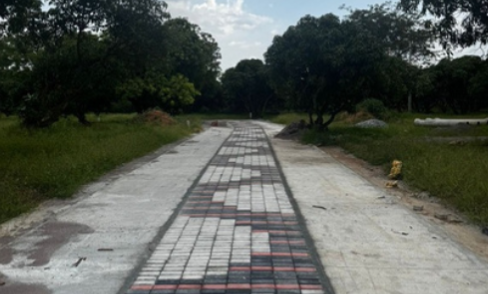
So far, it has been deployed in Karnataka, Odisha, Tamil Nadu, and Maharashtra. Examples of projects utilizing it include India’s first cement-free road on MG Road, Bengaluru; the road of an army school in Bengaluru; and the interior road of an industrial road in Odisha. Additionally, the startup is expanding its private clientele, currently working with Lodha Group and Taj Mangalore.
Environmental impact
Compared to using traditional Portland-cement-based concrete, solutions that use Eco-Concrete can reduce their carbon footprints by well over 80%. According to the startup’s reports, due to this zero-cement material, a cumulative total of 715 tons of carbon dioxide emissions have been avoided since 2024. One of the private clients of Ecopath, Nesta Ira Estates—a Bengaluru housing society—saved around 7.19 tons of CO2 emissions by itself.
Moreover, curing a 7.5-meter-wide, 1 km long road using conventional cement can consume 6.3 lakh to 10.5 lakh liters of water in merely 14 days. This much water is enough to meet the daily drinking water needs of 15,000–25,000 people in the same time period. By using Eco-Concrete, developers can bring this water consumption in their constructions down to zero.
Sustainable construction for the future
The results from tests of Eco-Concrete suggest that this material can drastically reduce the commercial demand for cement. The technology for sustainability in construction already exists. However, the main barrier to adoption remains in policy, which in turn affects perception by the general public.
Currently, codes, tender specifications, and pricing regulations in manufacturing assume the usage of cement-based concrete. Certification for any alternatives that eliminate cement—such as Eco-Concrete—is either slow or lacking. As a result, most builders will opt for traditional concrete, perpetuating the problems that come with it.
By openly recognizing zero-cement concretes and using them in public-sector projects, state governments can demonstrate their reliability. This will also enable more research on such materials. With policy-level support, they can help India’s urban infrastructure can meet the needs of both people and the environment.
Share Your Story Today, Shape Viksit Bharat Tomorrow
Got an idea, innovation, or experience that's making a difference? Share your story now and ignite India's transformation because your voice can drive the future forward!
Resources to Replicate This Idea
BUILD YOUR OWN INTERVENTION
Handpicked stories tailored just for you
Explore stories that inspire, inform, and ignite new ideas across tech, innovation, and real-world impact

Safe Access: India’s Community-Verified Digital Locator for HIV Prevention Services
Safe Access is a free, community-driven Indian platform that helps people locate verified PrEP and PEP providers nearby. By mapping...
Read More