
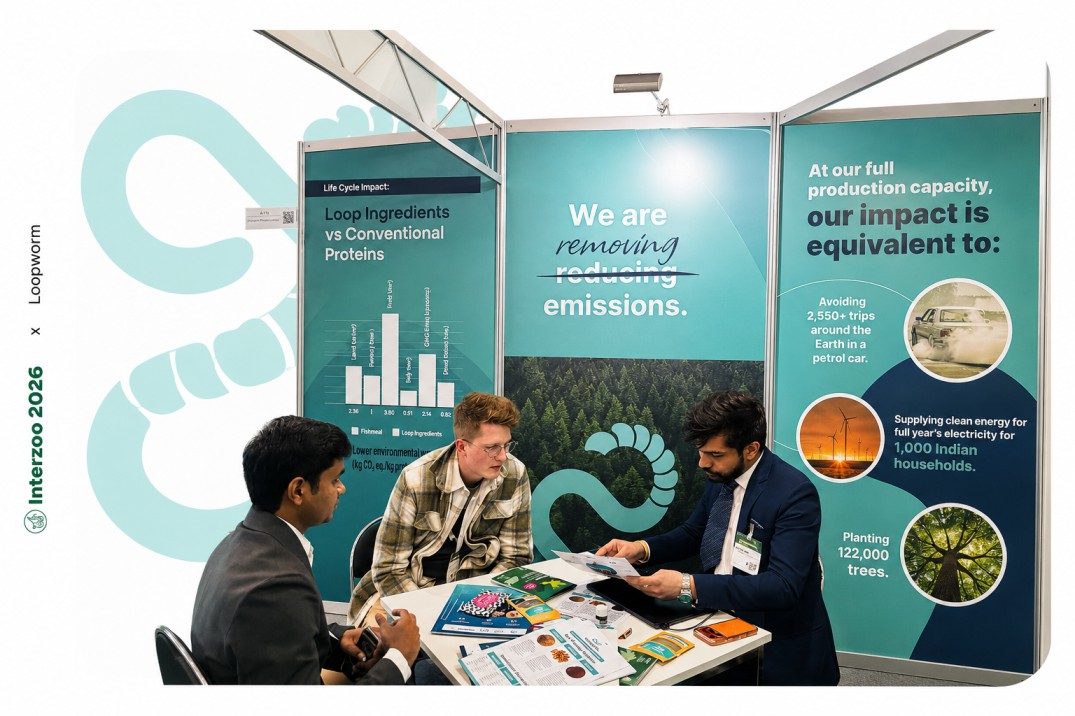
Engineering Insects for Impact: Loopworm’s Biomanufacturing Platform
Loopworm, based in Karnataka, uses insect biomanufacturing to convert silk-industry waste into sustainable protein and oil while developing silkworms for recombinant protein production, reducing emissions, improving farmer incomes, and strengthening India’s domestic biotechnology capabilities.
Updated on: 31 July 2026

Sector

Solution

Technology

State of Origin
Impact Metrics
7,000+ tonnes
of silk-reeling byproducts have been repurposed through Loopworm’s waste-to-value chain.
4,200+ tonnes
of CO₂e emissions have reportedly been avoided through the use of Loopworm’s insect-based protein and oil ingredients.
6,500+ tonnes
of wild fish have reportedly been spared from capture by replacing conventional fishmeal and fish oil.
600
silk reelers have experienced a reported 10% increase in income through the valorisation of their silk-industry byproducts.
Loopworm Private Limited is building India’s first insect-based biomanufacturing platform, one designed to serve two very different but related global needs. The first is nutritional: replacing fishmeal and fish oil, the backbone of aquaculture feed, with a more sustainable and reliable protein source. The second is biomedical: using the silkworm itself as a living factory to manufacture complex recombinant proteins for diagnostics, animal vaccines, and specialty enzymes. The broader objective is to demonstrate that a single insect species, farmed at scale, can anchor an entire biomanufacturing value chain, one that begins with waste valorisation and ends at the frontier of biotechnology.
Inside the Silkworm: A Living Factory
Loopworm’s core insight is that insects, and silkworms in particular, are unusually efficient biological converters. They turn low-value inputs like spent silkworm pupae discarded by India’s silk reeling industry, or organic waste in the case of Black Soldier Fly larvae into high-value protein and lipid biomass. This biomass is processed into two flagship ingredients, LoopMeal and LoopOil, which are used in aquaculture and pet nutrition formulations. In parallel, Loopworm has spent three years validating a more ambitious use of the same organism: engineering silkworms to express recombinant proteins. Unlike mammalian cell culture systems, which are capital-intensive and slow, or microbial systems, which are cheap but cannot perform the post-translational modifications many proteins need to function correctly, the silkworm sits in a unique middle ground. It is capable of the folding and modification steps that mammalian systems achieve, at a fraction of the capital cost and development time.
From Waste to Wonder-Protein: The Mechanics and the Mission
The platform operates in three linked phases. First, silk-industry byproducts are collected and processed at LoopFactory, a 6,000-tonne facility in Doddaballapur, Karnataka, certified to ISO 22000 and HACCP standards, yielding protein and oil ingredients. Second, the same processing and commercial infrastructure is being extended to Black Soldier Fly larvae, broadening feedstock flexibility to include general organic waste streams. Third, and representing the platform’s frontier bet, silkworms are being developed as a recombinant-protein production chassis, with R&D validation complete, results independently replicated, and pilot-scale equipment on order. This structure directly addresses two acute global pain points: rising fishmeal prices that threaten India’s shrimp export competitiveness, and the absence of a protein-production system that is simultaneously fast, affordable, and capable of producing functionally complex biologics.
Building Without a Blueprint: The Bottlenecks
Loopworm was, in effect, building an industrial category with no existing playbook. No machinery existed anywhere in the world for processing cultivated insects into finished protein products at scale, forcing the company to design and build its own equipment in-house, a path that carries higher manufacturing costs and prolonged commissioning and troubleshooting. On the frontier-science side, while silkworm-based protein expression appears in academic literature, no scalability data exists globally, meaning Loopworm had to conduct fundamental, resource-intensive research with genuinely uncertain outcomes. A further, less technical but equally significant bottleneck was institutional unfamiliarity: regulators, bureaucrats, and auditors had little prior exposure to farmed-insect protein systems, requiring Loopworm to invest heavily in stakeholder education and evidence-building before adoption could follow.
Counting Cocoons: The Impact So Far
The nutrition business reached profitability within two years of first sales in April 2024 and now supplies more than ten countries across four continents. Reported outcomes include a 15% increase in overall profitability for fish farmers using Loopworm ingredients directly, a 10–20% reduction in feed-additive costs for shrimp farmers, and a 10% income increase for the roughly 600 silk reelers whose byproducts feed the value chain. Aggregate figures claimed by the company include over 7,000 tonnes of silk-reeling byproducts repurposed, more than 4,200 tonnes of CO2-equivalent emissions avoided, and over 6,500 tonnes of wild fish spared from capture. Industry partners report tangible operational gains: BMR Group, a large aquaculture feed producer, cites 2–3% cost savings and improved supply stability after switching part of its formulation to LoopMeal and LoopOil, while independent farmers report better feed conversion, lower disease incidence, and more reliable product quality than adulterated fish-oil alternatives previously available to them.
Weaving Into India’s Development Story
The platform is closely aligned with several national priorities: strengthening India’s sericulture economy by converting a waste stream into export revenue, supporting the competitiveness of India’s shrimp export industry against volatile fishmeal costs, and building indigenous deep-tech biomanufacturing capability rather than importing it. It also speaks directly to India’s Bio-E3 policy framework, which prioritises smart proteins, affordable vaccines, diagnostics, and animal health, areas Loopworm’s frontier science division targets explicitly. The model additionally supports rural livelihoods, with women comprising roughly 70% of the value chain, and offers a domestically developed alternative in a category (recombinant protein production) where India currently depends heavily on imported systems and expertise.
What It Would Take to Spin Faster: Resources and Policy
Loopworm’s own account of its funding trajectory (non-dilutive grants from BIRAC, the Department of Biotechnology, and Start-Up Karnataka in its early years, followed by equity rounds from Omnivore, WaterBridge Ventures, and Japan-based ENRISSION INDIA CAPITAL) illustrates the kind of patient, blended capital such ventures require. Going forward, the company points to several enabling conditions: deeper policy alignment with the Bio-E3 framework; clearer, predictable regulatory pathways for insect-derived nutrition and recombinant proteins in lower-risk applications; low-interest and blended finance instruments, such as those envisioned under India’s Research, Development and Innovation Fund, to sustain long and uncertain R&D cycles without excessive dilution; and greater use of the Central Silk Board’s research infrastructure and trained talent pool. Demand-certainty from public health, veterinary, and aquaculture procurement bodies, alongside government-to-government trade facilitation, would further help de-risk both the domestic and export dimensions of the platform.
Share Your Story Today, Shape Viksit Bharat Tomorrow
Got an idea, innovation, or experience that's making a difference? Share your story now and ignite India's transformation because your voice can drive the future forward!
Resources to Replicate This Idea
BUILD YOUR OWN INTERVENTION
Handpicked stories tailored just for you
Explore stories that inspire, inform, and ignite new ideas across tech, innovation, and real-world impact

How AI Diagnostics Are Reaching India’s Frontline Health Workers
AffEx equips rural health workers with an AI-powered point-of-care screening kit — testing hemoglobin, blood pressure, ECG, and cardiac and...
Read More