From Fields to Flight Paths: Women Drone Pilots Enable Precision Spraying on 4,000+ Acres of Farmland
Women-led agricultural drone initiatives across Haryana, Uttar Pradesh, Punjab, and Chhattisgarh demonstrate how precision spraying can transform farming outcomes. Through certified training and service-based models, rural women deployed drones across 4,000+ acres, reducing water use by up to 90 percent, cutting spraying time to minutes per acre, increasing crop yields, and generating sustainable rural incomes.
Updated on: 29 December 2025

Sector

Solution

Technology

State of Origin
Uttar Pradesh
Impact Metrics
4,000+ acres
covered across Haryana, Uttar Pradesh, Punjab, and Chhattisgarh.
50+ rural women
trained and deployed as certified agricultural drone pilots and service providers.
₹6+ lakh
in direct income generated collectively by women-led drone service operations.
Up to 90% reduction
n water usage during pesticide and fertiliser application.
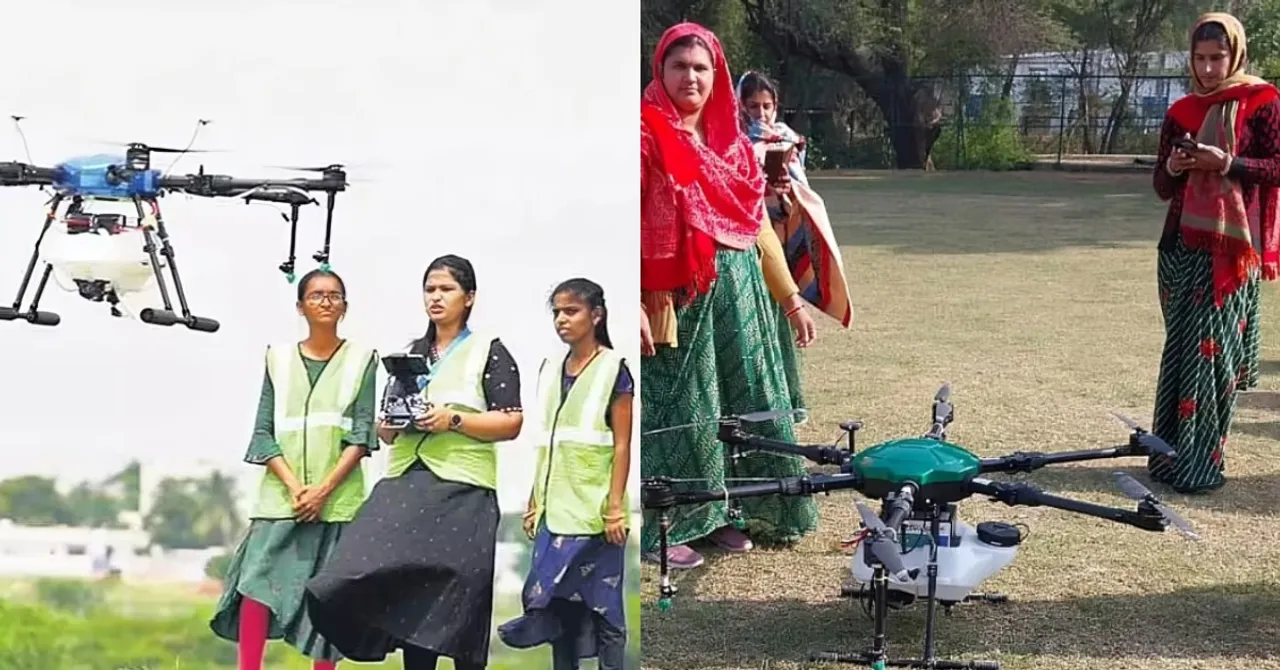
Across India’s agricultural heartland, a quiet technological shift is underway. Agricultural drones — once seen as advanced tools reserved for large farms or private players — are increasingly being operated by rural women farmers. Enabled through structured training, institutional partnerships, and government-backed initiatives such as the Drone Didiprogramme, these women are deploying drones for fertiliser and pesticide spraying, reducing labour intensity, improving input efficiency, and creating new income streams. From northern plains to tribal regions, the following state-wise cases demonstrate how women-led drone services are strengthening Indian agriculture while advancing rural livelihoods.
Haryana — Precision farming as a livelihood opportunity
In Pataudi, Haryana, agricultural drones are being used to deliver fertilisers with speed and accuracy by newly trained women pilots. One such pilot, Sharmila Yadav, transitioned from homemaking to professional drone operation after enrolling in a structured training programme supported by Drone Destination and the Indian Farmers Fertiliser Cooperative Limited (IFFCO). Through classroom instruction and field-based practice, she gained certification to operate agri-drones for crop spraying.
Within five weeks of deployment, she covered over 150 acres of farmland twice, earning close to ₹50,000 through service provision. Drone-based spraying significantly reduced manual labour, shortened spraying time, and ensured uniform application of inputs. The initiative also generated social impact, positioning women as skilled technology operators within farming communities.
Another example from Haryana is Nisha Solanki, the state’s first woman certified by the Directorate General of Civil Aviation (DGCA) to pilot agricultural drones. Beyond field operations, her work has focused on capacity building and technology diffusion. Through live demonstrations and hands-on sessions, she has trained and sensitised farmers on drone-enabled spraying techniques.
To date, she has conducted over 750 demonstrations across the state. These interventions have enabled farmers to reduce water usage by up to 90 percent during spraying operations and bring down application time to approximately five minutes per acre. This model highlights how women drone pilots can act as multipliers — combining service delivery with farmer education.
Uttar Pradesh — Collective enterprise in Varanasi
In Varanasi, Uttar Pradesh, a collective of nine rural women formed a drone service enterprise after receiving training at the Drone Academy of Professor Jayashankar Telangana State Agricultural University. Equipped with agricultural drones capable of spraying 10 litres of pesticide in 10 minutes, the group offers services to farms across the region.
Over a ten-month period, the collective covered more than 2,500 acres and generated revenues of ₹3.38 lakh. The intervention reduced labour dependency for farmers, improved precision in pesticide application, and demonstrated the viability of women-led collectives in agri-tech service delivery.
Punjab and Haryana — Expanding access to mechanisation
Across villages in Punjab and Haryana, more than 20 women farmers have been trained as professional drone pilots through institutions such as the Manesar Drone Kendra, with support from central government schemes. These women now provide fertiliser and pesticide spraying services in areas where mechanised solutions were previously limited.
Charging ₹200–₹250 per acre, they have made drone services affordable for small and marginal farmers while creating steady income opportunities for themselves. The initiative has contributed to time savings, improved operational efficiency, and wider adoption of precision agriculture practices.
Chhattisgarh — Drones in tribal agriculture
In the tribal regions of Chhattisgarh, 15 women farmers — known locally as Lakhpati Didis — have integrated drones into agricultural service delivery under the state’s Lakhpati Didi scheme. With access to drones, technical training, and enterprise support, these women collectively covered over 500 acres of farmland.
Each participant earned approximately ₹1 lakh annually, while supported farmers recorded yield increases from 24 to 30 quintals per acre and profit gains of nearly 15 percent. The initiative illustrates how drone technology can improve productivity and incomes even in resource-constrained settings.
Strengthening Indian agriculture through women-led agri-tech
These state-level cases demonstrate the transformative potential of agricultural drones when combined with women’s participation, institutional training, and policy support. Drone-based spraying improves input efficiency, conserves water, reduces labour intensity, and enhances crop yields. At the same time, it creates skilled livelihoods for rural women, strengthening their economic agency and role in agricultural decision-making.
Scaled nationally, women-led drone services can accelerate the adoption of precision agriculture, improve resilience to labour shortages and climate stress, and support India’s goals of sustainable, inclusive agricultural growth. By investing in training, access to technology, and local service models, such initiatives can play a critical role in modernising Indian agriculture while ensuring that its benefits are broadly shared.
Share Your Story Today, Shape Viksit Bharat Tomorrow
Got an idea, innovation, or experience that's making a difference? Share your story now and ignite India's transformation because your voice can drive the future forward!
Handpicked stories tailored just for you
Explore stories that inspire, inform, and ignite new ideas across tech, innovation, and real-world impact

From Sea to Fuel: How Indian Researchers Are Turning Seaweed into Clean Energy
An Indian marine bioenergy initiative is converting seaweed into high-energy biofuels using mechanised ocean farming and hydrothermal liquefaction. By producing...
Read More