
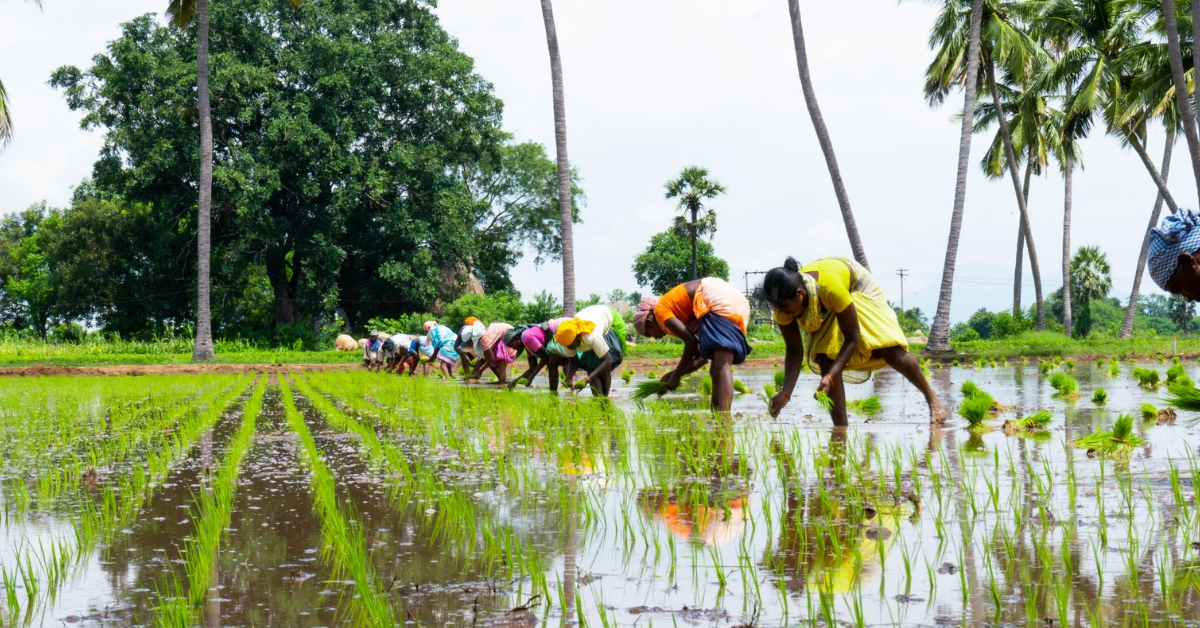
Harnessing GeoAI To Save 500 Billion Litres of Water and Decarbonise Rice Farming
By combining NASA-supported GeoAI, satellite radar imagery and ground-level IoT sensors sustainable rice farming practices can be monitored at individual farm level. The technology integrates remote sensing and biogeochemical modelling to measure, verify and quantify methane reductions and water savings, enabling transparent, high-integrity carbon credits at scale.
Updated on: 25 November 2026

Sector

Solution

Technology

State of Origin
Disclaimer:
Features ‘as is’ submissions and neither constitutes endorsement, certification, recommendation, or validation by NITI Aayog nor makes NITI Aayog liable in any manner.
Impact Metrics
500 billion litres of water
saved through Mitti Labs' climate-smart rice farming programmes.
Up to 50% methane reduction
achieved through alternate wetting and drying (AWD), which reduces methane emissions by interrupting the anaerobic conditions created by continuously flooded rice fields.
Up to 40% water savings
achieved through AWD compared with conventional continuously flooded rice cultivation.
7–8 major rice-growing states
across India covered by Mitti Labs' projects and technology-as-a-service programmes, spanning southern, southeastern and northern India.
Irrigated paddy fields in India are methane hotspots, releasing around 3.9 million tonnes of methane every year, according to data.
If methane emissions could be reduced from rice farming while helping farmers conserve water and build more resilient agricultural practices, it would be an antidote to the increasing carbon footprint. This is possible through alternate wetting and drying (AWD), a climate-smart irrigation technique that replaces the traditional practice of keeping rice paddies continuously flooded.
By allowing fields to dry out at specific stages of the growing cycle, AWD reduces the oxygen-deprived soil conditions that produce methane. The approach can cut methane emissions and water consumption, without compromising crop yields.
To measure and verify these benefits, Bengaluru-headquartered Mitti Labs has developed a GeoAI platform with support from NASA. The technology combines high-resolution satellite radar imagery with on-the-ground data to monitor flooding, soil moisture and crop health at the individual smallholder farm level. This provides transparent, independently verifiable evidence of emissions reductions, helping projects meet the growing demand for high-integrity carbon credits.
Scaling the adoption of climate-smart rice cultivation
A study suggests that net GHG emissions from global rice paddies approximately doubled from 1961–1980 to 2001–2020, driven primarily by a 52 percent increase in soil CO2 emissions and a 44 percent rise in soil CH4 emissions.
Mitti Labs works with farmers, businesses and carbon credit buyers to scale the adoption of climate-smart rice cultivation. Ultimately, the aim is to make rice farming more sustainable by tackling agricultural emissions, reducing pressure on freshwater resources and improving the resilience and livelihoods of farming communities.
On the demand side, the growing need among companies for high-quality, credible and transparent carbon credits to offset their emissions is addressed. This is particularly relevant for organisations with net-zero commitments or those subject to regulatory and compliance requirements. The company therefore focuses on generating high-integrity carbon credits supported by robust measurement, monitoring and verification processes.
On the supply side, projects that address the environmental impact of conventional rice cultivation are addressed. Rice is one of the most widely grown crops in India and across South and Southeast Asia. The widespread adoption of irrigation has encouraged farmers to keep their fields continuously flooded throughout the growing season, placing significant pressure on groundwater resources. Rice cultivation accounts for approximately one-third of global groundwater extraction, making water conservation an increasingly urgent priority, particularly in water-stressed countries such as India.
Continuous flooding also creates anaerobic conditions in the soil, leading to methane emissions. Methane is a potent greenhouse gas with a significantly greater short-term warming impact than carbon dioxide.
Both challenges are addressed by supporting the transition to alternate wetting and drying, a more sustainable rice cultivation practice. The resulting methane reductions are quantified and monetised through carbon credits. Revenue from these credits helps fund project operations and technology development, while providing financial incentives to farmers for adopting sustainable agricultural practices.
Through this approach, Mitti Labs combines climate mitigation, water conservation and improved farmer livelihoods within a scalable agricultural model.
Using a frontier GeoAI technology
A GeoAI platform is used to ensure that its projects deliver measurable, transparent and verifiable environmental outcomes. The platform relies extensively on remote sensing and satellite-based Earth observation data, particularly radar imagery, to monitor the adoption of sustainable farming practices. It tracks where changes in agricultural practices have taken place, as well as their frequency and intensity. Biogeochemical models are then used to quantify the resulting environmental impact at the sub-field level, with the data aggregated to assess outcomes across entire programmes. This approach helps provide reliable evidence of methane reductions and ensures transparency for carbon credit buyers.
The projects currently focus on four major rice-producing states in southern and southeastern India. In addition, the company provides its technology as a service to agricultural programmes in northern India, extending its reach to approximately seven or eight key rice-growing states. It has also recently expanded its operations into the Philippines.
Its partner organisations have established relationships and credibility within farming communities, enabling them to facilitate farmer engagement and build trust. They also recruit local field agents who serve as the primary interface with farmers, providing training, education, ongoing support and assistance with village-level mobilisation.
Driving behavioural change among farmers
While satellite monitoring and artificial intelligence support project management and carbon credit verification, farmer engagement focuses on practical, accessible agricultural techniques. The central intervention is alternate wetting and drying, which involves periodically allowing rice fields to dry before reintroducing water. This interrupts the anaerobic conditions responsible for methane production while reducing groundwater consumption.
Farmers are provided with a simple perforated pipe to monitor water levels in their fields. They are advised to re-irrigate when the water level falls approximately 10–15 cm below the soil surface, and to stop pumping once the appropriate water level is restored. This cycle is repeated throughout the growing season.
Farmers are also provided with training and ongoing field-level support to facilitate adoption.
Importantly, farmers are not charged for participating in the programmes. Instead, they receive financial incentives for adopting sustainable practices. This approach helps reduce barriers to participation while aligning environmental benefits with improved farmer livelihoods.
Scientific validation and impact quantification
Impact is measured through a combination of farmer participation, agricultural practice adoption and environmental outcomes. Key performance indicators include the number of hectares under management, the extent and consistency of AWD adoption, methane emissions reductions and reductions in water withdrawals.
The company has reported cumulative water savings of approximately 500 billion litres, equivalent to roughly one year’s water supply for Bengaluru. Its programmes can achieve methane emissions reductions of nearly 50 percent and water savings of approximately 40 percent, although actual outcomes vary depending on soil characteristics and local conditions.
Satellite-based monitoring is combined with field-level measurements to ensure the accuracy of its environmental impact assessments. Ground-truth data is collected through Internet of Things (IoT) devices, including flow meters and soil moisture sensors installed across treatment and control plots. These instruments measure water consumption and enable comparisons between fields adopting AWD and those using conventional continuous flooding.
Methane reductions are assessed through direct emissions measurements. Field experiments are conducted using acrylic chambers placed across treatment and control plots to collect gas samples at different stages of the growing season and across multiple seasons. These samples undergo gas chromatography analysis in laboratories to determine greenhouse gas emissions.
The differences in emissions between conventional and AWD cultivation provide an empirical basis for calculating methane reductions across different categories of farmers, soil types and agricultural practices. These findings are incorporated into biogeochemical models, to allow extrapolation of verified field-level observations across larger project areas.
By integrating remote sensing, ground-based measurements and scientific modelling, Mitti Labs seeks to establish a robust and independently verifiable framework for quantifying the environmental benefits of climate-smart rice cultivation.
The approach can contribute to India’s broader climate goals by addressing agricultural methane emissions, improving water-use efficiency and strengthening climate resilience. As India works towards its commitment to achieve net-zero emissions by 2070, reducing methane from rice cultivation offers an opportunity to deliver near-term climate benefits while supporting sustainable agricultural development. The adoption of AWD can also help alleviate pressure on groundwater resources, an increasingly critical challenge for the country. Furthermore, the generation of high-integrity carbon credits can attract private-sector investment into agricultural decarbonisation, creating financial incentives for farmers to adopt sustainable practices and supporting India’s transition towards a more resource-efficient and climate-resilient food system.
Share Your Story Today, Shape Viksit Bharat Tomorrow
Got an idea, innovation, or experience that's making a difference? Share your story now and ignite India's transformation because your voice can drive the future forward!
Disclaimer:
Features ‘as is’ submissions and neither constitutes endorsement, certification, recommendation, or validation by NITI Aayog nor makes NITI Aayog liable in any manner.
Resources to Replicate This Idea
BUILD YOUR OWN INTERVENTION
Handpicked stories tailored just for you
Explore stories that inspire, inform, and ignite new ideas across tech, innovation, and real-world impact


Engineering Healthier Buildings Through Frontier Technology and Smart Innovation
Here's how frontier technologies such as IoT, smart sensors and data analytics are being leveraged to transform indoor air quality...
Read More