How AI Diagnostics Are Reaching India's Frontline Health Workers
AffEx equips rural health workers with an AI-powered point-of-care screening kit — testing hemoglobin, blood pressure, ECG, and cardiac and respiratory health in under 10 minutes. The platform has screened 50,000+ people across six Indian states, closing gaps in early disease detection.
Updated on: 28 August 2026

Sector

Solution

Technology

State of Origin
Disclaimer:
Features ‘as is’ submissions and neither constitutes endorsement, certification, recommendation, or validation by NITI Aayog nor makes NITI Aayog liable in any manner.
Impact Metrics
50,000+ individuals
screened across community outreach, tribal health drives, and institutional partnerships.
6 Indian states
covered, enabling ASHA workers to operate diagnostic-grade equipment directly.
20+ health parameters
assessed per person, with full screening completed in under 10 minutes.
In India’s cities, a routine check-up can catch high blood pressure, early diabetes, or a heart murmur within weeks. In rural and underserved India, that same gap between disease onset and diagnosis often stretches to months — long enough for tuberculosis to progress silently in a working adult, for hypertension to set up a stroke, or for anaemia to become normalized exhaustion rather than a treatable condition. The disease itself is rarely the whole problem; the lag before it is found is.
That lag is structural, not just medical. Most Indians’ first point of contact with the healthcare system isn’t a hospital or a diagnostic lab — it’s a primary health centre, a mobile van, or an ASHA (Accredited Social Health Activist) worker walking door to door with a notebook, a weighing scale, and a blood pressure cuff. These frontline workers can notice something is wrong and refer a patient onward, but historically they have had no way to actually screen, measure, or diagnose in the field. By the time a patient reaches tertiary care, physicians involved in rural outreach in Karnataka note that the disease has often already progressed significantly — a delay that changes both the odds of recovery and the ultimate cost of treatment.
The Technology: A Diagnostic Lab in a Briefcase
AffEx is a portable, point-of-care screening platform built to close that gap directly at the point of first contact. Carried by a health worker in a kit roughly the size of a briefcase, it bundles together a non-invasive haemoglobin tester (no blood draw required), a digital blood pressure monitor, a glucometer, a smart BMI machine, a 12-lead digital ECG, an AI-enabled digital stethoscope that automatically flags cardiac murmurs, and a smartphone-based respiratory screening tool that analyzes a patient’s cough as a biomarker for tuberculosis, COPD, and asthma.
Together, these tools screen more than 20 health parameters in under ten minutes per person. Every reading is digitized on the spot and stored on a clinical dashboard that tracks individuals over time — turning a one-off camp visit into a longitudinal health record. Crucially, the platform is designed to close the loop after screening, not just at it: flagged patients are entered into a referral and teleconsultation pathway, and health workers can see who was referred, who followed up, and who didn’t. In a sector where health camps routinely identify problems and then have no mechanism to follow through, this tracking layer is arguably as important as the diagnostics themselves.
The underlying philosophy, described by its founder as “affordable excellence,” is a deliberate rejection of the idea that rural or low-income populations should receive a stripped-down version of medical technology. AffEx uses full medical-grade instruments, engineered and priced to be deployable at scale by a trained community health worker rather than a specialist.
Building the Platform: From Research Institution to Field Deployment
AffEx was developed under the Anjani Mashelkar Foundation (AMF), founded in 2011 by Dr. R.A. Mashelkar, former Director General of India’s Council of Scientific and Industrial Research (CSIR) and a Fellow of the Royal Society. AMF’s founding premise was that genuine innovation should deliver access equality even where income inequality persists — that “affordable” should not be a euphemism for lower quality.
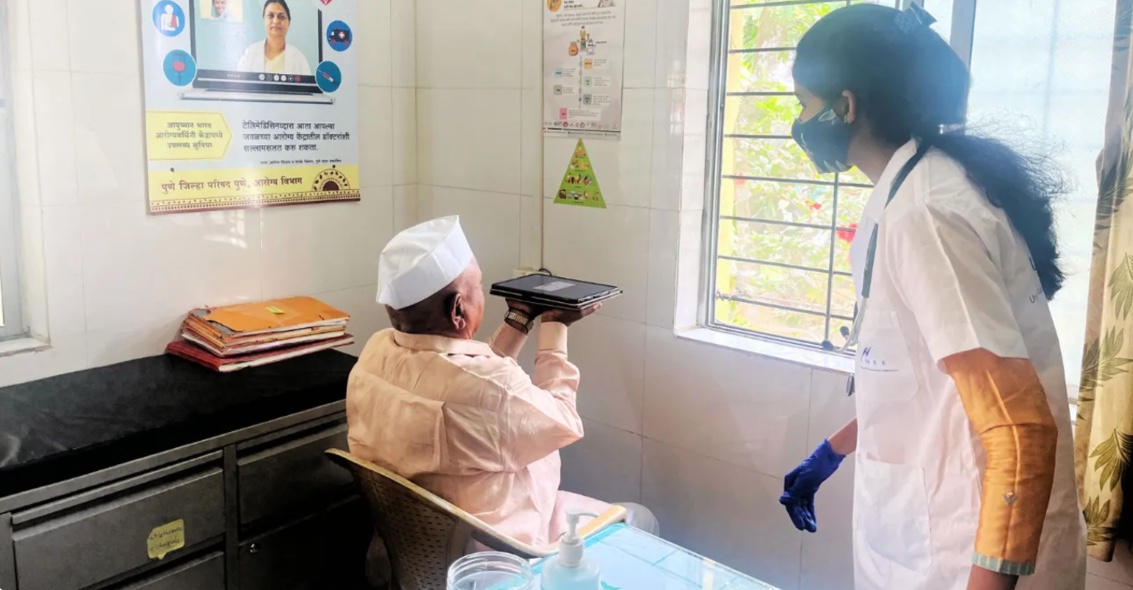
Rather than beginning as a hospital-based device or a hardware product sold to clinics, AffEx was built around the deployment model that actually reaches rural India: community health camps, mobile screening vans, and frontline workers already embedded in these communities, such as ASHA workers. That design choice shows up in the training model — health workers with no clinical diagnostic background are trained to operate devices like the AI-enabled stethoscope, interpret the platform’s automated flags, and route patients into follow-up care, rather than requiring a doctor or technician to be present at every screening.
This is a notable departure from most health-tech deployment in India, where diagnostic innovation tends to concentrate in private urban clinics and hospital networks with the infrastructure and paying patient base to absorb new equipment. AffEx instead routes its most sophisticated tools — AI-based cough analysis, automated murmur detection — through the exact workforce that already has trust and physical access in underserved communities, rather than trying to build parallel infrastructure to reach them.
Impact: What the Platform Has Found So Far
AffEx has been deployed across six Indian states, screening more than 50,000 individuals through community outreach programs, rural screening initiatives, tribal health drives, and institutional partnerships. Each screening covers over 20 parameters in under ten minutes, a throughput that lets a small team run camps at a scale that manual, symptom-based screening could not match.
The more meaningful impact, though, is qualitative and difficult to fully quantify from the outside: patients like a 60-year-old farmer in Gadag district, Karnataka, who had no symptoms he recognized as illness and was flagged as high-risk for tuberculosis through the platform’s cough-analysis tool — catching the disease at a stage where treatment could still be fully effective. For health workers, the shift has been just as significant. ASHA workers who previously could only observe and refer are now operating diagnostic-grade equipment themselves, a shift several describe as changing not just what they can do, but how communities perceive and trust them.
What AffEx does not yet have — at least not disclosed publicly — is granular outcome data: how many flagged patients completed treatment, what share of referrals converted to confirmed diagnoses, or cost-effectiveness figures compared to conventional screening. For a platform whose stated differentiator is closing the loop after screening, that follow-through data would be the strongest evidence of impact, and is a natural next disclosure as the program matures.
What This Means for Frontier Tech in India’s Health Sector
AffEx sits at an increasingly important intersection in Indian health-tech: AI-enabled diagnostics that are designed from the outset for frontline, non-specialist deployment rather than for hospital settings. That design choice matters more in India than almost anywhere else, because the constraint on rural healthcare access is rarely the absence of medical knowledge in a device — it is the absence of a trained specialist physically present to apply that knowledge. A platform that pushes AI-assisted diagnostic capability into the hands of an existing, trusted frontline workforce — rather than requiring new clinics, new specialists, or new patient travel — sidesteps that bottleneck directly.
It also reflects a broader pattern in Indian frontier-tech: some of the most consequential AI deployments in the country are not the most technically novel models, but the ones solved for distribution. Sophisticated diagnostics have existed for years; what has been missing is a form factor, price point, and workforce-training model that lets that sophistication reach a village health camp instead of staying confined to urban diagnostic chains. AffEx’s real test, going forward, will be whether it can scale past 50,000 screenings while proving out its follow-up-and-treatment pipeline — because in early detection, a flag without a completed treatment is only half the outcome. If it can demonstrate that closed loop at scale, it becomes a template not just for tuberculosis or cardiac screening, but for how AI-enabled point-of-care tools more broadly get built for — and reach — the majority of India that isn’t near a city hospital.
Share Your Story Today, Shape Viksit Bharat Tomorrow
Got an idea, innovation, or experience that's making a difference? Share your story now and ignite India's transformation because your voice can drive the future forward!
Disclaimer:
Features ‘as is’ submissions and neither constitutes endorsement, certification, recommendation, or validation by NITI Aayog nor makes NITI Aayog liable in any manner.
Resources to Replicate This Idea
BUILD YOUR OWN INTERVENTION
Handpicked stories tailored just for you
Explore stories that inspire, inform, and ignite new ideas across tech, innovation, and real-world impact


Turning Chemistry Into Code: The Technology Making Complex Diagnostics Faster and More Precise
Algorithmic Biologics is turning chemistry into code, using programmable DNA molecules to simplify complex diagnostic testing. Its technology could enable...
Read More