
Inside the Battery Tech Aiming to Cut 15,000 Tons of CO2 Per System
A deep dive into how LFP battery storage technology is tackling India’s solar curtailment crisis — converting wasted midday solar into reliable, low-carbon power for industrial users while cutting emissions and reducing fossil fuel imports.
Updated on: 23 July 2026

Sector

Solution
Solar Energy

Technology
Other

State of Origin
Impact Metrics
700,000 kWh
annual energy savings for a 1.2 MWh system.
₹42–52 lakh
annual savings for a typical 500 kW facility.
20% higher
Time-of-Day tariffs currently charged to commercial consumers between 6–10 PM, expected to apply nationwide by April 2027.
Three integrated tech layers
—battery hardware, grid integration software, and a Virtual Power Plant (VPP) platform—to manage distributed energy storage.
India hit its 2030 target of 50% non-fossil-fuel electricity capacity five years early, and installed solar capacity has since climbed to roughly 130 GW — more than half the country’s total generation capacity. But that success has created an unexpected problem: on many days, the grid generates more solar power than it can absorb. On a single day in 2025, India was curtailing roughly 2,500 megawatts of solar generation within a five-hour window — nearly 10,000 megawatt-hours of clean energy simply going unused. Meanwhile, Time-of-Day tariffs now charge commercial consumers roughly 20% more between 6–10 PM, a premium expected to apply nationwide by April 2027.
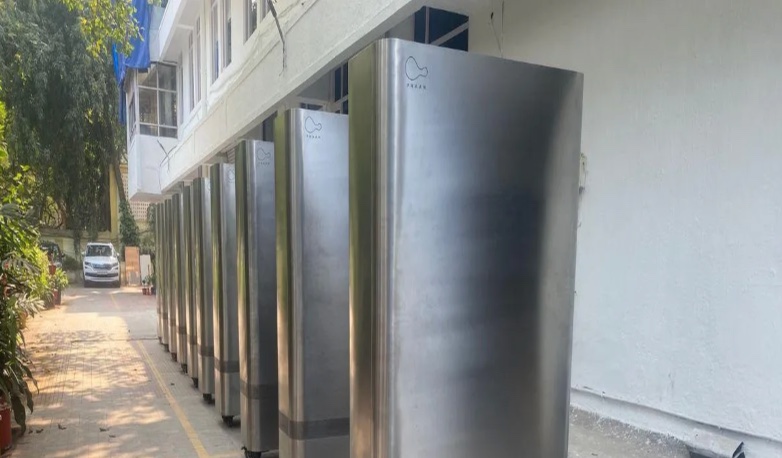
The mismatch — abundant, near-free solar power at midday and expensive, carbon-heavy power in the evening — is the gap Voltseal was built to close. Founded in Noida in 2025 by Mudit Narain and Abhijeet Pandey, the company builds Battery Energy Storage Systems (BESS) that capture surplus solar generation and discharge it when the grid, and the bill, need it most.
The Technology: LFP Batteries, Grid Engineering, and a Path to Virtual Power Plants
Voltseal’s product is built on lithium iron phosphate (LFP) battery chemistry — a variant of the lithium-ion technology used in electric vehicles, but tuned for stationary use. LFP cells are more thermally stable and fire-resistant than the NMC chemistry common in EVs, and better suited to being stacked into large, industrial-grade arrays.
According to the company’s product specifications, its systems are rated for 5,000+ battery cycles, 80–100% depth of discharge, and greater than 85–90% round-trip efficiency (energy out versus energy in). Switchover response time is under 200 milliseconds — near-instant — and each installation carries a two-year product warranty, with the system’s modular design allowing it to be configured to a customer’s specific load profile.
The harder engineering problem isn’t the cell itself but everything wrapped around it: converting stored DC energy into grid-compliant AC power at India’s 50 Hz, 220V standard, coordinated by an intelligent Battery Management System (BMS) for real-time analytics, and layered under a virtual power plant (VPP) concept that treats distributed batteries as a single, dispatchable resource. The company’s long-term ambition, in co-founder Mudit Narain’s words, is that “battery energy storage systems can enable renewable-powered microgrids, coupled with distributed generation and some demand-side management” — positioning Voltseal as an alternative electricity layer for commercial and industrial (C&I) customers, rather than just a hardware vendor.
How It Was Built: A Deliberately Layered Team
Voltseal’s founders bring complementary backgrounds. Mudit Narain, CEO and co-founder, has 18+ years at the intersection of energy, capital, and policy — including formal training at MIT’s Technology and Policy Program, seven years in the World Bank’s Energy Practice, and six years across the Government of India’s Atal Innovation Mission (NITI Aayog) and the Office of the Principal Scientific Adviser, alongside stints with venture funds INFUSE and Blume. Abhijeet Pandey, co-founder, brings 11+ years in strategy and sustainability, including six years at PwC India and five at Xynteo, working with Fortune 500 companies, global private equity funds, and multilateral institutions on energy and climate transactions.
Rather than build a single in-house engineering team from scratch, Voltseal has assembled specialized units: a hardware team drawn from IIT alumni, a software team built in partnership with BITS Pilani, and a network of equipment suppliers concentrated around Delhi NCR. Early technology development was financed in part through the Startup India Seed Fund Scheme.
Funding and Scaling
Voltseal counts Theia Ventures, Rainmatter, and Momentum Capital among its investors, with Social Alpha as an incubation partner. On the operating side, the company’s demand curve has moved faster than its own forecasts: it started the year targeting roughly 10 megawatt-hours of deployed storage capacity, and that internal target has since been revised upward five to six times, driven largely by state governments increasingly mandating storage alongside industrial and commercial solar installations.
That growth has exposed a structural gap in India’s battery supply chain. Voltseal still depends on imported battery cells even as it works to source software, controls, and balance-of-system components domestically. Five new domestic cell factories are coming online in India, one of which has committed to delivering samples by September — an early signal that the country’s storage manufacturing base, not just its demand, is starting to mature.
Impact: What’s Modeled, and What’s Real
It’s worth separating what Voltseal has actually achieved from what its systems are projected to deliver once deployed — the company is still moving from product design into first-order deployment, so its clearest numbers today come from its own illustrative case study rather than completed installations.
The illustrative case: a 1.2 MWh system sized for a 500kW facility. Per Voltseal’s product brochure, a system of this size — running two 2-hour cycles a day, 340 days a year — is modeled to save 700,000 kWh of energy annually over an asset life of 10–12 years. Under this model, the blended cost of BESS-plus-solar energy comes to roughly ₹6/kWh (versus ₹32–35/unit for diesel generator power and ₹8–10/unit for grid electricity), with a payback period of around 3 years and at least ₹90 lakh in net savings across the asset’s remaining life after payback. Broader modeling across VoltSeal’s benefit calculator suggests a 500kW facility could see ₹42–52 lakh in annual savings and a 3x reduction in diesel generator costs, with maintenance running at roughly 3% of capex per year.
Carbon avoidance is similarly modeled, not yet measured at scale. Using India’s grid emissions factor of 0.8 tonnes CO2/MWh, and assuming 1,500–2,000 operating hours a year, Voltseal estimates that each megawatt-hour of deployed battery storage avoids 12,000–15,000 tonnes of CO2 over a 10-year lifetime — with a 500kW diesel-replacement system alone projected to eliminate roughly 180 tonnes annually.
What’s factual today: the 5–6x growth in internal deployment targets since January, the shift from an outsourced contract factory to a dedicated larger facility, and the five domestic cell factories now coming online are real, verifiable facts about the company’s trajectory — even though they describe scaling capacity, not completed customer impact.
Implications for Urban Development and Frontier Tech in India
For urban infrastructure specifically, the relevance is direct. C&I demand — data centers, hospitals, malls, warehouses, EV charging hubs — is inherently urban and growing more energy-intensive by the year. Storage is what lets EV charging infrastructure run on solar-plus-grid power rather than grid alone, and it’s also what makes diesel generators avoidable during Delhi NCR’s annual GRAP restrictions, when generator use is banned at the higher air-quality alert stages — turning a seasonal compliance risk into a non-issue for facilities that switch to battery backup.
More broadly, Voltseal is a useful marker of where India’s climate-tech frontier is heading: policy (state storage mandates, tightening GRAP rules, rising ToD tariffs) is currently running ahead of industrial capacity, creating a demand vacuum that domestic manufacturers and software-hardware integrators are racing to fill. If that gap closes — as the emerging domestic cell factories suggest it might — battery storage could become the next major Indian climate-tech export category, following solar’s own trajectory from import-dependent to increasingly self-sufficient.
Share Your Story Today, Shape Viksit Bharat Tomorrow
Got an idea, innovation, or experience that's making a difference? Share your story now and ignite India's transformation because your voice can drive the future forward!
Resources to Replicate This Idea
BUILD YOUR OWN INTERVENTION
Handpicked stories tailored just for you
Explore stories that inspire, inform, and ignite new ideas across tech, innovation, and real-world impact

Safe Access: India’s Community-Verified Digital Locator for HIV Prevention Services
Safe Access is a free, community-driven Indian platform that helps people locate verified PrEP and PEP providers nearby. By mapping...
Read More