
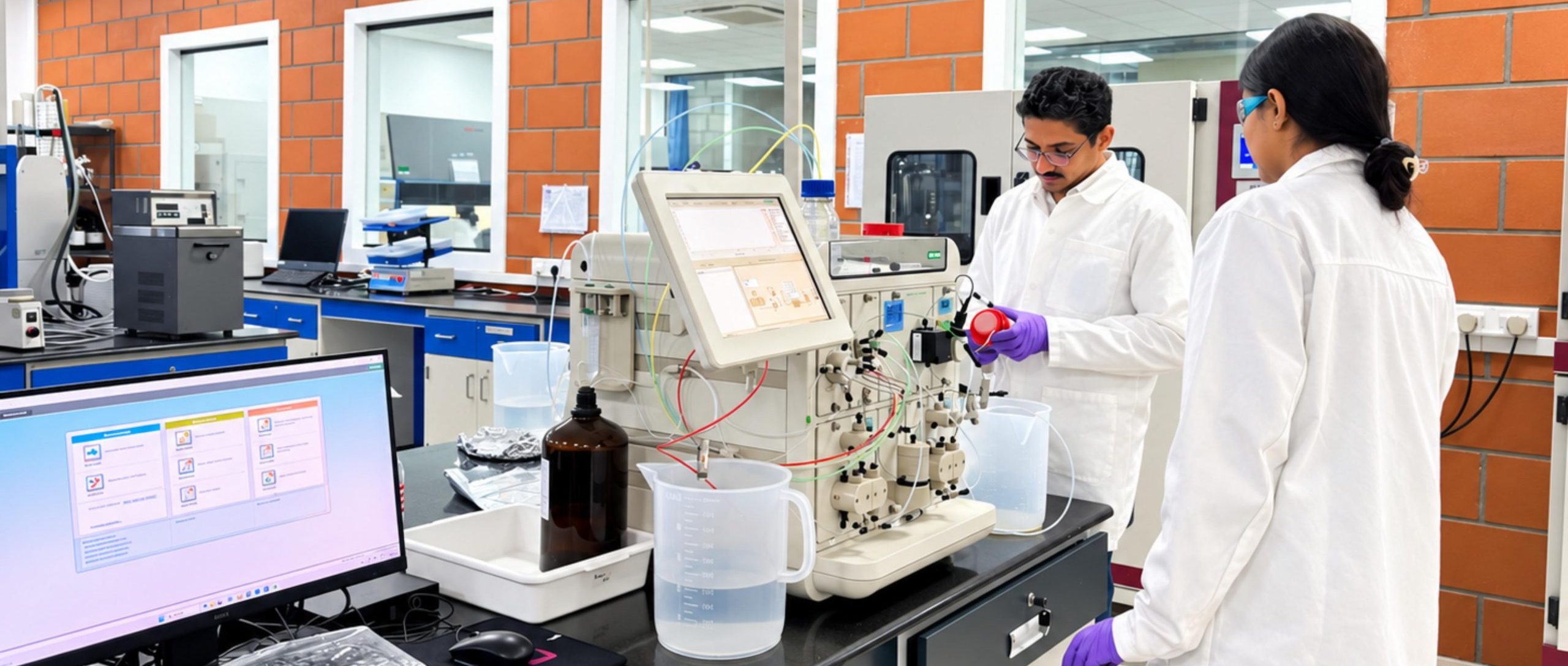
How Precision Fermentation is Challenging the Fuel, Fragrance, and Health Industries
The traditional extraction of many organic compounds can be resource-intensive and generate large amounts of waste. Precision fermentation offers a green alternative to this.
Updated on: 30 September 2026

Sector
Others

Solution

Technology

State of Origin
Disclaimer:
Features ‘as is’ submissions and neither constitutes endorsement, certification, recommendation, or validation by NITI Aayog nor makes NITI Aayog liable in any manner.
Impact Metrics
2G ethanol produced
without reliance on global suppliers.
Hexenol produced
without mint extract.
Vitamin K2 produced
with high purity via fermentation.
Considering the worsening effects of climate change, reducing the consumption of natural resources—and the carbon footprint—grows ever more important. However, many of the chemical compounds used in human life, from dietary components to cosmetics, come from plant or animal sources.
Preparing these compounds at a commercial scale requires large quantities of food, water, and land. In addition, many extraction processes can be time-consuming and release toxic waste into the environment.
Recognizing these problems, FermBox Bio of Bengaluru, Karnataka has adopted a new approach to biotechnology. Rather than extracting the desired organic compounds from living sources, this startup uses precision fermentation to directly manufacture them. Founded by Subramani Ramachandrappa, Preeti Dharmagoudar, and Ramanan Thirumoorthy in 2022, it has demonstrated the potential of green manufacturing via three different products.
What products does FermBox offer?
FermBox currently offers three products: one for the fuel industry, one for the fragrance industry, and one for human health.
The first of these is EN3ZYME, an enzymatic cocktail that hydrolyzes agriwaste to release fermentable sugars. These sugars may then be converted into 2G ethanol, which is in high demand in India as a fuel source. Usually, 2G enzymes in India are purchased from the international supplier Novonesis, and the preparation process consumes high amounts of sugar syrup. EN3ZYME presents an alternative source with reduced reliance on global supply chains or food crops.
The second is Bio-Hexenol, a variety of cis-3-hexenol that is produced without the traditional base of mint extract. Cis-3-hexenol has a fragrance reminiscent of freshly cut grass and is commonly used in the cosmetic industry. While mint cultivation requires pesticides and leaves pollutant residues, Bio-Hexenol relies solely on genetically modified microorganisms that convert sugars into the desired scent.
Finally, the third product is FermaQuinn K2 MK-7. This is a form of Vitamin K2—an important contributor to bone health—formed entirely through controlled fermentation. Noting its high purity and resource efficiency, FermBox envisions more vitamin alternatives in the coming years.
State of commercialization
FermBox was initially incubated at the Bangalore Bioinnovation Center (BIC), following which it applied for and won a number of BIRAC grants. In the years leading to 2026, it has been featured in several lists of green tech innovators. These include the World Economic Forum’s Technology Pioneers cohort of 2026, the 2026 APAC Cleantech 25, and 100 Desi DeepTechs.
Currently, the startup is in talks with international fragrance suppliers to provide them with Bio-Hexenol. EN3ZYME has already been deployed in some biorefineries in Assam. FermaQuinn K2 MK-7, the newest addition, was made public in September 2026.
Implications of using products
Each of the three listed products has significant implications for green manufacturing in India. As the largest exporter of mint extract in the world, the country faces high demand for cis-3-hexenol, but the traditional preparation process is pesticide-heavy and leaves pollutant residues. China already uses a chemical process to compete in producing this substance. By shifting towards FermBox’s fermentation-based process, Indian suppliers may gain advantages in both resource savings and environmental compliance.
Similarly, EN3ZYME can reduce the country’s dependence on foreign 2G ethanol sources, enabling it to produce higher volumes of fuel. This can boost the automobile, aviation, defence, and power industries among others. It will also mean that sugar-containing crops can be used for consumption rather than fuel generation.
Path forward
The Indian government has taken strong steps to promote cutting-edge research in biotechnology through initiatives such as the Biotechnology for Economy, Environment, and Employment (BioE3) Policy and BIREC’s Rapid Development and Innovative Fund (RDIF). These are welcome sources of support in this ecosystem.
The primary challenge for startups such as FermBox lies in the availability of space for manufacturing plants. As a component of the deep tech category, biotechnology can take years to yield commercially successful results, all the while needing consistent access to resources. By formally allocating sectors in industrial parks for biotech firms, policymakers could convey further confidence in their work and encourage more innovation in the field.
Share Your Story Today, Shape Viksit Bharat Tomorrow
Got an idea, innovation, or experience that's making a difference? Share your story now and ignite India's transformation because your voice can drive the future forward!
Disclaimer:
Features ‘as is’ submissions and neither constitutes endorsement, certification, recommendation, or validation by NITI Aayog nor makes NITI Aayog liable in any manner.
Resources to Replicate This Idea
BUILD YOUR OWN INTERVENTION
Handpicked stories tailored just for you
Explore stories that inspire, inform, and ignite new ideas across tech, innovation, and real-world impact


Powering India’s Digital Future Through AI, Semiconductor Innovation, and Human-Centred Governance
NagpurAI Infrastructure Labs is building an indigenous frontier-tech ecosystem spanning AI computing, semiconductor design, and aerospace manufacturing. Through its AP-DGI...
Read More