
India’s Home-Grown Satellite Eyes for Disaster Warning and Climate Monitoring
EON Space Labs is building India’s own satellite imaging systems to support disaster response, agriculture, climate monitoring, and national security. By developing lightweight, high-precision satellite cameras entirely in India, the initiative reduces dependence on foreign technology while enabling faster, more reliable Earth observation for public safety and development planning.
Updated on: 30 January 2026

Sector

Solution
Disaster Management

Technology

State of Origin
Disclaimer:
Features ‘as is’ submissions and neither constitutes endorsement, certification, recommendation, or validation by NITI Aayog nor makes NITI Aayog liable in any manner.
Impact Metrics
Over 90%
of the system is built in India, reducing dependence on foreign satellite imaging equipment.
Detects drones
and human movements that are over 2 kilometres away.
Light-weight satellites
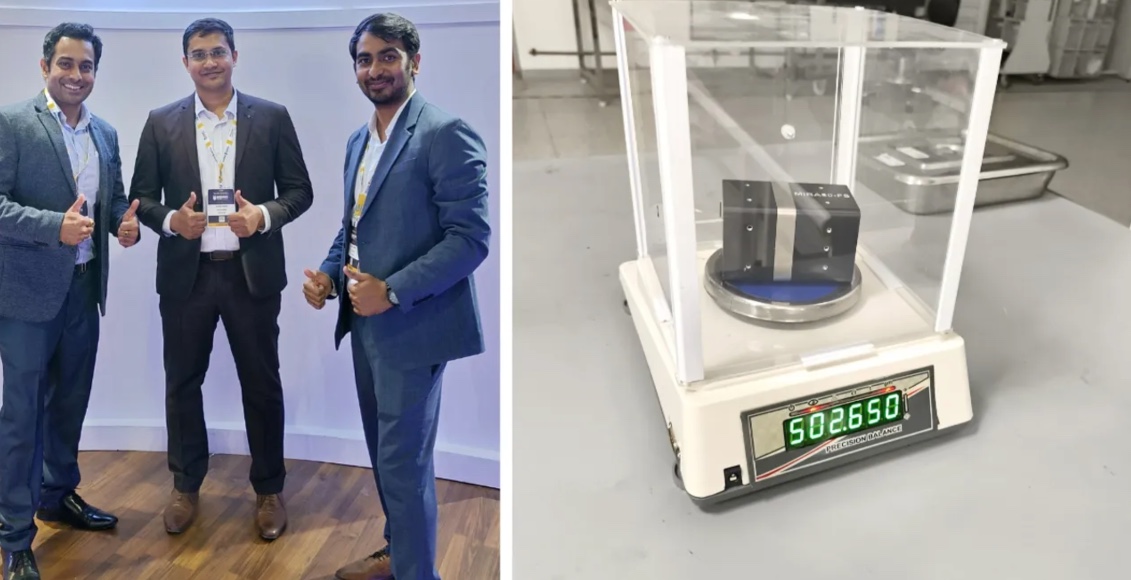
of just about 500 grams, making it among the lightest of its kind developed in India.
EON Space Labs is an Indian deep-tech startup developing compact, high-performance electro-optical and infrared imaging payloads for satellites, drones, and airborne platforms. Founded in December 2022 in Hyderabad by engineers Sanjay Kumar, Manoj Kumar Gaddam, and Punit Badeka, the company was established to address a critical gap in India’s space and Earth-observation ecosystem: the lack of indigenous, end-to-end control over advanced optical sensors—the “eyes” of satellites.
While India has achieved global recognition for its satellite launch capabilities and cost-efficient space missions, high-resolution electro-optical payloads have historically been imported, constrained by foreign supply chains and export controls. This dependency limited operational flexibility in applications such as disaster response, border surveillance, climate monitoring, and precision agriculture. EON Space Labs was founded to indigenise this most sensitive layer of Earth-observation infrastructure by designing, manufacturing, integrating, and qualifying space-grade optical systems entirely within India.
Technology foundation and approach

The founding team brings a distinctive background from precision medical optics, having previously worked at the LV Prasad Eye Institute on advanced imaging systems used to visualise the human retina. Their experience with adaptive optics, ultra-precision manufacturing, and reliability-critical medical devices informed EON’s core technological philosophy: optical systems must be stable, lightweight, and tightly integrated rather than complex assemblies prone to misalignment.
This approach led EON to focus on monolithic optical designs, where key optical components are machined from a single block rather than assembled from multiple elements. Such architectures are inherently lighter, more thermally stable, and better suited for the harsh conditions of space. The company established an integrated engineering pipeline covering optical design, mechanical structures, electronics, onboard software, and system-level qualification, addressing a long-standing fragmentation in India’s optics landscape.
More than 90 percent of EON’s systems are indigenously developed, with Indian manufacturing partners such as HHV Advanced Technologies supporting ultra-precision fabrication of lenses and monolithic components.
Flagship system and validation
EON’s flagship payload, the MIRA compact space telescope, exemplifies its miniaturisation-first philosophy. The current iteration, MIRA-50 FS, weighs approximately 502 grams, placing it among the lightest space-qualified imaging payloads developed in India. Mass reduction at this scale is strategically significant, as launch costs to low Earth orbit increase sharply with payload weight, and lighter instruments enable higher satellite counts and more frequent revisit cycles.
In November 2025, MIRA successfully completed thermo-vacuum testing at a NABL-accredited facility in Ahmedabad, meeting NASA-aligned qualification standards. This milestone marked the transition of the system from a laboratory prototype to a flight-ready payload. The telescope is currently scheduled for launch by June 2026.
Applications and operational impact
EON’s electro-optical and short-wave infrared (SWIR) systems are designed for persistent Earth observation across civilian and strategic domains. In orbit, they enable monitoring of floods, forest fires, crop health, infrastructure development, and maritime activity. Infrared capability allows imaging through haze, smoke, and low-light conditions, improving reliability during disasters and at night.
On aerial platforms, EON’s LUMIRA systems extend similar capabilities to drones and aircraft. Under the Ministry of Defence’s iDEX programme, the company has demonstrated detection of drones beyond 2 km, ships over 11 km off the Visakhapatnam coast, and human movement across borders at distances exceeding 1.5 km using SWIR imaging. These trials were conducted in real-world environments, including fog, salt spray, and continuous motion.
To address latency in Earth-observation workflows, EON is also integrating its optical payloads with satellites capable of higher revisit frequencies and onboard AI processing. This enables prioritisation and transmission of actionable insights rather than raw imagery—an advantage in time-critical scenarios such as disaster response and agricultural decision-making.
Strategic relevance for India
EON Space Labs demonstrates how cross-domain expertise, when aligned with national priorities, can accelerate indigenous capability development in space technology. By localising the design and production of satellite imaging payloads, the company reduces India’s dependence on imported optics while enabling scalable, lightweight constellations tailored to domestic needs.
As India expands its space-based applications in defence, climate resilience, food security, and disaster management, indigenous electro-optical systems will be central to operational sovereignty. Initiatives like EON strengthen not only the space sector but also adjacent ecosystems in advanced manufacturing, precision engineering, and AI-enabled analytics. In doing so, they contribute to a more resilient, responsive, and self-reliant national space infrastructure—one where India’s satellites do not merely launch from Indian soil, but also see the world through Indian-built eyes.
Share Your Story Today, Shape Viksit Bharat Tomorrow
Got an idea, innovation, or experience that's making a difference? Share your story now and ignite India's transformation because your voice can drive the future forward!
Disclaimer:
Features ‘as is’ submissions and neither constitutes endorsement, certification, recommendation, or validation by NITI Aayog nor makes NITI Aayog liable in any manner.
Resources to Replicate This Idea
BUILD YOUR OWN INTERVENTION
Handpicked stories tailored just for you
Explore stories that inspire, inform, and ignite new ideas across tech, innovation, and real-world impact

Pilotless Cargo Flights with Zero Failures: Reimagining Diagnostic Logistics in Indian Cities
An energy-efficient autonomous aircraft combining vertical take-off with fixed-wing cruise has completed over 1,000 flights carrying diagnostic samples between hospitals,...
Read More