Pilotless Cargo Flights with Zero Failures: Reimagining Diagnostic Logistics in Indian Cities
An energy-efficient autonomous aircraft combining vertical take-off with fixed-wing cruise has completed over 1,000 flights carrying diagnostic samples between hospitals, cutting delivery times from hours to minutes with no mission failures, and is now scaling into city-wide delivery networks.
Updated on: 30 September 2026

Sector

Solution

Technology

State of Origin
Disclaimer:
Impact Metrics
137x less
delivery costs, significantly lowering last-mile logistics.
Medical deliveries
including blood samples.
Fast deliveries
under 15 minutes, with drones cruising at 60 KM/H.
Moving small goods in India still depends on people and vehicles. Even a single diagnostic sample needs a courier and a road trip, so hospitals batch their transfers. In the pilot described below, road transport managed only three or four transfers a day, which meant samples waited and labs received them in fixed batches rather than a steady flow.
The problem is partly physical. Conventional aircraft are inefficient for small payloads because most of their weight goes into carrying the aircraft itself. Quadcopters, the common drone form, need heavy thrust just to stay airborne, which limits range and raises cost. For delivery, the benchmark in India is demanding: about 10 minutes to the doorstep, at very low cost.
The Intervention
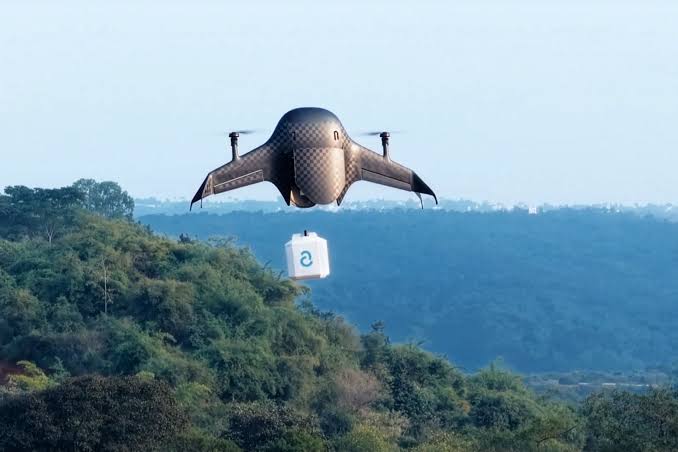
Airbound has built a lightweight autonomous aircraft meant to carry a greater share of its weight as cargo. Its design is a blended wing body tailsitter. It takes off and lands vertically like a drone but flies forward on wings like a fixed-wing aircraft. The airframe uses carbon-fibre composites, and the founder says it is light enough to lift with one hand, yet designed eventually to carry payloads heavier than itself.
How the Technology Works
- Tailsitter flight. Vertical take-off needs no runway, while wing-borne cruise uses far less energy than hovering rotors.
- Blended wing body. The airframe merges wing and fuselage to improve aerodynamic efficiency, which supports longer range at lower cost.
- Composite structure. Carbon fibre keeps the aircraft light, so more of the weight in flight is payload.
- Autonomous operations. Missions are flown without a pilot on board, enabling frequent, scheduled flights along fixed corridors.
Impact to Date
The clearest evidence comes from healthcare. In a 54-day pilot, the aircraft connected a Narayana Health clinic in Chandapura, Bengaluru, to a central laboratory in Electronic City. The aerial route supported up to 20 flights a day over about four kilometres. The pilot completed more than 700 flights carrying up to 40 samples each, with zero failures. Across its Narayana Health work, the company reports more than 1,000 autonomous flights, delivery times cut from hours to minutes, and no mission failures.
A commercial test is now underway in Andhra Pradesh, where the company plans a delivery network connecting three cities and eventually scaling to 10,000 flights a day across retail, e-commerce and healthcare. Airbound has raised nearly $50 million in total, including a $37 million Series A led by Greenoaks, to move from demonstration to commercial-scale manufacturing and operations.
Relevance and Importance
Faster sample transport matters because it lets laboratories work from a continuous flow of fresh samples. It also makes centralisation viable. Narayana Health’s founder says processing about 25,000 tests a day in one high-volume centre should cut cost per test while improving accuracy. If the cost of moving a sample falls to under a rupee, as the partners aim, a village clinic could in principle get the same diagnostic access as a city hospital. Beyond healthcare, the same corridors could serve retail and e-commerce, and the founder sees the platform eventually carrying passengers.
Alignment with India’s Development Goals
- Universal health coverage and SDG 3: Quicker, cheaper diagnostics support access to quality care regardless of geography or income.
- Infrastructure and innovation (SDG 9): Drone corridors form a new freight layer that does not depend on roads.
- Enabling policy: Drone Rules 2021 eased approvals, the government has announced plans for cargo drone corridors, and GST on drones was cut to 5%.
- Indigenous deep-tech: Aircraft design, manufacturing and operations are being built in India for domestic and global use.
- State-level adoption: The Andhra Pradesh agreement shows state governments building drone networks.
Challenges and Way Forward
The next phase is mostly about scale: reliable manufacturing, commercial operations, airspace integration and regulatory approvals for larger networks. The Narayana Health plans include a permanent corridor from Electronic City to a new hospital in Banashankari, with Kolkata among other cities targeted. Airbound is also moving into a field where Indian and global players are scaling quickly, so cost per delivery and operational reliability will determine adoption.
Share Your Story Today, Shape Viksit Bharat Tomorrow
Got an idea, innovation, or experience that's making a difference? Share your story now and ignite India's transformation because your voice can drive the future forward!
Disclaimer:
Resources to Replicate This Idea
BUILD YOUR OWN INTERVENTION
Handpicked stories tailored just for you
Explore stories that inspire, inform, and ignite new ideas across tech, innovation, and real-world impact


Solar-Charged, AI-Optimised Boats Cut Fuel Costs by 95% and Make Water Cleanup Safer
AI-optimised, remote-controlled electric boats collect organic and inorganic waste from lakes, ponds, and ports using predictive, zigzag coverage. They gather...
Read More