
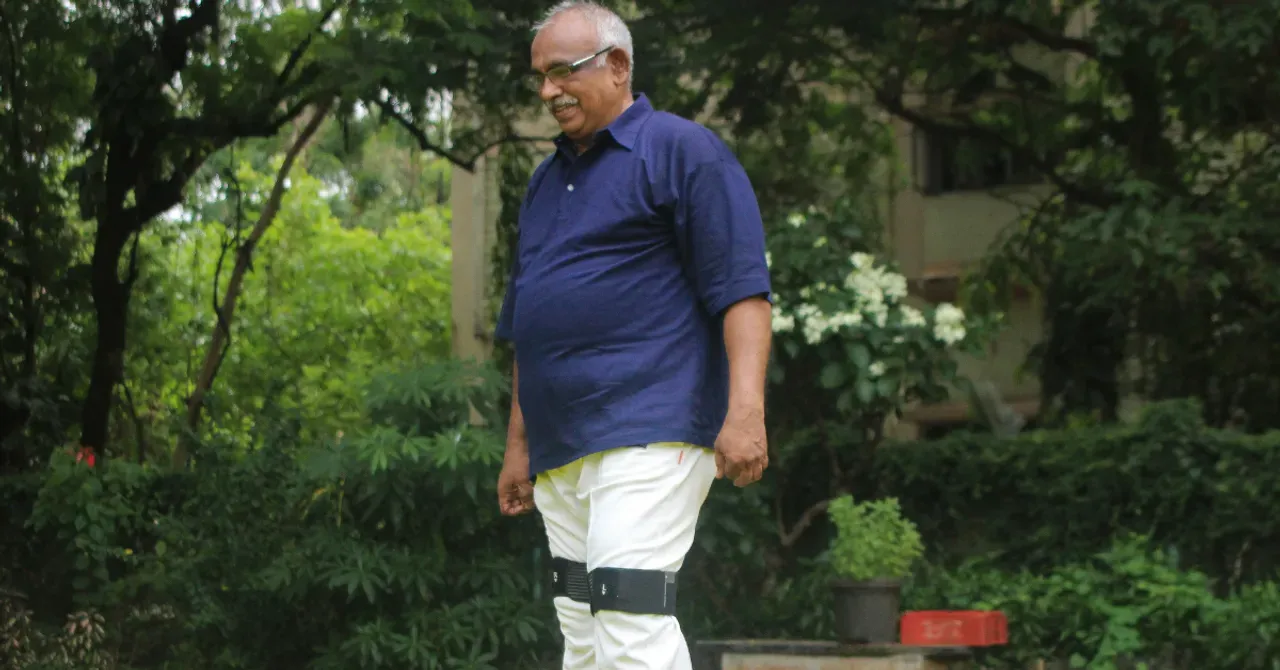
Sensor-Based Wearable Device Improves Mobility for People Living with Parkinson’s Disease
WALK is an Indian, clinically validated wearable medical device that helps people with Parkinson’s disease walk more safely and confidently. Using sensors, external movement cues, and a digital health platform for remote monitoring, the solution reduces walking interruptions, lowers fall risk, and enables continuous, personalised neurological care.
Updated on: 18 December 2025

Sector

Solution
Elder Care

Technology

State of Origin
Impact Metrics
~300 families
across India have benefitted from using the WALK.
Enables remote monitoring
of patients’ walking patterns.
Better balance
and increased physical activity for people using the device.
WALK is a clinically validated wearable medical device designed to reduce freezing of gait (FOG) in people living with Parkinson’s disease. Developed by Lifespark Technologies, a Mumbai-based health technology startup, the solution combines a lower-limb wearable, a mobile application, and a cloud-based clinical monitoring system. The device was co-founded by electrical and electronics engineer Amey Desai, alongside Dr Devendra Desai, a senior gastroenterologist with nearly three decades of clinical experience. The innovation emerged from a clear and urgent need: in India alone, an estimated 7 million people live with Parkinson’s disease, many of whom experience debilitating gait freezing that significantly increases fall risk, loss of independence, and healthcare burden.
The motivation behind WALK was both personal and scientific. Desai’s exposure to Parkinson’s disease through his grandfather, combined with his academic training in neural motor control at BITS Pilani and the University of Leeds, shaped the core insight behind the device. Research in neuromuscular physiology shows that walking is not governed solely by conscious brain control, but also by spinal circuits and patterned sensory feedback. When these internal cues fail—as in Parkinson’s disease—external rhythmic cues can help restore movement continuity.

Solution design and implementation
WALK was conceptualised as a non-invasive wearable that provides external sensory cues to interrupt freezing episodes and reinitiate gait. The device is worn on the lower legs and integrates accelerometers, gyroscopes, and inertial measurement units to continuously analyse walking patterns in real time. When gait irregularities associated with freezing—such as hesitation or disrupted step rhythm—are detected, the device delivers gentle rhythmic vibrations and mild electrical stimulation to the legs. These cues act as external triggers, helping the user resume coordinated movement.
The wearable is supported by a smartphone application that allows patients to personalise therapy settings, monitor walking performance, and access guided physiotherapy exercises tailored for Parkinson’s disease. Complementing this is the Pathfinder cloud platform, which securely stores gait data and enables clinicians to remotely monitor patient progress, review patterns, and refine treatment protocols. This three-layer architecture—device, app, and cloud—supports continuous, personalised care beyond clinical settings.
Clinical validation and regulatory pathway
The development of WALK followed a structured medical device lifecycle. Initial research began in 2018, with prototype development completed in 2021. The solution underwent iterative refinement through patient feedback and neurologist oversight. A critical milestone was achieving ISO 13485 certification, establishing compliance with international quality management standards for medical device manufacturing.
Subsequently, Lifespark obtained a test licence from the Central Drugs Standard Control Organisation (CDSCO), enabling safety and efficacy testing. Devices were evaluated for biocompatibility, electrical safety, electromagnetic interference and compatibility, and compliance with IEC 60601 standards for medical electrical equipment. Following successful validation, the company received a full manufacturing licence for scaled production.
Clinical trials were conducted at the National Institute of Mental Health and Neurosciences (NIMHANS), Bengaluru, under the guidance of neurology experts. In trials involving 20 Parkinson’s patients with freezing of gait, WALK demonstrated nearly a 50% reduction in freezing episodes within a single session, compared to no significant improvement with a sham device. These findings highlighted the device’s role as a complementary intervention alongside medication and physiotherapy.
Impact and outcomes

To date, nearly 300 families across India have used WALK. Users have reported improved walking confidence, reduced fear of falls, greater independence in daily activities, and enhanced quality of life. Clinicians have noted improved balance, mobility, and patient engagement with therapy. Importantly, the device enables remote monitoring, reducing the need for frequent hospital visits and supporting continuity of care in resource-constrained settings.
Lifespark Technologies was incubated at the Society for Innovation and Entrepreneurship (SINE), IIT Bombay, which provided access to prototyping infrastructure, clinical networks, and mentorship. The device is currently priced at approximately ₹50,000, with efforts underway to reduce costs further to improve accessibility.
Strategic relevance for India’s healthcare system
Wearable, sensor-driven assistive technologies like WALK demonstrate how indigenous innovation can address chronic disease management at scale. Parkinson’s disease is expected to rise with India’s ageing population, placing sustained pressure on neurological care services. Solutions that enable home-based rehabilitation, real-time monitoring, and clinician oversight can significantly reduce hospital load, improve patient safety, and enhance long-term outcomes.
More broadly, WALK illustrates the potential of combining engineering, clinical science, and digital health platforms to strengthen India’s healthcare ecosystem. Such models can be extended to other movement disorders, post-stroke rehabilitation, and geriatric care. By supporting mobility, dignity, and independence, wearable medical technologies can play a critical role in advancing preventive, patient-centred, and technology-enabled healthcare across India.
Share Your Story Today, Shape Viksit Bharat Tomorrow
Got an idea, innovation, or experience that's making a difference? Share your story now and ignite India's transformation because your voice can drive the future forward!
Resources to Replicate This Idea

BUILD YOUR OWN
Do you want to know how this innovator scaled their idea, how much it cost them, and what resources/partnerships they deployed?
Click here.
Handpicked stories tailored just for you
Explore stories that inspire, inform, and ignite new ideas across tech, innovation, and real-world impact

AI-Enabled Gynaecological Care Expands Access to 400,000+ Women Across India
Pinky Promise is a chat-first, AI-assisted women’s healthcare platform delivering affordable, confidential gynaecological care at scale. Founded in 2022, it...
Read More