Tagging, Tracking, Transforming: Blockchain-Enabled Recovery of Post-Consumer Textiles
A blockchain-tracked reverse logistics platform is tackling India’s 41-lakh-tonne post-consumer textile waste problem, using AI-driven backend infrastructure and patent-pending fibre recovery technology to turn household decluttering into a habit-forming, reward-based circular economy.
Updated on: 23 September 2026

Sector

Solution

Technology

State of Origin
Disclaimer:
Features ‘as is’ submissions and neither constitutes endorsement, certification, recommendation, or validation by NITI Aayog nor makes NITI Aayog liable in any manner.
Impact Metrics
2.7 million litres
of water saved with TooUsed.
~11,500 metric tonnes
of carbon emissions reduced over ~3 years.
35000+ livelihoods created
for waste workers and informal textile traders integrated into the platform's logistics network.
India generates roughly 71 lakh tonnes of textile waste every year, and about 41 lakh tonnes of that is post-consumer waste — clothes discarded by households rather than factories. Unlike industrial textile scrap, which already has established recycling channels, there is no organised system for what happens to a garment once a household decides it’s done with it. Most of it is thrown away, handed to domestic help (who often can’t use it either), or given to NGOs through channels that are inconsistent and inconvenient. As buying clothes has become faster and cheaper through e-commerce and quick-commerce apps, the imbalance has only grown: acquiring clothes is a one-tap experience, but discarding them responsibly is not.
This mismatch is the starting point for Tooused, a Delhi-founded startup that describes itself as building “reverse logistics” infrastructure for post-consumer textile waste — essentially, the missing pickup, sorting, and redistribution layer that lets households declutter clothing as easily as they acquire it.
How the Technology Works
Tooused’s model rests on three layers of technology, all built in-house on top of standard cloud infrastructure from partners like AWS and Google (including Google’s Vertex AI APIs for AI-related functions). The company describes these providers as supplying the “raw materials,” while its own tech team builds the actual product on top.
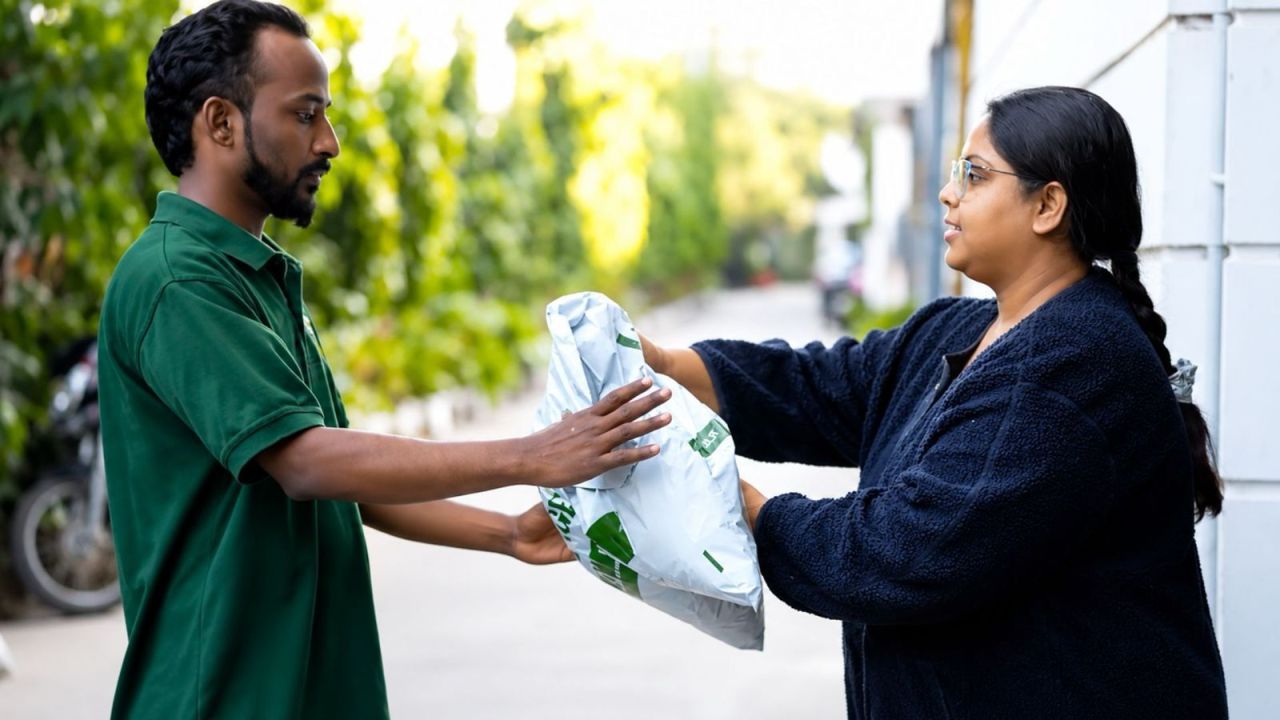
The consumer and rider apps form the front end: a household lists clothes for pickup through the app, a rider is dispatched to collect them, and each item is scanned and tagged so it can be tracked through the rest of its lifecycle. This tracking layer uses blockchain to record and trace items as they move through Tooused’s circular economy pipeline — useful both for accountability and for measuring downstream environmental impact.
A reward-based marketplace closes the loop for the consumer. Rather than simply asking people to donate clothes altruistically, Tooused gives users credits for decluttering, which they can redeem for products within the app’s marketplace. This “get back” mechanic is a deliberate behavioural design choice: it converts a one-time donation impulse into a recurring habit. The company says an average household using the platform declutters roughly every three months.
A patent-pending shredding and extraction process handles what happens to unusable garments. Clothes that cannot be resold or reused are mechanically broken down to extract cotton fibre, which is then refabricated into new materials or felt — turning waste that would otherwise go to landfill into a raw material for manufacturing.
Alongside this, Tooused runs what it calls a “Sathi network” — a last-mile logistics layer that integrates informal waste workers such as kabadiwalas (scrap dealers) and existing secondhand-clothing traders into its formal collection chain, rather than bypassing them.
Scale and Impact
Tooused has scaled from a Delhi pilot to pan-India coverage, including the northeastern states, in under two years — the company frames its reach in terms comparable to major delivery platforms. It currently serves over six lakh households across Android and iOS, of whom roughly 1.5–2 lakh actively use the decluttering and reward marketplace loop.
The impact splits into two categories. On the environmental side, the company estimates it has kept around 11,500 metric tonnes of carbon emissions out of the atmosphere and saved approximately 2.7 million litres of water over roughly three years of operation, by diverting clothing that would otherwise have gone to landfill into recycling or reuse. On the livelihoods side, Tooused says it has created income opportunities for roughly 35,000–36,000 people — waste workers, the Bagri community of secondhand-clothing traders, and others integrated into its Sathi network — with earnings improved by an estimated 40–45%.
The startup has been recognised at a national level for this work: it won a Ministry of Textiles innovation challenge and an IDH-CITI award for alternate uses of textile material, competing against thousands of applicants for both. It has also appeared on Shark Tank India and recently received a social impact grant from IIM Calcutta to help build out the Sathi network further.
Why This Matters for India’s Development Agenda
Tooused’s work sits at the intersection of several priorities India has been actively pushing: a circular economy for textiles, formalisation of informal waste-work livelihoods, and climate commitments tied to reduced landfill emissions and resource use. India’s textile sector is both economically vital and environmentally significant, and the absence of consumer-facing infrastructure for end-of-life garments has long been a gap in that sector’s sustainability story. Startups building this layer — collection, sorting, traceability, and material recovery — are effectively constructing capacity that neither large retailers nor government waste-management systems have prioritised.
The model is also notable for how it engages the informal sector rather than displacing it. By routing volumes through kabadiwalas and existing secondhand traders, Tooused is formalising and augmenting livelihoods that already exist in India’s waste economy, rather than building a parallel system that competes with them.
Building in India’s Startup Ecosystem
Tooused’s funding path is illustrative of a common early-stage trajectory: roughly ₹60 lakh from founders, a further ₹60 lakh angel round, and an ongoing pre-seed round targeting ₹3 crore. It also touched several government-linked support structures — presenting to Startup India’s Seed Fund network (though ultimately not taking the funding, citing unfavourable terms for a scaling company), exhibiting at Bharat Tex 2025 with government support, and planning to claim the three-year startup tax exemption from the next financial year.
The founders point to two recurring frictions in India’s startup ecosystem: the difficulty of building consumer awareness for a genuinely new behaviour (decluttering formally rather than donating informally or discarding), and a structural mismatch between how funding institutions benchmark early-stage companies and how genuinely novel business models actually look on paper. Neither is unique to Tooused — but both illustrate why sector-specific infrastructure like this tends to depend on patient capital and sustained public-sector engagement rather than one-time funding alone.
Share Your Story Today, Shape Viksit Bharat Tomorrow
Got an idea, innovation, or experience that's making a difference? Share your story now and ignite India's transformation because your voice can drive the future forward!
Disclaimer:
Features ‘as is’ submissions and neither constitutes endorsement, certification, recommendation, or validation by NITI Aayog nor makes NITI Aayog liable in any manner.
Resources to Replicate This Idea
BUILD YOUR OWN INTERVENTION
Handpicked stories tailored just for you
Explore stories that inspire, inform, and ignite new ideas across tech, innovation, and real-world impact

Pilotless Cargo Flights with Zero Failures: Reimagining Diagnostic Logistics in Indian Cities
An energy-efficient autonomous aircraft combining vertical take-off with fixed-wing cruise has completed over 1,000 flights carrying diagnostic samples between hospitals,...
Read More