The Future of Health, Through the Eye: A Novel AI Tool Advances Early Diagnosis for 16M+ Patients Globally
Remidio is reimagining preventive healthcare through AI-powered oculomics, enabling early risk detection of chronic eye and systemic diseases at the last mile. By shifting from mass screening to targeted risk triaging, its portable retinal diagnostics have reached 16M+ people globally—reducing costs, improving access, and ensuring timely care for those most at risk.
Updated on: 17 March 2026

Sector

Solution

Technology

State of Origin
Impact Metrics
16M+ people
risk-triaged across 55 countries.
250+ PHCs
covered in India, expanding last-mile access to preventive care.
~85% reduction
in screening costs, lowering per-patient costs from ₹4,000–5,000 to ~₹400 in public health programs.
1.2M+ retinal scans
analyzed, generating large-scale epidemiological insights including glaucoma prevalence (2.3%–6%).
This story was submitted under our programme Frontier Voices of India. If you have an innovation that’s solving critical challenges in India, we want to hear from you. Register using this link, or write to us at frontiertech@thebetterindia.com.
Across India’s vast public health landscape, where millions live far from tertiary hospitals and specialist care, the challenge is not merely about treating disease. It is about finding those who are most at risk — early enough to prevent irreversible harm.
This is the space where Remidio has carved out a distinctive role: reimagining how chronic diseases are risk-triaged at the last mile through the emerging science of oculomics. Founded in 2009 by Dr Anand Sivaraman, it posits that the human eye can unlock insights into systemic health, and uses AI for early detection of chronic eye and systemic diseases – an emerging concept known as oculomics.

From screening to risk triaging
In addition to covering 250 PHCs in India, Remidio has impacted over 16 million people across 55 countries with its model.
At the heart of this work is a deliberate distinction between “screening” and “risk triaging”. Screening implies comprehensive detection across an entire population — a promise that is difficult to uphold in resource-constrained settings. Risk triaging, by contrast, prioritizes identifying those most likely to suffer severe outcomes and ensuring they reach specialist care first.
For chronic conditions such as diabetic retinopathy, glaucoma, age-related macular degeneration (AMD), cardiovascular disease, and chronic kidney disease, this distinction matters deeply. Vision loss from chronic eye diseases is often irreversible by the time symptoms appear. Similarly, systemic complications of diabetes may remain silent until they become life-threatening.
Unlike conventional blood tests that require laboratory processing, trained personnel, and logistical infrastructure, a retinal image captured at the point of care can potentially deliver actionable insights instantly.
The origin story: solving the wrong bottleneck
The seeds of Remidio were sown long before oculomics became a buzzword. Dr Anand had previously worked in an in vitro diagnostics startup focused on reducing the cost of HIV testing. A perplexing observation stood out: pharmaceutical advances were driving down the cost of treatment, but the cost of diagnostics remained stubbornly high. In some cases, patients resorted to reflex antibiotic use because testing was more expensive than the medicine itself.
A similar inefficiency was evident in ophthalmology. Between 70–80% of an ophthalmologist’s time was spent determining who had a problem, rather than treating those who did. The question, then, was whether that initial detection could be “task-shifted” to the last mile — to primary care centres in the private sector or public health centres and sub-centres in government systems.
For Dr Anand, a chance encounter with an ophthalmologist during a train journey crystallized the mission. The doctor treated premature infants at risk of lifelong blindness — 65 to 80 years of avoidable visual disability if not detected early. Ironically, the cost of identifying which babies required intervention was at least five times the cost of treatment itself. You cannot treat everyone prophylactically; you must identify those who truly need care.
That insight — combined with personal experiences of mortality and morbidity linked to late detection — pushed the founding team to build a scalable access model powered by technology.
Designing for simplicity, not just affordability

Remidio’s approach rests on a core belief: what scales in India is not merely what is affordable, but what is simple.
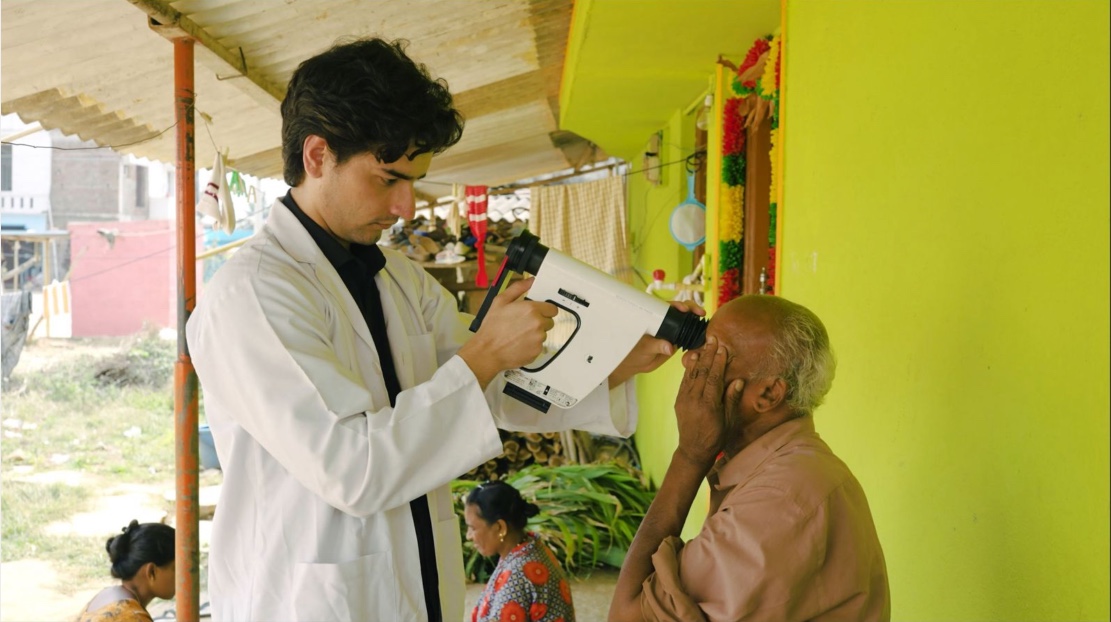
Point-of-care diagnostics often focus narrowly on cost reduction. But complexity — whether in device operation, training requirements, or workflow integration — can quietly derail scale. Remidio re-engineered retinal cameras to be portable, smartphone-based, and intuitive enough for frontline health workers.
Traditional retinal imaging systems resemble DSLR cameras: multiple lenses, manual adjustments, and steep learning curves. Remidio simplified this experience. Instead of switching lenses, a health worker can pinch-zoom on a phone interface; the optics adjust automatically. By embedding sophistication behind a simple user interface, the company reduced cognitive load on frontline workers.
This simplicity is a journey rather than an endpoint, but it has enabled a broader transformation across three ecosystems.
Transforming patients, providers and systems
At the patient level, early detection has prevented avoidable blindness. One example is a plumber named Nallamuthu, whose uncontrolled diabetes had already begun affecting his vision. Traveling to a tertiary hospital meant losing daily wages — an opportunity cost many cannot afford. A local vision centre equipped with Remidio’s device and AI detected his condition and fast-tracked him to care. Today, he drives his scooter independently again — a reminder that empowerment, not just disease prevention, is the true metric of success.
At the health worker level, the impact is equally profound. Vision centre workers — often women with limited formal medical education — gain confidence and social standing when equipped with effective diagnostic tools. Their role shifts from passive referral agents to active guardians of community health. In some cases, this empowerment has translated into entrepreneurial journeys of their own.
At the ecosystem level, ophthalmologists and health systems benefit from better resource allocation. In the private sector, specialists can focus more time on treatment. In the public sector, scarce resources can be directed toward those most at risk.
Measuring impact beyond 16 million
Remidio reports that over 16 million people globally have been impacted through its devices — a figure derived from usage data captured in a privacy-preserving manner. But the company emphasizes that impact must be layered.
- The first layer is volume: how many individuals were risk-triaged.
- The second is loop closure: how many of those identified actually received treatment.
A flagship example comes from a collaboration with the Government of Kerala and the UK National Health Service (NHS). Kerala sought to eliminate blindness due to diabetic retinopathy, inspired by the NHS model, and pilot programs were funded and independently evaluated. The results showed that nearly 99% of those detected with disease were previously unaware of their condition.

The program reduced the cost of chronic retinal screening by approximately 85% by moving triaging to the last mile. Combined screening and treatment costs in Kerala fell to around ₹400 per patient, compared to ₹4,000–5,000 in private settings — excluding diagnostic costs.
The initiative also catalyzed policy change. Under India’s Ayushman Bharat Digital Mission (ABDM) and related reimbursement pathways, risk triaging using such devices now qualifies for reimbursement between ₹750 and ₹1,250. This systemic incentive — encouraging early detection — arguably represents a deeper impact than the headline user numbers.
Remidio has also generated epidemiological insights at scale. With over 1.2 million scans analyzed, it has mapped glaucoma prevalence across geographies, finding variation between roughly 2.3% and 6%. Notably, gender distribution in triaging has been nearly equal — 50% men and 50% women — suggesting that improved convenience can drive equity.
Regulatory impact is another dimension. In the absence of a clear de novo pathway from India’s Central Drugs Standard Control Organization (CDSCO), Remidio had to validate its algorithms against US and European technologies before securing domestic approvals. The process took four years. Today, having become a regulatory predicate, subsequent innovators have moved faster — contributing to ecosystem growth.
International recognition further strengthened India’s innovation brand. In an independent NHS evaluation comparing ten AI algorithms, Remidio’s achieved the best balance of sensitivity and specificity. Its selection among the top three in the global “AI by Her” challenge, out of nearly 4,700 entries, also underscored diversity and public health leadership within its team.
Cracking the scaling puzzle
Health technology often falters at scale. Remidio attributes its expansion to three principles.
First, define the bigger problem. Instead of focusing narrowly on device sales, the company framed the Kerala engagement as a systemic blindness elimination effort. By partnering with the NHS for program design and validation, it built credibility that unlocked government scale-up from 10 to 243 centres.
Second, adopt an ecosystem approach. When utilization lagged in some centres, Remidio built a dedicated public health team to strengthen capacity and drive usage. Partnerships extended to pharmaceutical companies, recognizing that identifying untreated diabetic retinopathy patients expands appropriate therapy access. The logic was clear: out of 100 million Indians with diabetes, around 6 million might require injections, yet fewer than 1 million receive them. Ecosystem incentives matter.
Third, focus on constraints but act on leverage points. Programs were co-designed with ministries, insurers, and international funders. Registries for diabetic retinopathy were built to complement existing non-communicable disease databases, enabling longitudinal follow-up.
A global footprint
Remidio now operates in 55 countries. Its second largest deployment is in the United States. There, the problem is not access but cost containment. With roughly 25 million people living with diabetes in the US and only half receiving annual eye exams, insurers have a strong incentive to prevent expensive complications — often costing $25,000 or more per case.
Portable devices originally designed for India’s access gaps now serve home-based screening programs and even emergency rooms in the US. What solves an access problem in India addresses a cost problem in America.
In Africa and other parts of the Global South, partnerships with organizations such as the London School of Hygiene & Tropical Medicine (LSHTM), the Gates Foundation, and Wellcome Trust facilitate research and government programs. In Europe, automated kiosks are gaining traction, addressing labor cost challenges.
Having crossed 1,000 devices globally, Remidio’s growth reflects careful alignment with health system incentives — particularly insurers in developed markets.
The road ahead: Oculomics 3.0
As Remidio enters what it calls its “3.0” phase, the focus shifts from building devices and markets to embedding oculomics into national preventive health strategies. Maternal health risk prediction, based on first-trimester retinal biomarkers, is under validation. If successful, it could allow early identification of high-risk pregnancies long before complications arise.
The next decade of oculomics in India will likely hinge on three pillars: sustained clinical validation, supportive policy and reimbursement frameworks, and deeper integration with public health registries. Strategic partnerships — across government, insurers, pharma, and global health institutions — will remain central.
Above all, Remidio’s journey suggests that technology alone does not transform health systems. Impact emerges when clinical rigor, regulatory persistence, public health orchestration, and ecosystem incentives converge. In a country as complex as India, that convergence may be the true innovation.
Share Your Story Today, Shape Viksit Bharat Tomorrow
Got an idea, innovation, or experience that's making a difference? Share your story now and ignite India's transformation because your voice can drive the future forward!
Handpicked stories tailored just for you
Explore stories that inspire, inform, and ignite new ideas across tech, innovation, and real-world impact

How AI is Cutting Post-Harvest Losses and Strengthen Agricultural Markets Across India
Agrograde uses artificial intelligence to address post-harvest quality assessment gaps in India’s agricultural markets. It deploys AI-based apps and sorting...
Read More