This IIT Madras Initiative Is Breaking Language Barriers in AI Education
IIT Madras is using multilingual AI education to make emerging technologies accessible to millions, enabling learners from diverse backgrounds to build future-ready skills. The initiative demonstrates how language-inclusive technology can accelerate digital inclusion and expand India’s AI workforce.
Updated on: 27 June 2026

Sector

Solution

Technology

State of Origin
Impact Metrics
90K+ registrations
showing rapid scale-up and sustained learner interest across India.
Broadened access to AI education
by removing language and technical entry barriers.
Reduced intimidation around AI learning
through a step-by-step, beginner-friendly approach designed to support first-time learners.
Reframed AI as a cross-disciplinary capability
moving it beyond computer science to a practical skill relevant for educators, students, researchers, and professionals across domains.
How can the scope of various professional avenues be widened when people begin integrating AI (artificial intelligence) into them?
It can be revolutionary.
But when language stands as a barrier, how can this be overcome?
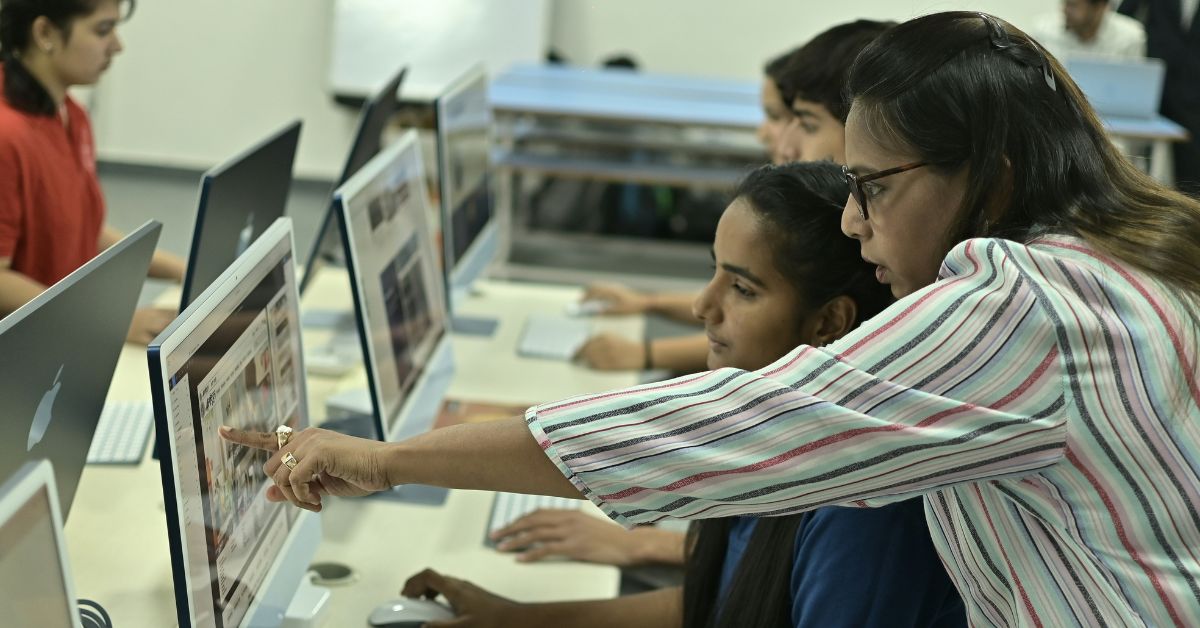
The answer lies in ‘AI For All’, a set of courses by IIT Madras, introduced in Hindi on SWAYAM Plus, making AI education more accessible to learners across India.
Introduced in May 2025 in collaboration with IIT Madras Pravartak, the initiative aims to democratise AI literacy by offering six free, beginner-friendly courses that require no prior coding experience: AI for Educators, AI in Physics, AI in Chemistry, AI in Accounting, Cricket Analytics with AI, and AI/ML using Python. The focus is on practical, real-world applications through hands-on exercises, case studies, and interactive learning.
The response has been overwhelming, with over 42,000 registrations in the first edition and more than 50,000 in the second. The launch of Hindi-language courses on 22 January 2026 marked another milestone, extending AI education to learners who are more comfortable studying in their native language.
AI For All: An inclusive educational blueprint
According to Prof R Sarathi, Dean (Planning), IIT Madras, learning in one’s mother tongue improves conceptual understanding and confidence. The initiative particularly targets learners from tier 2 and tier 3 cities, where access to quality technical education remains limited. By combining AI-assisted translation with human review, the programme ensures that the content remains accurate, engaging, and easy to understand.
IIT Madras Pravartak has also adopted a human-centric approach by introducing AI concepts gradually, reducing the fear often associated with emerging technologies.
As AI reshapes industries, IIT Madras’ bilingual initiative reflects a broader vision: making AI education inclusive, practical, and accessible, ensuring that learners from diverse academic backgrounds and linguistic communities can confidently participate in India’s growing AI ecosystem.
Making AI multilingual
India has set an ambitious goal of increasing its higher education Gross Enrolment Ratio (GER) to 50 percent by 2035 and 65 percent by 2047. Meeting these targets will require accommodating an additional 37 million learners by 2035 and 66 million by 2047. Recognising the scale of this challenge, the government is exploring non-linear models of growth and leveraging technology to ensure equitable access to high-quality education for learners across the country.
In this context, making AI accessible is not only about teaching people how to use it; it is also about ensuring that AI understands the people it is meant to serve.
This is where initiatives like Project Vaani, led by the Indian Institute of Science (IISc), Bengaluru, and ARTPARK, complement efforts such as IIT Madras’ AI For All programme. While AI For All is focused on making AI education available in languages that learners are comfortable with, Project Vaani is working on the equally important challenge of making AI itself multilingual.
India is home to hundreds of languages and dialects, yet most AI systems have traditionally been trained on English or a handful of widely spoken languages. This creates a significant gap, as speech recognition systems, virtual assistants, translation tools, and conversational AI often struggle to understand the linguistic diversity of the country.
Project Vaani aims to address this by creating one of India’s largest open-source speech datasets. The project plans to collect over 150,000 hours of speech from nearly one million speakers across all 773 districts of India, carefully capturing diversity across languages, dialects, age groups, gender, education levels, and urban-rural populations. By making these datasets publicly available, the initiative hopes to accelerate the development of technologies such as automatic speech recognition, speech-to-speech translation, and natural language understanding that reflect how Indians actually speak.
The project goes beyond linguistic diversity by collecting speech from individuals with neurological, developmental, and cognitive conditions. Such datasets can help build speech technologies that work better for people with atypical speech patterns, making AI more inclusive rather than optimised only for the ‘average’ speaker.
Taken together, Project Vaani and IIT Madras’ AI For All illustrate two sides of the same challenge. One is lowering the barrier for people to learn AI, while the other is lowering the barrier for AI to understand people.
The broader implications extend beyond education or technology. More inclusive language models could improve access to healthcare, government services, digital banking, agriculture advisories, and online education for millions who are more comfortable communicating in regional languages.
As India builds its digital public infrastructure, ensuring that AI reflects the country’s linguistic and cultural diversity will be essential. In that sense, accessibility is no longer simply about translating interfaces; it is about creating AI that can both speak to India and listen to it.

Share Your Story Today, Shape Viksit Bharat Tomorrow
Got an idea, innovation, or experience that's making a difference? Share your story now and ignite India's transformation because your voice can drive the future forward!
Resources to Replicate This Idea
BUILD YOUR OWN INTERVENTION
Handpicked stories tailored just for you
Explore stories that inspire, inform, and ignite new ideas across tech, innovation, and real-world impact

Safe Access: India’s Community-Verified Digital Locator for HIV Prevention Services
Safe Access is a free, community-driven Indian platform that helps people locate verified PrEP and PEP providers nearby. By mapping...
Read More