
Turning Waste Into Carbon Assets: RenewCred's Digital Infrastructure for Climate Finance
RenewCred, a Bengaluru startup founded by Abhimanyu Rathi and Yogendra Panchal, uses IoT sensors, AI verification, and blockchain to turn agricultural waste into tradeable carbon credits — creating a new income stream for Indian farmers while building credible market infrastructure for climate action.
Updated on: 24 June 2026

Sector

Solution

Technology
AI
& 1 other

State of Origin
Disclaimer:
Impact Metrics
100,000 tonnes of CO₂e
equivalent emissions reduced, avoided, or removed.
22 projects
spanning multiple states through partners in Gujarat, Madhya Pradesh, Maharashtra, Tamil Nadu and Telangana.
93 scientists
from across 6 countries have helped develop RenewCred's methodologies, verification frameworks, algorithms and digital systems.
In the planning discourse around Indian cities, the peri-urban fringe — that sprawling, ambiguous zone where urban growth meets agricultural land — is usually discussed in terms of encroachment, land-use conflict, and transition. What is rarely discussed is its potential as a site of climate finance.
That is the gap RenewCred is beginning to close.
Founded in Bengaluru in May 2024 by Abhimanyu Rathi and Yogendra Panchal, RenewCred is a carbon credit platform that creates verified, market-tradeable environmental credits from climate action in rural and peri-urban landscapes. While the company’s first projects are rooted in agriculture, the model it has built has implications that extend far beyond the farm — into how Indian cities finance their climate transitions, how carbon markets can be anchored in verified local action, and how value can flow from urban buyers to rural producers.
The Urban Carbon Problem
Cities are responsible for a significant share of India’s greenhouse gas emissions, and urban local bodies, corporations, and developers are increasingly under pressure to demonstrate climate commitments — whether through ESG reporting, regulatory compliance, or net-zero pledges. The demand for carbon credits is growing. But the supply side has a credibility problem.
Global carbon markets have faced persistent criticism for issuing credits that do not represent genuine emissions reductions — projects that exist on paper but deliver limited verifiable impact. For urban buyers seeking offsets, this creates both a financial and reputational risk.
RenewCred was designed specifically to solve this. Co-founder Abhimanyu Rathi — a chemical engineering gold medallist with additional qualifications in environmental law and policy, and a former venture capitalist — identified the core problem not as a lack of climate action, but as a lack of market infrastructure to monetise it.
“Climate solutions were not failing because the science was weak,” he explains. “There were already people creating genuine environmental benefits. The bigger challenge was that there was no efficient market infrastructure. People were doing good work for the planet but had no way to monetise that impact.”
Building the Infrastructure First
Rather than rushing to market, RenewCred spent nearly two years in pre-launch development. The founders assembled a scientific advisory network of 93 researchers across six countries, working to develop methodologies, verification frameworks, and digital monitoring systems capable of producing credits that could withstand scrutiny.
This deliberate foundation-building is significant from an urban planning perspective. It mirrors the logic of infrastructure development: the value of a system is not in any individual project, but in the platform that makes many projects legible, verifiable, and tradeable.
The platform publicly launched in 2026, with the first carbon credits issued in April of that year. As of now, RenewCred has 22 projects in its pipeline, with seven progressing through formal registration and three already issuing credits — spanning biochar production, electric mobility, solar energy, compressed biogas, livestock methane reduction, and clean cooking solutions.
The Technology Stack: Making the Invisible Legible
The core technical challenge in carbon markets is measurement — converting diffuse, invisible environmental processes into standardised, auditable units of value. RenewCred’s answer is a layered Digital Monitoring, Reporting and Verification (DMRV) system built around IoT sensors and a three-tier AI and machine learning framework.
In biochar projects — among the first to generate credits within the platform — IoT devices monitor the pyrolysis process in real time, tracking feedstock weight, temperature, and pressure. This continuous data stream replaces the periodic paper-based reporting that has historically made carbon markets vulnerable to manipulation or error.
The AI framework processes this data in three stages. The first layer performs data quality checks, flagging incomplete readings or inconsistencies. The second applies verified emissions calculations and project methodologies to estimate actual climate impact. The third looks for anomalies that might indicate errors or manipulation.
Before any credits are issued, an independent third-party verifier reviews the project findings. Credits are then registered on a blockchain-enabled registry — a distributed, tamper-resistant ledger that records every credit’s issuance, transfer, and retirement, preventing double-counting and providing urban buyers with a clear, auditable provenance trail.
This architecture matters for cities. When a municipal corporation, real estate developer, or urban enterprise purchases a carbon credit to offset its emissions, it needs confidence that the credit is real. RenewCred’s stack is designed to provide that confidence at scale.
The Urban-Rural Value Chain
Biochar production, one of RenewCred’s flagship project types, illustrates how the platform creates a value chain that connects urban demand to rural climate action.
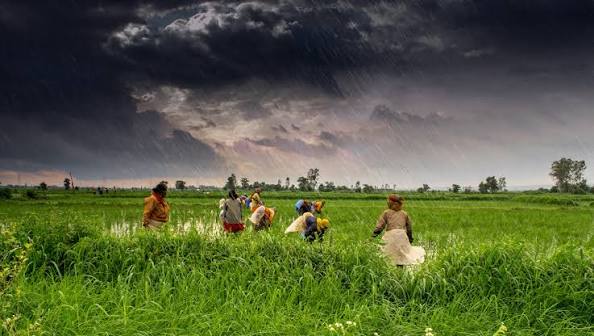
Agricultural residue — the stalks, leaves, and biomass left after a harvest — is one of India’s most persistent open burning problems. The resulting air pollution is an acutely urban issue: particulate matter from field burning regularly degrades air quality in cities across North and Central India. RenewCred’s model creates a financial incentive to end that burning, by making the residue economically valuable in a different form.
When residue is processed through pyrolysis — heating organic matter in a low-oxygen environment — it becomes biochar, a carbon-rich material that locks atmospheric carbon into the soil for extended periods. The climate benefit is real, measurable, and durable. When properly verified, it generates carbon credits that urban buyers can purchase.
Smaller artisanal biochar systems cost around ₹5 lakh to establish. Industrial-scale facilities using advanced pyrolysis technology can cost up to ₹5 crore. These investments sit at the boundary of urban and rural capital — they require the kind of patient climate finance that cities, development finance institutions, and ESG-driven investors are increasingly positioned to provide.
The Economic Geography of Impact
The projects currently active in RenewCred’s ecosystem include Arka Carbon in Madhya Pradesh and Maharashtra, JEET Agrotech in Gujarat, Konwert Motors in Tamil Nadu, and Bartronics India Limited in Hyderabad — a distribution that reflects the platform’s ambition to operate across India’s varied climate and agricultural geographies.
The platform currently engages between 200 and 220 direct participants, with benefits extending to nearly 300 people, including women and members of marginalised communities involved in operating project infrastructure. Participating farmers can expect to earn between ₹30,000 and ₹45,000 in additional annual income — a meaningful supplement in rural economies where margins are thin and incomes are seasonal.
This year, the platform expects to generate approximately 100,000 carbon credits — equivalent to 100,000 tonnes of carbon dioxide either reduced or prevented from entering the atmosphere. As the portfolio scales, the monitoring and documentation costs per project are expected to fall, making the model increasingly viable for smaller projects and more marginal producers.
What This Means for Urban Climate Planning
For urban planners and policy makers, RenewCred’s model points toward a vision of the city that extends beyond its administrative boundary. India’s cities cannot achieve their climate goals in isolation. The air quality that urban residents breathe, the carbon that needs to be sequestered, and the land-use pressures that shape urban expansion are all deeply entangled with the agricultural and rural systems that surround them.
A robust, trustworthy carbon market — one built on verifiable science, continuous digital monitoring, and transparent registries — creates the connective tissue for a different kind of urban-rural relationship. Cities become buyers of rural climate action. Farmers and rural communities become climate service providers. And the infrastructure that makes this exchange possible — platforms like RenewCred — becomes as important to urban sustainability as the more visible green infrastructure of parks, transit, and energy systems.
“Farmers should not be treated as passive beneficiaries,” Rathi says. “They should become climate warriors. Whether it is biochar, regenerative agriculture, agroforestry or better water management, they should be leading these solutions.”
That reframing — from passive periphery to active climate producer — may be one of the most consequential shifts in how India’s cities think about the land and communities that surround them.
Share Your Story Today, Shape Viksit Bharat Tomorrow
Got an idea, innovation, or experience that's making a difference? Share your story now and ignite India's transformation because your voice can drive the future forward!
Disclaimer:
Resources to Replicate This Idea
BUILD YOUR OWN INTERVENTION
Handpicked stories tailored just for you
Explore stories that inspire, inform, and ignite new ideas across tech, innovation, and real-world impact

How AI Diagnostics Are Reaching India’s Frontline Health Workers
AffEx equips rural health workers with an AI-powered point-of-care screening kit — testing hemoglobin, blood pressure, ECG, and cardiac and...
Read More