
Wearable Biosensors and Mobile Decision Support: Real-Time Labour Monitoring at One-Third the Cost
A wearable sensor patch and mobile app track fetal and maternal vitals during labour, automate records and trigger complication alerts. Priced at one-third of conventional machines, the system supports nurse-led deliveries and has monitored over 60,000 mothers across 250+ facilities.
Updated on: 23 September 2026

Sector

Solution
Neonatal Care

Technology
IoT

State of Origin
Disclaimer:
Impact Metrics
2 lakh+ pregnancies
have been monitored using Janitri's technology.
8,000+ lives
saved through timely interventions.
Continuous monitoring
of fetal and maternal health enables early detection of labour complications.
Maternal and newborn deaths are among the most preventable losses in healthcare. WHO data cited in the coverage shows that a maternal death occurred almost every two minutes in 2020, with nearly 95% in low and lower-middle-income countries. India’s maternal mortality ratio fell 26.9% between 2013 and the Sample Registration System report of 2019, but the numbers remained a serious concern.
The causes are structural. India records about 26 million births a year against roughly 70,000 registered obstetricians and gynaecologists. The Federation of Obstetrics and Gynaecological Societies of India estimates a 40% shortfall of specialists. Staff nurses assist about 80% of deliveries in countries like India and must record labour progress on a partograph, which is hard to do well without training. Conventional cardiotocography (CTG) machines are expensive, non-portable, restrict the mother’s movement and depend on a gynaecologist to interpret the traces.
The Intervention
Janitri was founded by Arun Agarwal, who grew up in Rajasthan’s Alwar district and had seen relatives and neighbours lose mothers and newborns around childbirth. He spent time on weekends visiting about 100 public and private hospitals, speaking with women, nurses, gynaecologists and technicians. He found missing infrastructure, overworked and undertrained staff, and poor connectivity. His idea received a one-year fellowship from the Biotechnology Industry Research Assistance Council (BIRAC) in 2015, and the foundation was registered in 2016.
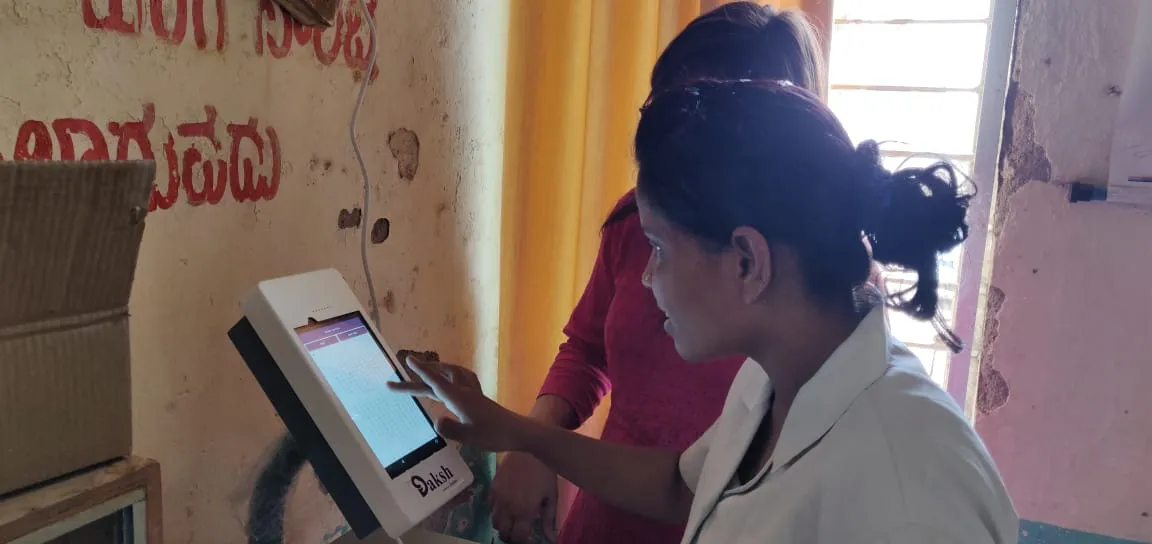
The solution has two parts. Keyar is a wearable, battery-powered patch with sensors, placed on the abdomen during labour. It records fetal heart rate, uterine contractions and maternal pulse. Daksh is a mobile and tablet application that receives the readings and generates the partograph automatically.
How the Technology Works
The system turns a manual, error-prone process into continuous, guided monitoring:
- Non-invasive sensing. The patch lets the mother move, unlike conventional CTG setups.
- Automated partograph. Vitals flow directly into the app, so nurses no longer fill in charts after delivery.
- Protocol-driven prompts. The app reminds staff to check labour vitals as per the WHO intrapartum protocol. One nurse reported an alarm every 30 minutes for fetal heart rate checks.
- Algorithmic alerts. An inbuilt algorithm flags complications.
- Remote oversight. Live data can be viewed on a doctor’s phone from anywhere. If a patient is referred, the labour record travels with her so the receiving hospital can prepare.
The device costs Rs 45,000, about one-third the price of a CTG machine.
Impact
Deployment has grown from 115 hospitals and over 25,000 women monitored in 2019. By 2023, the product was in more than 250 hospital settings across India, Kenya and Brazil, with over 60,000 mothers monitored and more than 1,000 staff trained. The founder also secured a Rs 1 crore deal on Shark Tank India.
Early feedback was strong. A Bengaluru obstetrician found the device as effective as CTG machines. She called it cost-effective, portable and well suited to rural labour wards. A nurse at a Tumkur district facility said her workload fell because the partograph is generated automatically and the gynaecologist can review data remotely. A Daksh dashboard has also been used at the National Health Mission Karnataka office.
Relevance and Importance
Because India has too few specialists, the practical route to safer childbirth runs through the nurses who already conduct most deliveries. The intervention supports them with real-time guidance and lets a specialist supervise several labour wards remotely. A lower price and a portable form factor make the technology viable in rural and resource-poor facilities where CTG machines are rarely available. Digitised records also strengthen referrals, a common failure point in emergencies.
Alignment with India’s Development Goals
- SDG 3 and national health priorities: Earlier detection of complications serves the goal of reducing maternal and neonatal mortality, a long-standing focus of the National Health Mission.
- Equity of access: Low cost and portability help extend quality obstetric care beyond urban tertiary hospitals.
- Workforce multiplication: Decision support lets limited specialist capacity supervise more facilities.
- Digital health: Structured, shareable labour data supports India’s push to digitise health records.
- Innovation ecosystem: The journey from a BIRAC fellowship to deployment in multiple countries shows what the public-supported startup pipeline can deliver.
Limitations and Way Forward
The sources report adoption and user feedback but not the number of deaths prevented or independently audited clinical outcomes, so rigorous evaluation is a natural next step. Expanding coverage while keeping training, connectivity and device maintenance reliable will determine whether the model works at the scale of India’s public health system.
Share Your Story Today, Shape Viksit Bharat Tomorrow
Got an idea, innovation, or experience that's making a difference? Share your story now and ignite India's transformation because your voice can drive the future forward!
Disclaimer:
Resources to Replicate This Idea
BUILD YOUR OWN INTERVENTION
Handpicked stories tailored just for you
Explore stories that inspire, inform, and ignite new ideas across tech, innovation, and real-world impact


Pilotless Cargo Flights with Zero Failures: Reimagining Diagnostic Logistics in Indian Cities
An energy-efficient autonomous aircraft combining vertical take-off with fixed-wing cruise has completed over 1,000 flights carrying diagnostic samples between hospitals,...
Read More