A Revolution for India’s Welfare: How AI is Helping 7.6 Million Families Access Public Schemes
Welfare schemes are a vital lifeline for millions of India’s poor, but accessing them can be difficult due to their lengthy application processes. Harnessing the power of AI, Haqdarshak Empowerment Solutions has built a user-friendly interface to make this easier. This unlocks benefits with a far-reaching impact on livelihoods and, in turn, economic growth.
Updated on: 24 March 2026

Sector
Others

Solution
Public Welfare

Technology

State of Origin
Impact Metrics
>$2.2 billion in benefits
unlocked for citizens via government schemes.
36,000 women employed
as agents to help users search and apply for schemes.
Benefits for employers
including in task completion, recruitment, and marketing.
Life-saving COVID relief
made available to marginalized communities during the pandemic.
How ambitious is the goal to eradicate generational poverty in India? Aniket Doegar, the founder of Haqdarshak Empowerment Solutions, envisions a considerable move towards this vision by 2030 – empowering 100 million families with access to welfare and financial schemes. His targets are clear; this empowerment means financial inclusion, climate resilience, livelihood creation, and social protection.
Aniket’s dedicated efforts towards this goal over the last 10 years are an exceptional case study in what it truly means to include India’s most vulnerable, and integral, populations in the vision of development. When it comes to Haqdarshak, technologies like Artificial Intelligence are not just reserved for the elite – these are tools that can exponentially equip India’s underserved communities with the financial and social capital required to evolve in tandem with a changing world.
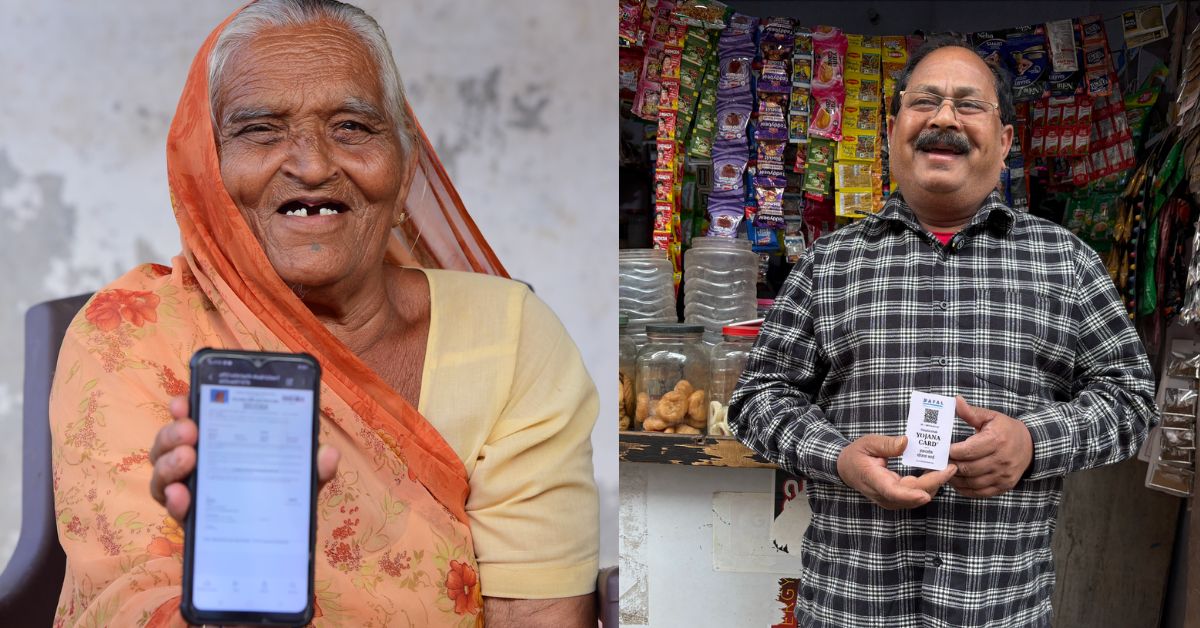
Aniket founded Haqdarshak in 2015 to provide an AI-powered interface for accessing and testing eligibility under welfare schemes; this enterprise has already brought material benefits to 7.6 million Indian families.
What gave rise to this idea

Despite the considerable strides that India has made in access to consumer goods and information technology since liberalization, generational poverty remains a challenge that plagues millions of its families. Successive governments have used an array of welfare schemes to mitigate this challenge, supporting the toiling masses in core areas such as health, education, and agriculture.
However, the utilization of such schemes by the poor is limited due to a lack of awareness, difficulty accessing the prerequisite documentation, and political–bureaucratic heterogeneity across India’s states and union territories. It was in the hopes of bridging these gaps that Haqdarshak initiated operations.
Aniket, an alumnus of the Teach for India Fellowship who had been working in the social impact ecosystem for years, noted the limited reach of several government schemes intended to empower the Indian poor. He observed that some urban families accessed fewer than 50% of the welfare programs for which they were eligible for a variety of reasons. This was undesirable as access to welfare can endow low-income groups with the socioeconomic capital needed to build sustainable livelihoods.
In the years that would follow, Aniket and his team set up an integrated online platform to simplify and demystify the process of viewing and accessing over 5,000 welfare schemes across India. Their dedication to accessibility has meant that this service is provided free of charge to end users and is available in multiple Indian languages.
What the organization provides

Haqdarshak works with four core components, with its key priorities being tech-driven ease of use and human-driven support.
The first component, and their largest investment, has been in the aforementioned platform that consolidates information on schemes covering a range of areas: health insurance, pensions, agricultural subsidies, educational scholarships, and more. This database is available on both the Haqdarshak app as well as on mobile devices.
The second component is an AI-powered search engine that combs this database to gauge eligibility for various schemes. Through voice, text, and local languages, citizens discover programs, government schemes, what they are eligible for, and how they can access them.
To run this engine, a user only needs to enter their personal information and location. The search results provide information on what documentation is needed to apply for each displayed scheme. The same platform also has provisions for grievance logging and tracking. This makes it straightforward for candidates to discover and begin to access public resources that have been legally dedicated for their benefit.
Thirdly, recognizing that many users have difficulties related to tech-awareness and general literacy, Haqdarshak trains agents – 70% of whom are women – to assist users in person. These agents, who come from the same income groups as users, often go from door to door and help users procure the documentation and ID proofs required for scheme eligibility.
Finally, the entire endeavor is operated within a B2B2C framework, partnering with corporate entities, governments, and civil society members across the board to support its operations while directing pressure away from end users.
This is achieved by using powerful impact analytics — time saved in the workplace, benefits for recruitment, marketing insights, etc. — to show how employees who access social benefits create greater value for employers.
This approach works in tandem with laws that require employers to invest in employee wellbeing, ensuring that Haqdarshak’s work remains sustainable and stable in the long run.
Obstacles faced on the road
Aniket highlights that in the last few years, the advent of Aadhar and UPI payment schemes has helped make considerable strides in simplifying processes of public scheme access. However, challenges persist.
On the one hand, there are logistical problems such as delays in gathering documentation and IDs, which can make it difficult for users to apply for the schemes they find via the database. The provision of human agents to help has likely mitigated this difficulty, but not entirely overcome it.
He notes that extremely poor and marginalised citizens are often required to provide more documents and IDs. This, he opines, is a big structural challenge.
Additionally, in India, the matter of government scheme deliveries are State subjects. While the central government may announce programmes at the national level, their adoption and implementation are determined by individual states, unless mandated through Constitutional or nationwide systems such as Aadhaar or UPI. This results in significant variation across states, each with its own administrative priorities and delivery models.
Lastly, aligning perceptions among higher-income professionals leading corporate social initiatives can present a challenge. This is often influenced by the view that welfare schemes are primarily short-term in nature. To address this, a combination of supportive policy frameworks, public awareness efforts, and evidence-based studies highlighting the socio-economic and corporate value of welfare interventions is essential.

Measuring impact over a decade
Haqdarshak has, over the years, navigated these challenges well. Their work has received recognition across the world, from Shark Tank to the World Economic Forum. The value of all the schemes unlocked for users via the Haqdarshak database has exceeded $2.2 billion, distributed among at least 7.6 million Indian families and an additional 150,000 MSMEs.
Of the 52,000 agents working to spread awareness and assist Haqdarshak’s users, 36,000 are women. This means that nearly 70% of this workforce has seen the effects of female empowerment, gaining their own incomes and hence greater financial autonomy.
The largest area in which the organization has contributed (40% in terms of value added) has been health insurance, particularly during the COVID-19 pandemic, where marginalized communities such as tribal groups used it to secure life-saving medical support.
On balancing the notion that social welfare and financial gains are not fundamentally compatible, Aniket points to a conscious choice to register Haqdarshak as a private sector enterprise, and not a non-profit. He says a B2B model has helped them sustain, which is essential in scaling to their vision of reaching hundreds of millions and beyond.
The way forward
Aniket says that expanding participation among middle- and upper-income groups remains a critical lever in strengthening the uptake of welfare schemes. These, he adds, are key decision makers across corporates, policy, and technology ecosystems, so their perceptions are significant in influencing adoption.
While there continue to be demands for higher investment in social welfare, an oft-underaddressed concern is related to the permeability of the existing schemes. Haqdarshak aims to counter this hurdle directly by utilizing a sophisticated and yet free digital database and application system, connecting the masses to the resources owed them. Its sustainable financial structure suggests great potential for scaling in the future.
This, in turn, will increase the participation of the Indian working classes in its development story, boosting economic growth and living standards across the board.
Share Your Story Today, Shape Viksit Bharat Tomorrow
Got an idea, innovation, or experience that's making a difference? Share your story now and ignite India's transformation because your voice can drive the future forward!
Resources to Replicate This Idea

BUILD YOUR OWN
Do you want to know how this innovator scaled their idea, how much it cost them, and what resources/partnerships they deployed?
Click here.
Handpicked stories tailored just for you
Explore stories that inspire, inform, and ignite new ideas across tech, innovation, and real-world impact

AI-Enabled Gynaecological Care Expands Access to 400,000+ Women Across India
Pinky Promise is a chat-first, AI-assisted women’s healthcare platform delivering affordable, confidential gynaecological care at scale. Founded in 2022, it...
Read More