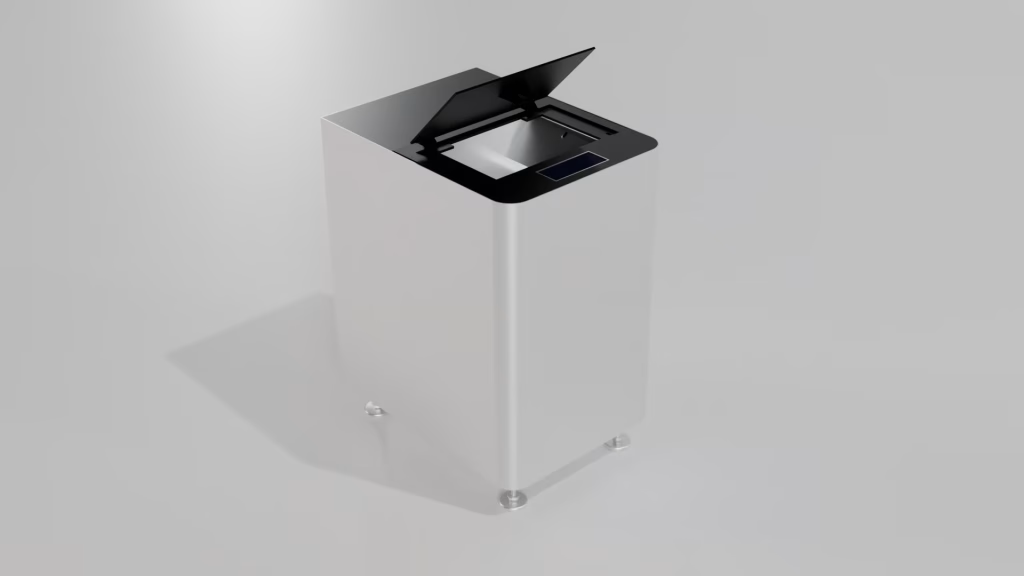

Affordable Respiratory Care for All: This Portable Capnograph Has Helped Monitor 10,000+ Patients at ~50% of the Usual Cost
Capnography, or the monitoring of CO2 levels, is crucial in respiratory care, but mainstream capnographs are neither cheap nor portable. RespiCOz, developed to fill this gap by Brainiac Healthcare, is a pocket-sized capnograph built for low-resource settings.
Updated on: 31 August 2026

Sector

Solution

Technology

State of Origin
Impact Metrics
300+ capnography units sold
as of August 2026.
10+ Indian states and 3 foreign countries
using RespiCOz.
250+ clinicians across 100+ medical settings
monitoring CO2 levels with RespiCOz.
For patients on ventilators, the continuous, non-invasive monitoring of carbon dioxide in the breath—also known as capnography—is strongly recommended. This is especially crucial in cases involving anesthesia or emergency medicine. Without it, the prediction of respiratory abnormalities can be very difficult.
However, most medical institutions in India lack capnographs. This is for three reasons: a lack of awareness, the limited availability of these devices, and high procurement costs.
What if this were not the case—what if a capnograph was accessible enough to be used in the most remote of villages? This was the question that led Ahmedabad-based Brainiac Healthcare Pvt Ltd. to launch RespiCOz in 2021. By separating the CO2 detection and processing features, this capnography device provides all the functionality of its competitors at a fraction of their cost.
How does RespiCOz work?
In India, many doctors do not monitor CO2 levels in the breath at all, instead relying on physical observation, chest movement, and pulse oximetry to predict respiratory complications. Unfortunately, these methods are not entirely reliable when patients present with esophageal intubation, circuit disconnection, or respiratory depression.
Mainstream capnographs in the market come in the form of large and heavy monitors. Due to their combining sensors, processors, displays, and batteries, they are expensive and thus not widely used in developing countries such as India.
Brainiac Healthcare’s solution is to make the CO2 sensor as small as possible and outsource the processing, battery, and display components to a regular smartphone. The company’s pocket-sized sensor, RespiCOz, uses non-dispersive infrared to measure a patient’s exhaled CO2 level and respiratory rate, then transmits this information to an app on the clinician’s phone via Bluetooth for analysis.
Funding for the innovation
Initially, RespiCOz was developed via bootstrapping from the founder, Krunal Prajapati, with an investment of INR 1.5 lakh.
Once a proof of concept had been prepared, the company won grants from a handful of incubators including BIRAC Testing Labs. These grants—together amounting to ~INR 28.6 lakh—were used to build further prototypes and test them at Anand Surgical Hospital in Ahmedabad.
Usage of the capnograph
As of August 2026, Brainiac Healthcare had sold more than 300 capnography units, helping doctors monitor the respiratory health of 10,000+ patients. In addition to reaching 10+ states in India, RespiCOz has also been exported to 3 foreign countries.
Altogether, with the help of 20+ channel partners, the startup has benefited 250+ clinicians across 100+ hospitals, clinics, and ambulance services.
Since RespiCOz is small and compact, it costs approximately 50% of a conventional capnography monitor. This makes it especially valuable in remote and resource-constrained settings.
Recognition in the press
In recognition of its innovation, Brainiac Healthcare has received positive coverage in various Gujarati news outlets including Ahmedabad Mirror, Gujarat Samachar, and Sandesh. It has also won an Innovation2Impact award from Gujarat Technological University.
How can RespiCOz’s impact be scaled?
Brainiac Healthcare faces the same challenges as most health tech startups. These include long waiting times for approval from the Central Drugs Standard Control Organisation (CDSCO), a shortage of manufacturing subsidies, and difficulties accessing credit.
By addressing these three limitations, policymakers can enable inventions such as RespiCOz to attract revenues faster. This, in turn, will reward innovation in health technology as a whole, creating benefits for both businesses as well as the general public.
Share Your Story Today, Shape Viksit Bharat Tomorrow
Got an idea, innovation, or experience that's making a difference? Share your story now and ignite India's transformation because your voice can drive the future forward!
Resources to Replicate This Idea
BUILD YOUR OWN INTERVENTION
Handpicked stories tailored just for you
Explore stories that inspire, inform, and ignite new ideas across tech, innovation, and real-world impact

How AI Diagnostics Are Reaching India’s Frontline Health Workers
AffEx equips rural health workers with an AI-powered point-of-care screening kit — testing hemoglobin, blood pressure, ECG, and cardiac and...
Read More