
How a Bio Swim Pond Startup Is Bringing Nature-Based Water Infrastructure to Indian Cities
A chartered accountant adapted Europe’s bio swim pond technology for India, creating chemical-free, self-cleaning swimming pools that use ecological filtration. The case explores how nature-based engineering can reduce water and chemical use while advancing sustainable urban infrastructure and biodiversity.
Updated on: 22 July 2026

Sector

Solution

Technology

State of Origin
Impact Metrics
100% chemical-free
water treatment, with chlorine or synthetic disinfectants
Cooler microclimates
around homes and buildings.
Significant reduction
in freshwater consumption over the pool's lifetime.
As Indian cities expand, the demand for recreational and residential water infrastructure is rising. Conventional swimming pools, however, come with significant environmental costs. They rely heavily on reinforced concrete, chlorine-based treatment systems, energy-intensive filtration, and frequent water replacement. Besides increasing operational costs, these systems consume large volumes of water and introduce chemicals that can affect both human health and surrounding ecosystems.
Against this backdrop, a nature-based alternative is emerging. Inspired by natural ponds and ecological water purification systems, bio swim ponds use biological processes instead of chemicals to keep water clean. While still a niche innovation in India, they demonstrate how ecological engineering can reshape urban water infrastructure, offering lessons for sustainable urban development.
One such example comes from Coimbatore, where chartered accountant Vikash Kumar transformed a personal challenge into a commercially viable urban sustainability solution.
Growing up in rural Tamil Nadu, Kumar learnt to swim in village ponds surrounded by native vegetation. Years later, when he wanted to build a swimming pool for his young son, he found himself dissatisfied with conventional options that depended on chlorine for water treatment. Concerned about skin irritation, respiratory effects, and the environmental footprint of chemical pools, he began exploring natural alternatives.
His research led him to bio swim ponds—a model already gaining popularity across parts of Europe. Recognising that these systems could be adapted for Indian climatic conditions, Kumar established Biosphere, a company that designs and builds natural swimming ponds using ecological filtration rather than chemical treatment. Today, the venture generates over ₹3 crore in annual revenue, serving homeowners, farmhouses, hospitality properties, and eco-tourism destinations across India.
More importantly, it demonstrates how nature-based engineering can become a practical component of sustainable urban infrastructure.
Technology: How Bio Swim Ponds Work
Unlike conventional pools that rely on chlorine or salt-based sanitisation, bio swim ponds function as living ecosystems.
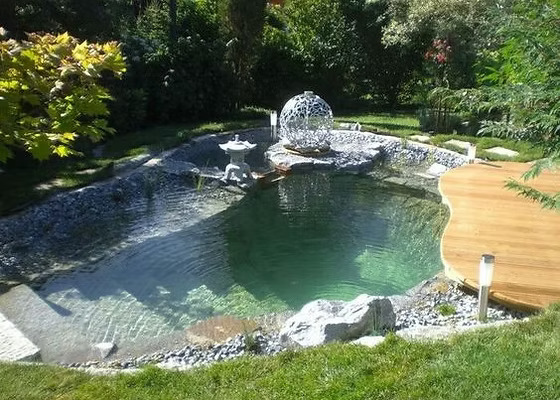
The system consists of two integrated zones: a swimming area and a regeneration zone. Instead of chemical disinfectants, water continuously circulates through layers of natural filtration media, where biological processes remove impurities before the water returns to the swimming area.
The filtration process combines multiple natural elements:
- Aquatic plants absorb nutrients that would otherwise promote algae growth.
- Gravel beds physically trap suspended particles while providing habitat for beneficial microorganisms.
- Beneficial bacteria colonise the gravel and naturally break down organic matter, preventing contaminants from accumulating.
- Low-energy circulation pumps ensure continuous water movement through the ecological filtration system.
Together, these components replicate the self-cleaning mechanisms found in healthy natural ponds.
Biosphere’s ponds are built primarily using locally sourced natural materials instead of concrete-heavy construction. According to the company, the systems require no chlorine, no synthetic filtration chemicals, and do not require annual draining or replacement of water. Depending on client requirements, the ponds can also incorporate waterfalls, koi habitats, natural streams, and landscaped ecological zones, blending recreation with biodiversity.
Each installation typically takes around 45 days to complete.
Adapting a Global Model for Indian Conditions
Bio swim ponds are not a new technology globally. Countries such as Germany, Austria, and Switzerland have used biological swimming ponds for decades as environmentally friendly alternatives to traditional pools.
The innovation in Biosphere’s model lies in localisation.
Rather than replicating European designs, the company adapted the technology to Indian climatic conditions, locally available materials, and consumer preferences. This localisation reduces construction costs, improves resilience under tropical weather conditions, and enables maintenance practices that are practical within Indian operating environments.
This represents an important characteristic of frontier technologies: innovation often comes not from inventing entirely new technologies, but from adapting proven global solutions to local contexts through engineering, ecological understanding, and design.
Environmental and Urban Development Impact
The significance of bio swim ponds extends well beyond recreational infrastructure.
Conventional swimming pools typically require continuous chemical dosing, high-energy filtration systems, and periodic draining for maintenance. Bio swim ponds eliminate or substantially reduce many of these resource-intensive processes.
Potential environmental benefits include:
- Elimination of chlorine and synthetic water treatment chemicals.
- Reduced energy consumption through low-power circulation systems.
- Lower embodied carbon by reducing dependence on reinforced concrete and synthetic liners.
- Minimal water replacement compared to conventional pools.
- Creation of habitats that support aquatic plants, insects, birds, and other biodiversity.
In increasingly dense urban environments, these ecological systems also create green-blue infrastructure—spaces where water bodies simultaneously deliver recreational, ecological, and climatic benefits.
Unlike conventional pools, which function as isolated engineered systems, bio swim ponds integrate landscape architecture, ecological restoration, and water management into a single intervention.
Business Model and Scaling
What began as a personal experiment has evolved into a specialised enterprise serving a growing niche market.
Biosphere primarily caters to:
- Individual homeowners
- Farmhouses
- Resorts
- Hospitality developments
- Eco-tourism projects
Each installation is custom designed, allowing clients to integrate aesthetic landscaping alongside functional ecological filtration.
While public information does not indicate institutional funding or venture capital investment, the company appears to have grown through customer demand and project-based revenues. This organic growth demonstrates an alternative pathway for climate-focused enterprises that scale through specialised expertise rather than mass manufacturing.
Although annual installations remain relatively limited compared to conventional pool construction, the model illustrates how nature-based infrastructure businesses can establish commercially viable markets around sustainability.
Broader Implications for Urban Development
The wider relevance of this technology lies not in replacing every swimming pool, but in demonstrating how ecological engineering can reshape urban infrastructure.
As Indian cities grapple with water scarcity, rising temperatures, biodiversity loss, and increasing demand for public open spaces, biological water systems could find applications beyond residential recreation.
Similar principles could inform:
- Urban parks featuring ecological ponds instead of ornamental water bodies.
- Sustainable resort developments that integrate natural water management.
- Residential townships seeking lower-impact recreational amenities.
- Educational campuses using living water systems for environmental learning.
- Community spaces that combine biodiversity conservation with recreation.
More broadly, the technology aligns with the growing emphasis on Nature-based Solutions (NbS) in urban planning. Rather than relying exclusively on mechanical systems, Nature-based Solutions leverage ecological processes to deliver infrastructure services such as water purification, cooling, habitat creation, and climate resilience.
For Indian cities, where climate adaptation increasingly intersects with urban design, such approaches could complement conventional engineering rather than replace it.
What This Means for Frontier Technologies in India
Bio swim ponds illustrate an important shift in how frontier technologies are being understood.
Frontier innovation is often associated with artificial intelligence, robotics, drones, or advanced materials. Yet ecological engineering—combining biology, environmental science, landscape architecture, and low-energy mechanical systems—also represents a frontier technology domain because it applies scientific understanding to create more sustainable infrastructure.
The Biosphere model demonstrates several characteristics increasingly relevant for India’s innovation ecosystem:
First, it shows how international technologies can be successfully adapted to local environmental conditions rather than simply imported.
Second, it highlights the growing commercial viability of climate-positive infrastructure, where environmental benefits become part of the product value rather than an external outcome.
Third, it reinforces the importance of interdisciplinary innovation. The technology sits at the intersection of ecology, civil engineering, water management, architecture, and sustainable design, reflecting the integrated thinking increasingly required to address urban challenges.
Finally, it suggests that future urban infrastructure need not always become more technologically complex. In some cases, the most resilient systems combine modern engineering with ecological processes that have functioned naturally for centuries.
As India expands its focus on sustainable urbanisation, nature-based technologies such as bio swim ponds offer a compelling example of how biological systems can be integrated into built environments. While still an emerging market, their broader significance lies in demonstrating that ecological infrastructure can simultaneously support recreation, biodiversity, resource efficiency, and climate resilience. For urban planners, developers, and policymakers, they represent a practical example of how frontier technologies can move beyond digital innovation to reshape the relationship between cities and the natural systems on which they ultimately depend.
If you’d like, I can also adapt this to match the exact tone and structure of your previous NFTR case studies (Education and Healthcare), with sections like Challenge, Technology, Implementation, Impact, Scalability, and Policy Implications for consistency across the repository.
Share Your Story Today, Shape Viksit Bharat Tomorrow
Got an idea, innovation, or experience that's making a difference? Share your story now and ignite India's transformation because your voice can drive the future forward!
Resources to Replicate This Idea
BUILD YOUR OWN INTERVENTION
Handpicked stories tailored just for you
Explore stories that inspire, inform, and ignite new ideas across tech, innovation, and real-world impact


How AI Diagnostics Are Reaching India’s Frontline Health Workers
AffEx equips rural health workers with an AI-powered point-of-care screening kit — testing hemoglobin, blood pressure, ECG, and cardiac and...
Read More