How a Student Hovercraft Project Became India's Defence-Tech Backbone
ideaForge, India’s pioneer indigenous UAV manufacturer, builds full-stack drones — airframes to autopilots — for defence, homeland security, and civil use. DGCA-certified, NATO-listed, and combat-deployed in Operation Sindoor, with over 1 million operational flights completed.
Updated on: 27 August 2026

Sector

Solution

Technology

State of Origin
Disclaimer:
Features ‘as is’ submissions and neither constitutes endorsement, certification, recommendation, or validation by NITI Aayog nor makes NITI Aayog liable in any manner.
Impact Metrics
Over 1,000,000
operational flights completed.
Ranked 3rd globally
among dual-use drone manufacturers (DRONEII, 2024).
Every 3 minutes
an ideaForge drone takes off.
61 patents granted
out of the 112 filed.
From a Student Idea to a National Response
ideaForge began in 2007 as a student project at IIT Bombay, when one of its co-founders wanted to build a hovercraft and fly it over Powai Lake. This campus idea might have died down quickly if it weren’t for a major event in the history of the nation, which turned out to be an inflection point in ideaForge’s journey — the 26/11 Mumbai terror. Watching India respond to the crisis with no indigenous UAV surveillance capability, the founders redirected their work toward a specific gap: aerial reconnaissance for defence and homeland security. By 2009, that redirection had already produced results — the company built what was then the world’s smallest and lightest autopilot, at roughly 10 grams, half the weight of the nearest competitor, and became the first in India to indigenously develop and manufacture vertical take-off and landing (VTOL) UAVs.
Building an Ecosystem Before Building a Company
The more consequential decision came earlier than the products themselves. When ideaForge started, none of the components that go into a drone were commonly available in India — no local autopilots, communication systems, or ground control stations to source and assemble. Rather than import and integrate, the founders chose the harder route of building the full stack from first principles: airframes, autopilots, payloads, communications, and ground control, developed in-house over nearly two decades. This was less a strategic preference than a necessity, but it shaped everything that followed — a company that had to build its own supply chain ended up owning it, which is now framed internally as one of its sharpest competitive advantages in a market shifting from selling hardware to selling mission platforms.
The Architecture of Situational Awareness
ideaForge’s technology is built to answer one question in real time: what is happening on the ground, right now. Its UAVs combine sensors, onboard intelligence, and autonomous flight to capture information and relay it securely to operators, who can then assess risk and act faster. The company has since layered on capabilities like GNSS-denied operations, collision avoidance for all-weather flying, LiDAR-based sensing, and AI-driven image recognition — built for reliability when human intervention isn’t practical, whether that’s a contested electronic-warfare environment or a disaster zone with no clear ground truth.
From ISR to Combat-Ready: The Product Suite
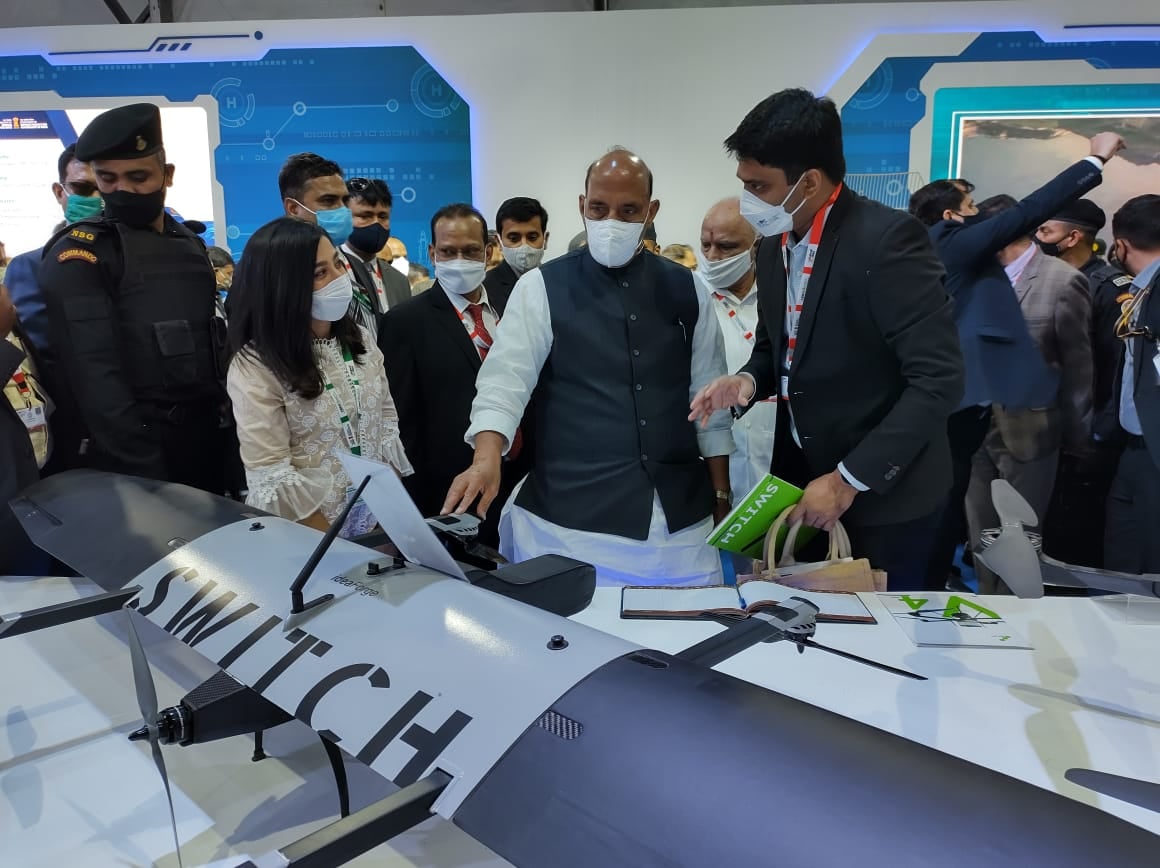
That reliability has been tested formally. Products including the Q4i, NETRA V3+, Q6, and SWITCH hold Type Certification from the DGCA, and SWITCH and Q6 have been assigned NATO stock numbers alongside “Fit for Indian Military Use” certification from the DGQA. Field-testing has taken the platforms from the Himalayan high-altitude terrain to the Thar Desert’s heat and, most recently, to Fairbanks, Alaska, where SWITCH and NETRA V4 Pro were flown with the U.S. Army’s Arctic Drone Integration Cell in temperatures as low as -30°F — ideaForge is the only drone company to have tested systems at both poles. The company has also begun extending beyond surveillance into combat and logistics: ZOLT, its tactical platform, is designed for long-range ISR and precision payload delivery.
Proof Under Fire: Operation Sindoor
The clearest validation of that two-decade trajectory came during Operation Sindoor, when the Indian Army deployed ideaForge platforms already inducted into service after rigorous field trials for urgent ISR and post-strike assessment. What began as a response to a 2008 security failure had, by this point, become embedded infrastructure for exactly that kind of operation — a closing of the loop the founders set out on seventeen years earlier.
Beyond Defence: Civil and Environmental Applications
The same core technology has moved into civil use with comparatively little modification. In partnership with C-DAC, ideaForge’s drones are being integrated into India’s emergency response network (Dial 112). Forest departments use them to detect illegal logging, poaching, and sand mining; last year, UAVs enabled early fire detection in the NNTR forest, supporting the safe relocation of tigers without habitat disturbance. The platforms have also supported one of the world’s largest mapping missions under the SVAMITVA scheme, and provided crowd-management surveillance at large religious gatherings such as the Pandharpur and Kanwar Yatras.
Economic Footprint and Global Recognition
ideaForge now employs over 500 people and has filed 112 patents, 61 of which have been granted. Its drones complete over a million operational flights, with a customer base spanning the Indian Armed Forces, state police, disaster response agencies, and enterprise clients including Adani, Vedanta, and Mahanadi Coalfields. That footprint is beginning to extend internationally: the company was ranked third globally among dual-use drone manufacturers by DRONEII in 2024, trained NATO personnel at the U.S. National Test Pilot School, and — notably — has a pilot order from the Lamar Consolidated Independent School District in Texas to deploy SWITCH and Q6 V3 UAVs for school surveillance.
Compounding, Not Breakthrough
For CEO Ankit Mehta, the company’s growth doesn’t read as a series of breakthroughs. “Entrepreneurship, for me, has never been a story of sudden breakthroughs — it’s been about what I call compounding success,” he says. “From the outside, progress often looks invisible, but underneath, you’re compounding capabilities every single day.” That framing traces back to the company’s leanest years: between 2009 and 2015, ideaForge operated without raising equity, building products through small projects, grants, and early customer revenue — including one stretch when a key investor’s cheque fell through and Mehta took a short corporate job to build a financial cushion before returning to the company with almost no safety net.
Share Your Story Today, Shape Viksit Bharat Tomorrow
Got an idea, innovation, or experience that's making a difference? Share your story now and ignite India's transformation because your voice can drive the future forward!
Disclaimer:
Features ‘as is’ submissions and neither constitutes endorsement, certification, recommendation, or validation by NITI Aayog nor makes NITI Aayog liable in any manner.
Resources to Replicate This Idea
BUILD YOUR OWN INTERVENTION
Handpicked stories tailored just for you
Explore stories that inspire, inform, and ignite new ideas across tech, innovation, and real-world impact

Pilotless Cargo Flights with Zero Failures: Reimagining Diagnostic Logistics in Indian Cities
An energy-efficient autonomous aircraft combining vertical take-off with fixed-wing cruise has completed over 1,000 flights carrying diagnostic samples between hospitals,...
Read More