Engineering Independence: Astrek Innovations and India's Rehabilitation Challenge
Kochi-based Astrek Innovations is transforming rehabilitation with robotic exoskeletons that help people with lower-limb disabilities regain mobility while reducing treatment costs, increasing therapy capacity, and strengthening India’s homegrown medical technology ecosystem.
Updated on: 31 July 2026

Sector

Solution

Technology

State of Origin
Impact Metrics
69+ patients
with stroke and spinal cord injuries have completed rehabilitation using Astrek's robotic exoskeleton.
18–19 rehabilitation centres
including facilities in Japan, have adopted Astrek's technology.
₹1.5–2 crore cost barrier addressed
by providing an indigenous alternative to imported robotic rehabilitation systems.
20% of manufacturing roles
are currently filled by persons with disabilities, with a target of increasing this to 40–60% within one year.
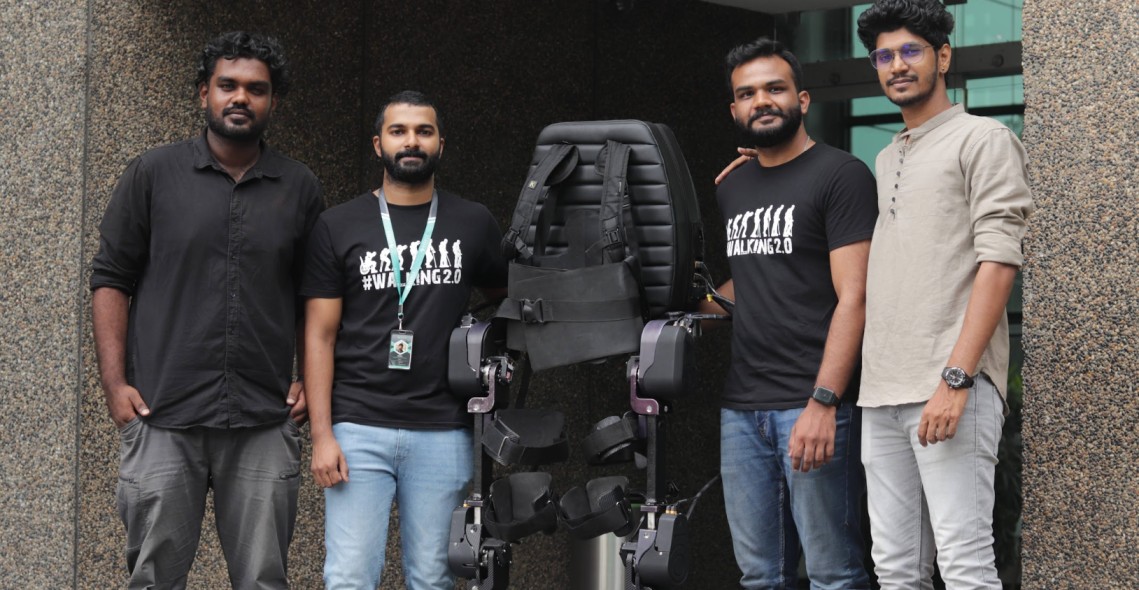
Astrek Innovations was founded in Kochi in 2018 to help people with lower-limb disability walk again through better rehabilitation.
The idea grew out of a personal experience for co-founder Robin Kanattu, whose grandfather lost his ability to walk because he never received proper rehabilitation. Robin and his co-founder Alex M Sunny saw the same pattern repeat itself among many people with stroke or spinal cord injury while volunteering with an NGO that built simple assistive devices. Realising this was a much larger problem than any one device could solve, they decided to build a proper, lasting solution instead.
Astrek’s work is addressing a growing gap in healthcare delivery. The World Health Organization estimates that around one in six people globally, i.e approximately 1.3 billion people, live with a significant disability. In India, the 2011 Census recorded 26.8 million persons with disabilities (2.21% of the population), many of whom continue to face barriers in accessing timely and affordable rehabilitation services.
Engineering an exoskeleton
Astrek’s main product is a wearable robotic device that fits around a patient’s body like an exoskeleton, with motors at the joints that power movement. In the early stages, the device simply helps the patient stay stable. Over time, it adds resistance so the patient can build muscle and bone strength, in much the same way strength training works at a gym.
The company holds one granted patent for a stable mechanical system that needs fewer sensors to keep patients upright, along with a second, pending patent for making the entire device modular, down to the wiring, so that parts can be swapped like building blocks. The team has also spent six years collecting walking data from healthy people, which they use to predict a natural walking pattern for each patient based on their body size and shape. A dashboard that lets doctors track patient progress over time is also in the works.
The device addresses two connected problems. The first is that rehabilitation is highly labour-intensive: safely moving a patient’s legs often needs two or three staff members, which makes it expensive, risky, and slow, and limits how many patients a centre can treat.
The second is cost. Imported rehabilitation devices run to about ₹1.5–2 crore, giving hospitals a poor return on investment, and servicing them is difficult since they come from abroad. Because of this, Astrek chose to sell to rehabilitation centres first rather than directly to patients, reasoning that India does not yet have a strong culture of paying for rehabilitation or assistive technology, so building trust through hospitals made more sense. The modular design tackles both problems at once: standard parts keep manufacturing costs down, and a broken part can simply be swapped out rather than repaired on site.
Building deep-tech against the odds
In building Astrek, Robin and Alex have navigated a complex ecosystem where investors were mostly drawn to software startups that promised fast returns, leaving little funding for hardware research, so the team relied on their own effort and on foreign grants from countries like Japan, Chile, the UAE, Korea, and Israel.
Finding the right people was also difficult, since the work needs robotics engineers, embedded systems experts, and medical knowledge all at once, a rare combination to find in one place. As a result, the team had to bring in several advisors along the way. For a long time, certification rules were unclear, with different authorities giving conflicting advice on what was required. Building and testing the hardware itself took many rounds, since results in the lab do not always hold up in the real world. On top of this, India’s limited local manufacturing for precision parts meant the team had to import motors and batteries, which brought customs delays and duties that made timelines hard to predict.
Measuring impact beyond patients
So far, more than 69 patients, mostly people with stroke or spinal cord injury, have used Astrek’s device across roughly 18 to 19 rehabilitation centres, including some in Japan. Although these numbers are still modest, they reflect the realities of a deep-tech medical startup navigating lengthy product development and regulatory approval. More importantly, the intervention demonstrates how robotics can make rehabilitation more accessible by reducing the physical burden on therapists, increasing the number of patients that rehabilitation centres can serve, and lowering dependence on expensive imported equipment.
To measure impact, the team relies on the Berg Balance Test along with checks on hip strength and overall stability before and after treatment. At present, Astrek rents its device to rehabilitation centres while working towards CDSCO certification, which is required to manufacture and sell medical devices in India. About 20% of the company’s metal-cutting and manufacturing work is already done by persons with disabilities, and the team hopes to raise this to 40–60% within a year, including through discussions with government bodies in the UAE to bring more people with disabilities into the workforce.
Enabling innovation
Astrek has grown largely on the strength of foreign grants, since Indian investors have shown less appetite for funding early-stage hardware research. Certification has improved in recent years, as bodies like CDSCO, ICMR, and BIRAC now coordinate more closely than they once did. Going forward, more domestic funding for hardware R&D, simpler customs processes for parts not yet made in India, and stronger local precision manufacturing would go a long way in reducing the costs and delays that startups like Astrek continue to face.
Beyond mobility: why Astrek matters
India’s population is ageing, while the demand for rehabilitation is expected to increase faster than the availability of trained physiotherapists. Astrek’s work speaks directly to this challenge. By building an Indian alternative to expensive imported rehabilitation devices, the company is reducing costs while strengthening domestic capabilities in medical robotics and precision manufacturing. Its decision to employ persons with disabilities within its own production process further extends its impact beyond healthcare by creating more inclusive livelihood opportunities.
More broadly, Astrek illustrates how indigenous health technologies can contribute to India’s long-term development priorities. Better access to rehabilitation improves quality of life, supports greater economic and social participation among persons with disabilities, and reduces pressure on an already constrained healthcare system. In doing so, the intervention contributes to Sustainable Development Goal (SDG) 3 (Good Health and Well-being) by expanding access to rehabilitation services, SDG 9 (Industry, Innovation and Infrastructure) by promoting indigenous medical innovation and manufacturing, and SDG 10 (Reduced Inequalities) by improving mobility and inclusion for persons with disabilities. Rather than viewing rehabilitation as a niche healthcare service, Astrek demonstrates how assistive technologies can simultaneously strengthen healthcare delivery, foster technological self-reliance, and advance inclusive development.
Share Your Story Today, Shape Viksit Bharat Tomorrow
Got an idea, innovation, or experience that's making a difference? Share your story now and ignite India's transformation because your voice can drive the future forward!
Resources to Replicate This Idea
BUILD YOUR OWN INTERVENTION
Handpicked stories tailored just for you
Explore stories that inspire, inform, and ignite new ideas across tech, innovation, and real-world impact

Safe Access: India’s Community-Verified Digital Locator for HIV Prevention Services
Safe Access is a free, community-driven Indian platform that helps people locate verified PrEP and PEP providers nearby. By mapping...
Read More