How Electric Boats Cleared 42 Tons of Waste in Umiam Lake, Meghalaya
India has thousands of water bodies, but most of these are heavily polluted, posing threats to both public health and tourism. Clear Robotics of Bengaluru is using its fleet of remotely controlled electric boats to clear them of waste while also safeguarding operator wellbeing.
Updated on: 31 August 2026

Sector

Solution

Technology

State of Origin
Impact Metrics
100+ tons of waste removed
across India, Singapore, the Philippines, and the UAE.
25-boat fleet
powered with electricity rather than diesel.
Up to 95% reduction in fuel costs
through electric boat operation.
The pollution of water bodies in India is a concern that has remained unresolved for decades. Not only does it endanger human health and aquatic ecosystems but it also reduces the visual appeal of scenic locations, lowering tourist revenue. For these reasons, both state and national governments routinely conduct campaigns to remove waste from water bodies.
In such campaigns, manually removing waste requires large amounts of skilled manpower. Waste collectors must know how to not only operate boats but also swim. In addition, they may be exposed to hours of direct sunlight, as well as hazardous waste in the water.
Clear Robotics, founded in 2020 by Sidhant Gupta and Utkarsh Goel, is a startup that uses remote-controlled electric boats to clean up waste material from water bodies. With its head office in Bengaluru and branches in Hong Kong and Singapore, it offers a waste management solution that has demonstrated affordability, safety, and effectiveness across multiple parts of the country.
How the solution works
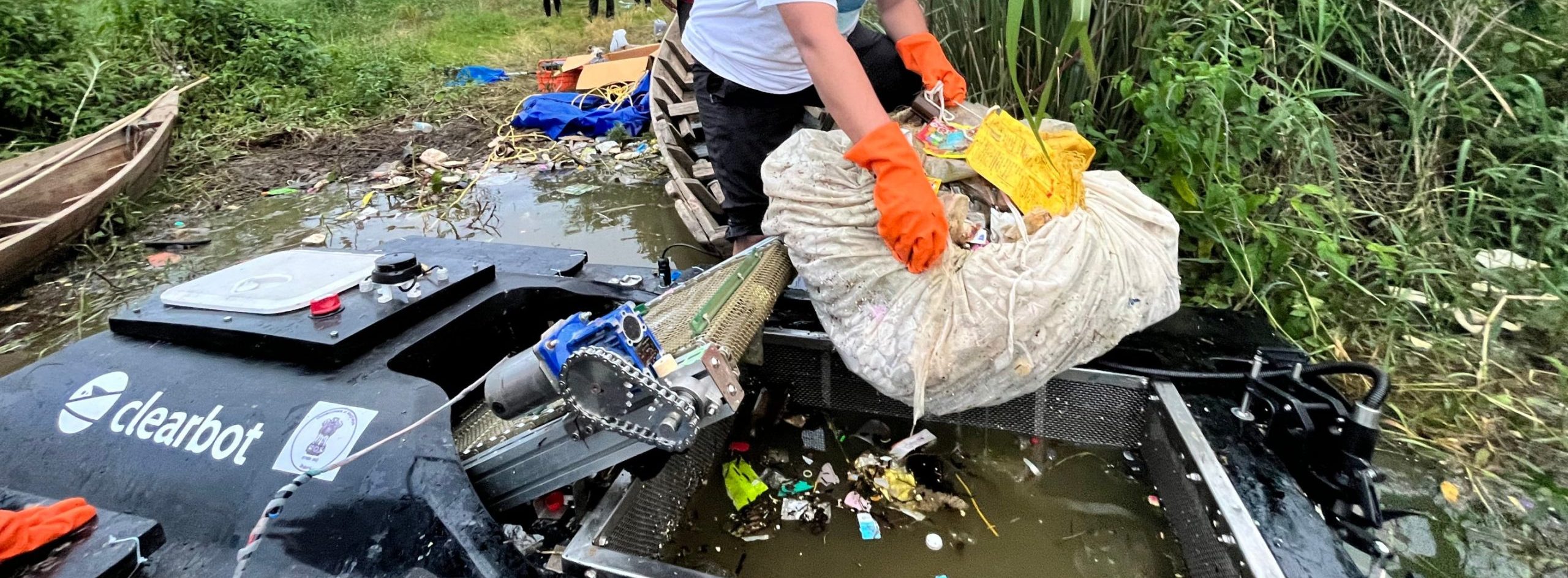
Water bodies in India contain a variety of waste materials, which can be either organic (e.g., hyacinth plants) or inorganic (plastic, sewage, oil). Clear Robotics has designed a fleet of electric boats, of varying sizes and capacities (150 kg–3 tons), that can be driven across any given water body to collect all accumulated waste. These boats can either be controlled using a simple radio controller or programmed to follow given paths with waypoints.
Each boat comes with attached cameras that transmit video feeds back to a human operator in real time. The operator can then decide which of the detected objects should be collected by the boat and which should be ignored.
In the autonomous boats—i.e., those following pre-programmed paths within a geofenced location—there are also LiDAR-powered software algorithms that help automatically avoid objects such as birds or animals.
All boats are electric and can be charged at solar docking stations.
Clear Robotics has found that the most efficient method of clearing waste from a water body is to drive their boats in a zigzag manner, similar to the operation of a domestic vacuum cleaner. Prior to the commencement of any cleaning project, the field team also records the patterns of waste accumulation on the water surface by tracking factors such as wind and tide, which can help determine where to focus the boats. This combination of human intelligence and mechanized technology has proven advantageous across projects.
Where is Clear Robotics active?
Clear Robotics has undertaken projects from different regions of India, as well as some in Singapore, the Philippines (Manila), and the UAE. Notable project sites in India include Bharatput in Rajasthan, the Jawaharlal Nehru Port in Mumbai, Visakhapatnam, Kolkata, and Chennai.
The startup’s largest undertaking was in Meghalaya, where it partnered with The Meghalayan Age Ltd. (a State Department of Tourism initiative) to clear the Umiam Lake in 2024.
Clear Robotics’ boats can be operated in both freshwater bodies, such as lakes and ponds, as well as marine settings such as around ports. Since they do not rely on diesel, they can be quickly deployed even in remote locations.
As of August 2026, the fleet consisted of 25 boats, ~13 of which were in India.
What are the advantages of using these boats?
Clear Robotics’ boats have cleared over 100 tons of waste in total, of which 42 tons were cleared in Meghalaya alone.
The main advantage of using them is cost saving: since the boats are electric, the fuel costs of boat operation can be reduced by up to 90%. At the same overall cost, a Clear Robotics boat can collect 3–4 times more waste than a manually operated boat. Moreover, carbon emissions can be reduced by 95%, ensuring that any waste removal project is a net positive in terms of environmental sustainability.
The other significant advantage of using these boats is that they require minimal human contact with the waste. With merely one hour of training, any individual can be prepared to operate an electric boat. Manpower can be used to supervise waste collection, then segregate and recycle waste, rather than directly gathering it and endangering worker health.
Recognition of work
Clear Robotics’ work was first publicly recognized by the CEO of the gaming company Razor, who provided the funds for building the startup’s first boat as part of the UN World Oceans Day in 2021. Today, most of the funding for its projects comes from CSR projects, Rotary Clubs, and NGO partners.
Path forward
According to Sidhant Gupta, gaining regulatory approval for Clear Robotics’ projects has been straightforward because the Indian government has repeatedly shown an interest in clearing waste from water bodies. Each electric boat is highly licensed, insured, and certified, ensuring that the startup is fully accountable for delivering excellent results. The next step would be to expand the fleet of boats currently in operation, building boats that can handle higher volumes of waste (5–6 tons).
While there is already a demand for green technology integration in India’s ports, adding legal requirements for this would increase the incentives for companies such as Clear Robotics to innovate. Through formal legislation in this direction, policymakers can demonstrate greater alignment with Swachh Bharat and other national programs to boost both tourism and public health.
Share Your Story Today, Shape Viksit Bharat Tomorrow
Got an idea, innovation, or experience that's making a difference? Share your story now and ignite India's transformation because your voice can drive the future forward!
Resources to Replicate This Idea
BUILD YOUR OWN INTERVENTION
Handpicked stories tailored just for you
Explore stories that inspire, inform, and ignite new ideas across tech, innovation, and real-world impact

How AI Diagnostics Are Reaching India’s Frontline Health Workers
AffEx equips rural health workers with an AI-powered point-of-care screening kit — testing hemoglobin, blood pressure, ECG, and cardiac and...
Read More