BetaTANK's Frontier Robotics Solution Could Replace Dangerous Manual Work
What began as one seafarer’s frustration with dangerous tank cleaning has evolved into a deep-tech robotic platform for hazardous industries.
Updated on: 16 July 2026

Sector

Solution

Technology

State of Origin
Disclaimer:
Features ‘as is’ submissions and neither constitutes endorsement, certification, recommendation, or validation by NITI Aayog nor makes NITI Aayog liable in any manner.
Impact Metrics
5–10 bar positive-displacement pumping
enabling the removal of thick, viscous petroleum sludge more efficiently than conventional suction-based robotic systems.
370 mm height
helps it pass under most tank steam heating coils.
Multi-industry robotic application
adapted for petroleum storage tanks, underground fuel tanks, petrochemical facilities, and high-temperature foundries to reduce hazardous manual work.
Zone 0 safety-compliant design
allowing safe operation in explosive atmospheres where conventional electrically powered robots cannot function.
Captain D Chandrasekhar’s innovation began with a question he first asked himself while cleaning an oil tank as a Merchant Navy officer in the mid-1990s: why were humans still entering one of the world’s most hazardous industrial environments to remove sludge when technology had advanced enough to send people to the moon?
Nearly three decades later, that question became the motivation for BetaTANK Robotics to develop patented robotic systems that clean petroleum and petrochemical storage tanks remotely, eliminating the need for workers to enter toxic confined spaces.
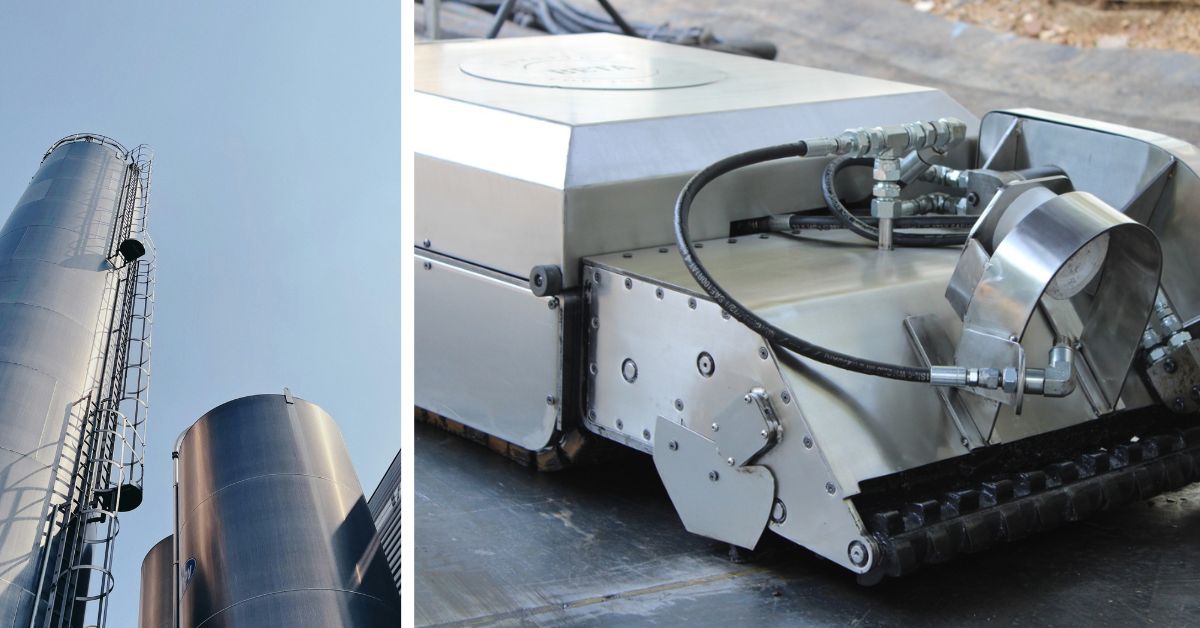
The core innovation lies in replacing hazardous manual cleaning with a remotely operated hydraulic robot.
Traditionally, cleaning petroleum tanks requires workers to enter massive storage tanks coated with thick oil sludge. Inside these enclosed spaces, they face multiple dangers, including oxygen-deficient atmospheres, hydrocarbon vapours, hydrogen sulphide gas, slippery surfaces and the constant risk of explosions.
Workers manually shovel sludge into bags that are then hauled out using pneumatic winches, a process that has changed little over several decades.
BetaTANK’s robotic system removes the need for human entry altogether. Operators remain safely outside the tank while controlling the robot remotely through an explosion-proof camera that provides a live video feed.
The robot travels along the tank floor, navigates beneath internal heating coils and removes sludge without exposing workers to hazardous conditions. By taking people out of the tank, the technology addresses one of the most dangerous maintenance operations in the petroleum industry.
Designing a robot for this environment required rethinking conventional industrial robotics. Most factory robots rely on electric motors, but inside petroleum tanks even a tiny electrical spark can ignite flammable gases.
BetaTANK therefore developed a hydraulically powered robot, using pressurised fluid instead of electricity to drive movement. Hydraulics eliminate ignition risks while providing sufficient power to operate in harsh industrial conditions. Apart from an explosion-certified camera used for navigation, the robot contains no conventional electrical systems inside the hazardous environment. Every component, from hydraulic assemblies to fasteners, was engineered to comply with stringent international Zone 0 certification, one of the highest safety standards for environments where explosive gases may be continuously present.
Another major innovation is the company’s sludge removal mechanism. Most robotic tank-cleaning systems worldwide rely on vacuum suction to extract sludge. BetaTANK instead uses a positive-displacement pumping system. Rather than pulling sludge towards the machine, the robot pushes it into an onboard pump and expels it using discharge pressures of five to ten bar.
According to the company, this approach allows much thicker petroleum sludge to be removed more efficiently than conventional suction-based systems, which often struggle with dense, viscous material. Chandrasekhar describes it as moving from first-generation suction technology to a second-generation pumping approach better suited to industrial-scale cleaning.
The innovation extends beyond a single robot. BetaTANK has also developed a compact robotic system capable of entering underground fuel storage tanks at petrol stations through standard 24-inch access openings. The company is further adapting its technology for petrochemical facilities and high-temperature foundries, where hazardous maintenance work is still performed manually.
By applying the same principles across multiple industries, the startup aims to reduce worker exposure wherever environments are toxic, confined or otherwise unsafe for human entry.
Although still in the pre-revenue stage, BetaTANK’s broader vision is not merely to automate industrial cleaning but to fundamentally redesign hazardous maintenance by ensuring that dangerous work is performed by machines rather than people.
Frontier tech in hazardous environments
BetaTANK’s retail tank robotic system combines three key engineering innovations. Its folding arm geometry allows the robot to pass through narrow manholes before expanding once inside, enabling it to clean a much larger area without requiring structural modifications to the tank.
The robot also uses a closed-loop wash system, where water cleans the tank interior while the contaminated wash is simultaneously collected, filtered and recovered, reducing waste and improving efficiency.
Most importantly, the robot is powered by a hydraulic drive system instead of electricity, eliminating the risk of sparks in highly flammable environments and allowing safe operation in tanks containing explosive vapours.
This represents frontier technology by applying advanced robotics, hydraulic engineering, remote operations and safety-certified industrial automation to solve a problem that has remained largely unchanged for decades. Rather than improving the existing manual process, the company has fundamentally reimagined how petroleum and petrochemical tanks can be cleaned by eliminating hazardous human entry altogether. In doing so, it addresses one of the oil and gas industry’s most dangerous maintenance operations through an indigenous deep-tech solution.
A defining feature of frontier technologies is their ability to operate in environments where conventional systems cannot.
Beyond its technical innovation, BetaTANK demonstrates how frontier technology can transform worker safety. Instead of relying on protective equipment to reduce risk, the company removes people from the hazardous environment altogether by enabling remote operation. The same technological platform is now being adapted for underground fuel storage tanks, petrochemical facilities and high-temperature foundries, showing how robotics can replace dangerous manual work across multiple industries.
By combining advanced robotics, hydraulic engineering, remote sensing and intrinsically safe design into a commercially deployable system, BetaTANK illustrates how frontier technologies can solve long-standing industrial challenges while improving both safety and operational efficiency.
Potential to scale the robotics to reduce human intervention
As cities expand, so does the infrastructure needed to store and transport petroleum, chemicals and industrial fuels. Refineries, fuel depots, petrochemical plants, airports and logistics hubs all depend on large storage tanks that require regular cleaning and maintenance.
Scaling BetaTANK’s robotic technology could make these essential operations significantly safer while improving the reliability of urban industrial infrastructure.
The most immediate benefit is worker safety. Hazardous tank cleaning remains one of the most dangerous industrial jobs, exposing workers to toxic gases, oxygen-deficient environments and confined spaces. By eliminating the need for human entry, robotic systems can reduce the risk of occupational injuries and fatalities while creating safer workplaces in rapidly industrialising cities.
The technology can also improve operational efficiency. Automated cleaning enables tanks to be serviced more consistently and with less downtime, helping ensure uninterrupted fuel supplies that power public transport systems, emergency services, airports and industries.
As cities become increasingly dependent on reliable energy infrastructure, minimising maintenance delays becomes critical.
Beyond petroleum storage, the underlying robotic platform can be adapted for hazardous maintenance in petrochemical plants, underground fuel tanks and other confined industrial environments commonly found in urban areas. This reduces reliance on manual labour for dangerous tasks while encouraging industries to adopt safer, technology-driven practices.
By replacing hazardous manual work with advanced robotics, BetaTANK supports the development of smarter, more resilient and worker-centric cities. As urban centres continue to industrialise, such frontier technologies can help build infrastructure that is not only more efficient but also safer, ensuring economic growth does not come at the cost of human lives.
Share Your Story Today, Shape Viksit Bharat Tomorrow
Got an idea, innovation, or experience that's making a difference? Share your story now and ignite India's transformation because your voice can drive the future forward!
Disclaimer:
Features ‘as is’ submissions and neither constitutes endorsement, certification, recommendation, or validation by NITI Aayog nor makes NITI Aayog liable in any manner.
Resources to Replicate This Idea
BUILD YOUR OWN INTERVENTION
Handpicked stories tailored just for you
Explore stories that inspire, inform, and ignite new ideas across tech, innovation, and real-world impact


A Startup Has Discovered a New Way To Neutralise Carbon Emissions Through Everyday Choices
Climes leverages climate-tech to calculate carbon footprints and fund verified environmental projects, making everyday purchases and travel more sustainable while...
Read More