How Hemispheric Solar Dryers Can Achieve Off-Grid Drying and Disinfection
Sunlight can be used to dry or disinfect various items, but it is not reliable due to weather fluctuations. Dr Sanjeev Damodar Suryawanshi has designed a hemispheric solar dryer that stabilizes heat and moisture conditions, offering a long-term storage solution.
Updated on: 31 August 2026

Sector
Healthcare

Solution

Technology

State of Origin
Impact Metrics
100–150 stakeholders
benefiting from long-term storage of farm products and linen.
4 models available
for the dryer, catering to different storage capacities.
INR 8.26 lakh grant
from La Fondation Dassault Systèmes in recognition of innovation.
Moisture can be a prime source of microbial infection, leading to the contamination of otherwise usable goods. The traditional method of eliminating it—open-air drying—not only evaporates water but also exposes objects to UV rays, effectively sterilizing them. However, this method is highly dependent on the weather, and may still leave the drying objects exposed to dust, insects, and other undesirable agents. Thus, it is not reliable, especially in high-stakes economic sectors such as agriculture and health.
Modern society’s default solution, the mechanical dryer, can be effective, but it comes with high fuel and electricity costs and greenhouse gas emissions. There is a need for more affordable and green means of drying and disinfection.
Dr Sanjeev Damodar Suryawanshi, of Dhule’s SSVPS College of Engineering, may have the answer. Combining solar thermal physics and biomass-based energy generation, he has designed a drying and storage system that can maintain dry, sterile conditions without electricity.
How does the drying system work?
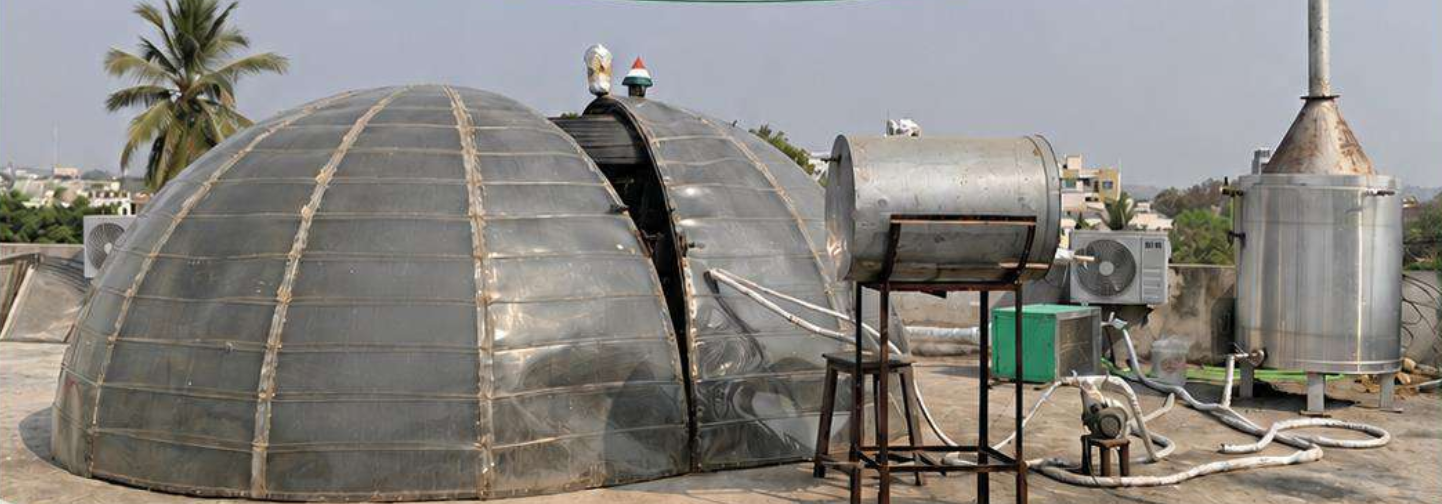
The core of the drying system—which appears in the shape of an enclosed hemisphere—is heat generation. During sunlight hours, this is achieved through the solar collectors that form the surface of the hemisphere. Radiation from the sun enters the hemisphere, then becomes trapped within, increasing the internal temperature as in a greenhouse. The floor of the hemisphere, a bed of pebbles, absorbs the heat over many hours. At the same time, through controlled air vents, moist air is expelled from the system.
At night, or when sunlight is not strong, heat comes from two sources. The first of these is a boiler that works on non-cattle-feed biomass. The second is the bed of pebbles in the hemisphere, which releases heat when the outside temperature drops. Together, these sources ensure that the items stored within the hemisphere are kept dry and free of contaminants throughout the day.
Currently, the hemispherical solar dryer is available in four models of varying capacities: 1 kg, 100 kg, 500 kg, and 1 ton.
Testing the system on the field
Following an investment of ~ INR 15 lakh for manufacturing and development, the drying system has been deployed across various districts in Maharashtra. It has directly benefited 100–150 stakeholders, primarily farmers but also students and researchers interested in thermal storage technology.
A variety of agricultural products have been stored using this innovation, including grapes, ginger, onion, papaya, beetroot, pulses, groundnut, and leafy vegetables. Additionally, hospital linen has also been sterilized and shelved within the hemisphere setup.
Recognition of the innovation
Although the innovation is still in its early stages, it has received recognition—and a grant of INR 8.26 lakh—from La Fondation Dassault Systèmes. It has also been featured on prestigious platforms such as Avishkaar, DIPEX Official, and the Innovation Pavilion at MET & HTS in Mumbai.
Next steps for scaling
Further support from innovation schemes and incubators could provide more capital for manufacturing hemispherical solar dryers and open up avenues for commercialization. Alongside financial aid, partnerships with agricultural universities, ICAR institutions, Krishi Vigyan Kendras (KVKs), and farmer–producer organizations (FPOs) could boost the research and development process, as well as allowing more field testing.
By encouraging grassroots innovations such as this, policymakers could help democratize access to long-term storage, especially in regions without reliable access to electricity.
Share Your Story Today, Shape Viksit Bharat Tomorrow
Got an idea, innovation, or experience that's making a difference? Share your story now and ignite India's transformation because your voice can drive the future forward!
Resources to Replicate This Idea
BUILD YOUR OWN INTERVENTION
Handpicked stories tailored just for you
Explore stories that inspire, inform, and ignite new ideas across tech, innovation, and real-world impact

How AI Diagnostics Are Reaching India’s Frontline Health Workers
AffEx equips rural health workers with an AI-powered point-of-care screening kit — testing hemoglobin, blood pressure, ECG, and cardiac and...
Read More