
Hyperspectral Imaging Satellites: A Transformative Tool for Environmental Management in India
Pixxel, a space-tech startup founded by Awais Ahmed and Kshitij Khandelwal, is using hyperspectral imaging satellites to deliver detailed environmental data for industries and governments. Their innovation is helping address issues like pollution, climate change, and resource depletion.
Updated on: 19 June 2025

Sector

Solution

Technology

State of Origin
Impact Metrics
250+ spectral bands
with 5 m resolution captured.
Maps, monitors and strengthens
pollution, water quality, species detection.
Strengthens and solidifies
climate action and biodiversity monitoring in India.
Pixxel’s core innovation lies in its hyperspectral imaging satellites, which capture images across over 250 spectral bands. This technology surpasses traditional multispectral imaging by providing detailed information on the physical and chemical properties of Earth’s surface. It enables precise identification of pollutants, ecosystem monitoring, and habitat feature distinction, revolutionising environmental assessment methods. With a 5-meter spatial resolution, Pixxel’s satellites offer accurate data on water quality, species detection, and carbon estimation, supporting sustainable environmental management practices.
Addressing India’s environmental challenges
India faces significant environmental challenges, including pollution, declining natural resources, and climate change. Pixxel’s technology aligns with national initiatives like Atmanirbhar Bharat and Viksit Bharat by providing critical data for informed decision-making. The ability to track water quality parameters, detect pollutants, and support early warning systems for Harmful Algal Blooms (HABs) exemplifies its strategic value. By enabling accurate species boundary maps, Pixxel aids in resource allocation and habitat regeneration, contributing to India’s environmental sustainability goals.
Pixxel’s journey has not been without challenges. Securing funding and building hardware were significant hurdles for the young founders. However, their determination led to successful fundraising, including a $36 million investment from Google. Despite delays caused by the COVID-19 pandemic, Pixxel launched its first commercial satellite, ‘Shakuntala,’ on a SpaceX Falcon-9 rocket in April 2022, followed by ‘Anand’ on an ISRO PSLV-C54 rocket in November 2022. These milestones mark Pixxel as a trailblazer in India’s space sector.
Impact and potential for replication
Pixxel’s impact extends beyond environmental monitoring. Its technology supports various industries, including agriculture, oil and gas, and mining, by providing actionable insights for better decision-making. For instance, fertiliser companies can use nutrient maps to optimise soil health, while agritech firms like Australia’s DataFarming benefit from enhanced crop monitoring. The potential for replication is vast, as Pixxel’s satellites offer scalable solutions for global environmental challenges.
A national gamechanger
Pixxel’s hyperspectral imaging satellites represent a significant advancement in environmental management, offering India a powerful tool to combat climate change and resource depletion. By providing detailed, actionable data, Pixxel empowers stakeholders to implement targeted strategies for sustainable development. As India strives towards a greener future, Pixxel’s technology stands as a national gamechanger, poised to transform environmental assessment and management on a global scale.
Share Your Story Today, Shape Viksit Bharat Tomorrow
Got an idea, innovation, or experience that's making a difference? Share your story now and ignite India's transformation because your voice can drive the future forward!
BUILD YOUR OWN

BUILD YOUR OWN
How can I implement this innovation effectively?
How is this innovation being adopted around the world?
Where else could this innovation make an impact?
Who has seen real results from using this innovation?
What insights do experts share about this innovation?
What policies support or influence this innovation?
How could this innovation evolve in the future?
Is this innovation accessible and inclusive for everyone?
How can I contribute to or participate in this innovation?
What resources can help me explore this innovation further?
If you would like to know more about this innovation, fill this form to contact the innovator.
Handpicked stories tailored just for you
Explore stories that inspire, inform, and ignite new ideas across tech, innovation, and real-world impact

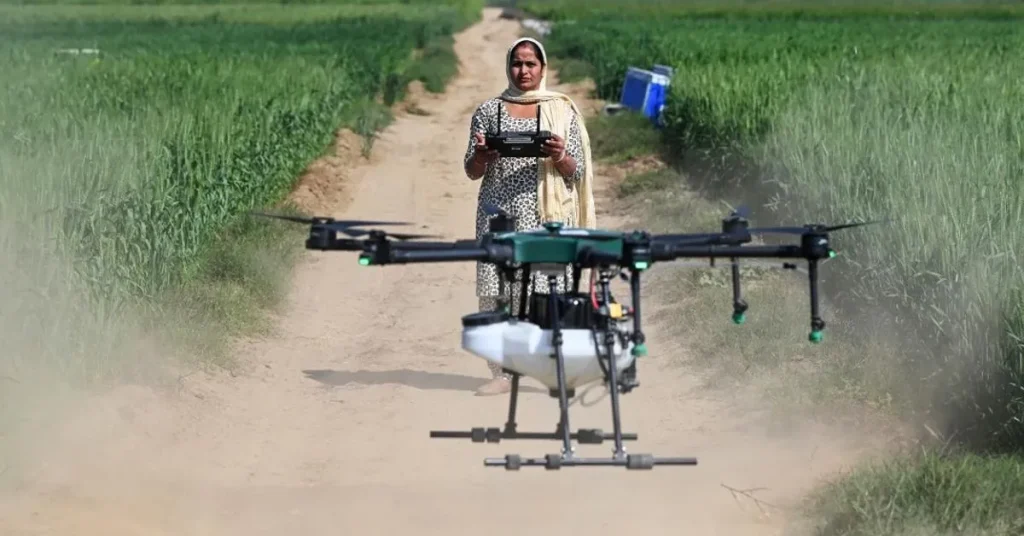
From Self-Help Groups to Drone Pilots: Meet the Women Building Rural Income Worth Lakhs
Across India’s farmlands, women are taking charge of the skies. Through the Government of India’s Drone Didi Initiative, trained women...
Read More