Inside Arunachal Pradesh’s AI-Driven Push for Startup Growth and Transparent Governance
Arunachal Pradesh is transforming its startup and investment ecosystem through digital governance platforms, AI-driven applicant screening, DIY innovation labs, and a Single Window Clearance System under EoDB. The initiative has streamlined approvals, improved transparency, supported 156 startups, generated ₹32.19 crore in startup revenue, and enabled ₹809 crore worth of investment proposals.
Updated on: 06 May 2026

Sector

Solution
Public Welfare

Technology
AI

State of Origin
Impact Metrics
29,075 licenses issued
through the Single Window Clearance System under EoDB across multiple departments
₹14.9 crore
in government revenue generated through the EoDB licensing system
156 startups
directly supported through the Startup Portal and DIY Lab ecosystem.
In a geographically remote and infrastructure-constrained state like Arunachal Pradesh, navigating government approvals, accessing startup support, and securing investment opportunities was once a difficult and time-consuming process. Entrepreneurs often had to move between multiple departments to obtain licenses and clearances, while startups struggled to access information, funding support, and innovation infrastructure. Fragmented systems, limited transparency, and manual procedures created delays that discouraged both business growth and youth-led entrepreneurship.
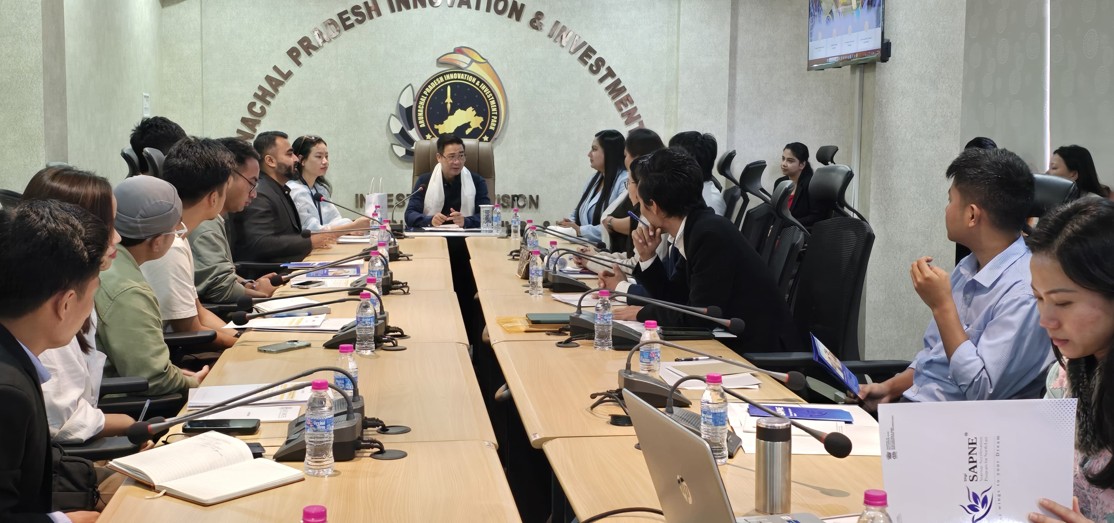
To address these long-standing challenges, the Government of Arunachal Pradesh, through the Arunachal Pradesh Innovation and Investment Park (APIIP), launched a suite of integrated digital initiatives including the Startup Facilitation Portal, Youth Empowerment Sphere (YES), Single Window Clearance System under Ease of Doing Business (EoDB), and the Investment Portal. Led by Shri Tabe Haidar, Nodal Officer for EoDB, Startups and Investment, the initiative aims to create a technology-driven ecosystem that simplifies governance, improves accessibility, and strengthens innovation and investment across the state.
Building a Unified Digital Ecosystem
At the core of the transformation is the Single Window Clearance System under the Arunachal Pradesh Ease of Doing Business Act, 2021. The platform digitises approvals and regulatory processes across departments, allowing businesses to apply for licenses and clearances online through a unified interface. Real-time tracking, automated workflows, and inter-departmental coordination have reduced delays, improved transparency, and minimised the need for repeated physical visits to government offices.
The Startup Portal and the upcoming Youth Empowerment Sphere (YES) further consolidate access to startup schemes, mentorship support, application systems, and grievance redressal mechanisms into single digital platforms. This has helped reduce information gaps and made government services more accessible, particularly for entrepreneurs in remote districts.
Enabling Innovation Through DIY Labs and AI
Another critical gap the initiative sought to address was the lack of innovation infrastructure within the state. To solve this, APIIP established Do-It-Yourself (DIY) Labs equipped with advanced tools such as 3D printers, electronics facilities, design software, laser engraving systems, and packaging support. These labs allow startups to rapidly prototype, test, and refine products locally, significantly reducing development time and costs.
Artificial Intelligence has also been integrated into the state’s entrepreneurship ecosystem. In the fourth edition of the Arunachal Pradesh Entrepreneurship Development Program (APEDP), AI-based systems were used to screen and shortlist applicants. By analysing over 500 applications, the system reduced evaluation timelines from nearly two weeks to a much faster and more scalable process while ensuring fair and merit-based selection.
Challenges in Scaling Digital Governance
Implementing these reforms, however, was not without challenges. Integrating multiple government departments and legacy systems into one digital ecosystem required extensive coordination and process standardisation. Connectivity constraints in remote and mountainous regions also affected platform accessibility and adoption. Government officials and users needed training to adapt to digital workflows and AI-driven systems, while concerns around interoperability, cybersecurity, and data accuracy emerged during scaling.
Despite these barriers, phased implementation, stakeholder engagement, and continued policy support enabled the initiatives to gain traction across all 28 districts of the state.
Measurable Impact Across Startups and Investments
The impact has been significant. Through the Single Window Clearance System under EoDB, more than 29,075 licenses have been issued across departments including Finance, Planning & Investment, Trade & Commerce, Industries, and Legal Metrology & Consumer Affairs. The platform has generated approximately ₹14.9 crore in government revenue.
The startup ecosystem has also witnessed measurable growth. A total of 156 startups have directly benefited from the Startup Portal and DIY Lab ecosystem. Collectively, these startups generated revenue worth ₹32.19 crore during 2024–25. The DIY Labs have enabled startups to prototype and test products in-house, strengthening Arunachal Pradesh’s product innovation capabilities and reducing dependence on external facilities.
The Investment Portal has emerged as another key intervention by centralising information related to incentives, operational procedures, land banks, and investment opportunities. So far, five investment proposals worth approximately ₹809 crore have been grounded through the platform, improving investor confidence and reducing procedural bottlenecks.
Improving Trust and Accessibility
The reforms have also improved public trust in governance systems. Entrepreneurs can now access services remotely, track applications in real time, and navigate approvals through simplified digital workflows. Faster approvals and reduced administrative burdens have allowed founders to focus more on innovation and operations rather than paperwork.
Founders have acknowledged the shift. Darga Taipodia, founder of APU NAM, noted that the Startup Portal created a seamless and transparent application experience, while the use of AI in APEDP strengthened confidence in the fairness of the selection process. Similarly, Chalang Hakhun, founder of C & C Organic Pickle, highlighted how the DIY Lab enabled startups to experiment, prototype, and prepare products for market readiness within the state itself.
National Recognition and the Road Ahead
The initiative has also earned national recognition. Arunachal Pradesh was named a “Best Performer” in the fifth edition of the State Startup Ranking Framework by the Department for Promotion of Industry and Internal Trade (DPIIT), Government of India, for its digital infrastructure, policy support, and startup-focused governance reforms.
Today, Arunachal Pradesh’s integrated approach to digital governance, startup facilitation, AI-driven administration, and innovation infrastructure demonstrates how technology can transform public service delivery in geographically challenging regions. By simplifying regulation, strengthening entrepreneurial support systems, and improving transparency, the state is building a more inclusive and future-ready economic ecosystem.
Share Your Story Today, Shape Viksit Bharat Tomorrow
Got an idea, innovation, or experience that's making a difference? Share your story now and ignite India's transformation because your voice can drive the future forward!
Resources to Replicate This Idea
BUILD YOUR OWN INTERVENTION
Handpicked stories tailored just for you
Explore stories that inspire, inform, and ignite new ideas across tech, innovation, and real-world impact


No Spray, No Residue: The Pheromone Tech Protecting 100,000+ Acres of Indian Farmland
ATGC Biotech pioneers pheromone-based "insect family planning," replacing chemical pesticides with mating disruption technology (CREMIT™). Covering 100,000+ acres and 30,000+...
Read More
ATGC Biotech: How Pheromone-Based “Insect Family Planning” Is Transforming Sustainable Pest Control in Indian Agriculture
ATGC Biotech is transforming agricultural pest management through pheromone-based “Insect Family Planning,” disrupting pest reproduction instead of relying on chemical...
Read More