Inside Maharashtra’s Moving Classroom That Brings AI and STEM Learning to 50,000+ Government School Students
A mobile AI and ICT lab bringing VR, coding, and STEM tools to rural Maharashtra schools, Dnyan Rath bridges the digital divide by delivering experiential learning directly to Zilla Parishad classrooms.
Updated on: 05 June 2026

Sector

Solution
Rural Education

Technology

State of Origin
Disclaimer:
Features ‘as is’ submissions and neither constitutes endorsement, certification, recommendation, or validation by NITI Aayog nor makes NITI Aayog liable in any manner.
Impact Metrics
50,000+ students and teachers
reached across rural and tribal Zilla Parishad schools in Nagpur district.
100% reduction
in need for individual school-level advanced labs (VR, coding, 3D printing infrastructure delivered as shared mobility asset).
Zero infrastructure burden
on individual schools, eliminating the need for permanent lab construction or maintenance at each location.
Zilla Parishad Nagpur’s Dnyan Rath (AI/ICT Lab on Wheels), founded in March 2026 under the leadership of Vinayak Mahamuni, is a mobile education innovation designed to address one of rural India’s most persistent inequities — unequal access to experiential and technology-enabled learning.
In many government schools across remote and tribal regions, classrooms have improved in infrastructure and enrollment, but the nature of learning remains largely unchanged. Students still depend heavily on textbooks and blackboards, with limited exposure to coding, artificial intelligence, virtual reality, or hands-on STEM tools. This creates a quiet but deep divide between what rural students learn and what the modern world increasingly demands.
Dnyan Rath was built as a response to this gap — not by waiting for infrastructure to catch up, but by making advanced learning mobile.
The learning gap hidden in plain sight
The challenge facing rural education in Nagpur’s Zilla Parishad schools is not access to schooling, but access to experience.
While urban and private schools increasingly integrate digital labs, robotics kits, and immersive learning systems into their curriculum, rural schools often remain constrained by three structural limitations.
The first is lack of exposure to modern technologies. Most students in remote schools have never interacted with tools like coding platforms, VR systems, or 3D printers. As a result, learning remains abstract and theoretical, especially in science and mathematics.
The second is infrastructure inequality. Setting up advanced labs in every school requires significant capital investment, maintenance capacity, and technical support — all of which are difficult to sustain across dispersed rural geographies.
The third is limited teacher enablement for new-age tools, where even when digital equipment is available, structured training and guided usage models are often missing.
Together, these factors create an opportunity divide that goes beyond academics and begins to influence aspiration itself.
A classroom that moves — the idea of Dnyan Rath
Instead of attempting to replicate fixed infrastructure in every school, Dnyan Rath reimagines access itself.
The solution is simple in concept but ambitious in execution — a fully equipped bus that functions as a travelling AI and ICT lab, rotating across Zilla Parishad schools and bringing frontier technologies directly to students.
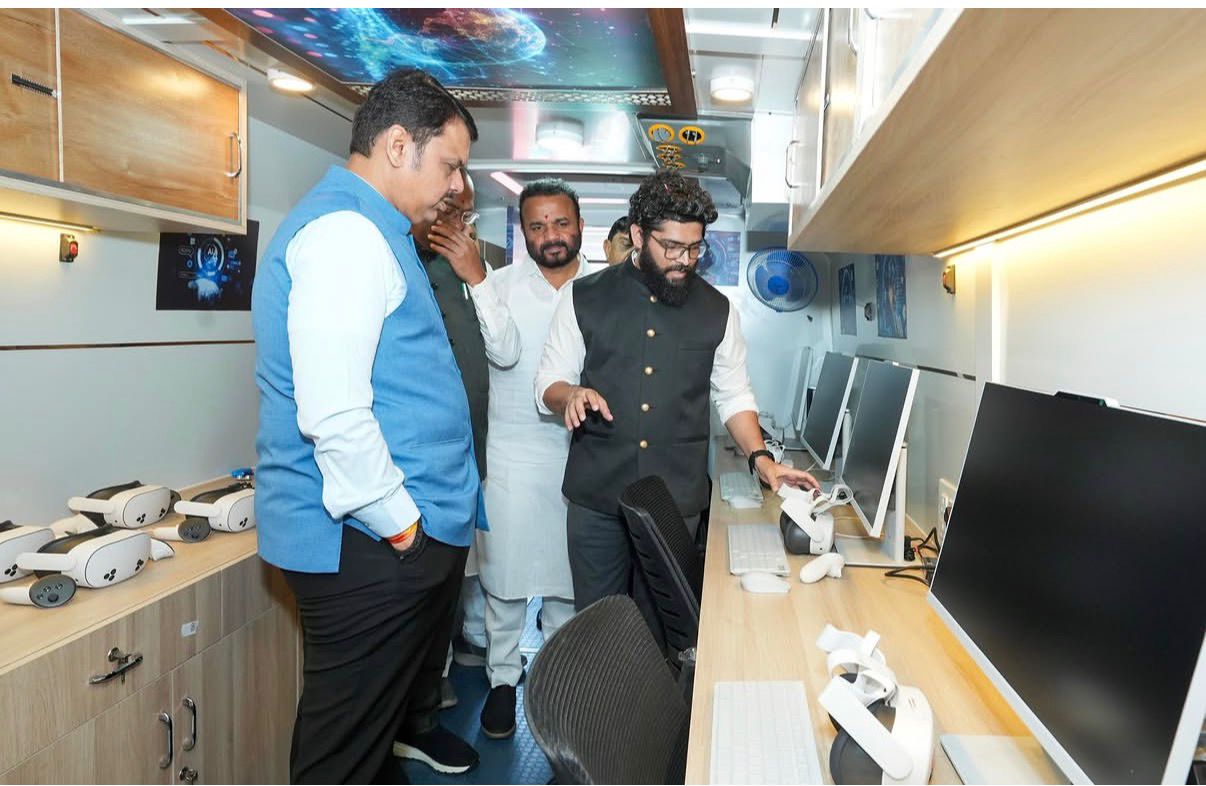
Inside the mobile lab, the bus is transformed into a compact digital ecosystem. It houses computers, VR headsets, 3D printers, coding platforms, interactive digital screens, internet connectivity, and STEM learning kits.
This setup allows each visiting school to temporarily become a high-tech learning environment, without requiring permanent infrastructure.
A trained facilitator from Pi Jam Foundation accompanies the unit to ensure structured delivery of sessions and to guide both students and teachers through hands-on activities.
From textbooks to immersive learning
The most significant shift introduced by Dnyan Rath is not technological — it is pedagogical.
Learning inside the mobile lab is designed around interaction rather than instruction.
Through virtual reality, students are able to visualise complex concepts in science and geography, turning abstract ideas into immersive experiences. Coding platforms introduce logical thinking at an early stage, helping students move from memorisation to problem-solving. 3D printers and STEM kits allow them to design, build, and test physical models, transforming learning into a process of creation.
The presence of internet-enabled systems and large interactive screens further expands access, enabling video-based learning, group activities, and structured digital lessons that are consistent across schools.
What changes most fundamentally is the student’s relationship with knowledge — from passive absorption to active engagement.
Building a lab on wheels — and the challenges behind it
While the concept is elegant, the execution required solving several real-world constraints.
Designing a fully functional technology lab within a bus demanded careful integration of hardware systems, power backup, ventilation, and safety mechanisms to ensure that sensitive equipment could withstand continuous movement.
Operationally, routing the bus across scattered rural schools required precise coordination at the district and block levels, with attention to road conditions, accessibility, and seasonal disruptions.
Another challenge was user readiness. For many students, this was their first exposure to digital tools, requiring structured onboarding and step-by-step familiarisation rather than direct immersion.
Finally, maintaining equipment such as VR headsets and 3D printers in a mobile environment required strong maintenance protocols and trained personnel to ensure long-term functionality.
Despite these challenges, the model has been stabilised through structured modules, standardized sessions, and consistent facilitation.
Early outcomes — access, engagement, and confidence
Since its rollout, Dnyan Rath has reached more than 50,000 students and teachers across rural villages, creating measurable improvements in both access and engagement.
One of the most immediate outcomes has been equalisation of exposure. Students in remote schools now experience the same technologies that were previously limited to urban classrooms or private institutions.
There has also been a clear rise in classroom engagement levels. Hands-on learning tools have significantly increased participation, curiosity, and attentiveness among students who were earlier confined to textbook-based learning.
Importantly, the initiative has improved conceptual clarity, particularly in science and mathematics, where visualisation and interaction have replaced abstract memorisation.
At a system level, Dnyan Rath also offers cost efficiency and scalability, as a single mobile unit can serve multiple schools, reducing the need for duplicated infrastructure.
Beyond the classroom — reshaping aspiration in rural India
The impact of Dnyan Rath extends beyond academic outcomes into social and psychological transformation.
For many students, this is their first direct interaction with technologies like VR, coding, and 3D printing. This exposure helps break the perception that advanced technology belongs only to urban environments.
It also plays a role in aspiration building, encouraging students to consider careers in science, technology, and design — fields that were previously outside their awareness.
Teachers benefit through indirect capacity building, as exposure to structured digital learning sessions helps them gradually integrate new methods into regular teaching practices.
At the community level, the arrival of the Dnyan Rath becomes an event in itself — sparking curiosity, discussion, and renewed interest in education.
Conclusion — a mobile blueprint for equitable learning
Dnyan Rath represents a shift in how educational infrastructure can be imagined in resource-constrained environments.
Instead of waiting for fixed labs to reach every school, it brings the lab itself to the student — combining mobility with frontier technologies to create equitable access to experiential learning.
In doing so, it does not just improve access to tools. It changes how students learn, what they believe they can learn, and ultimately, what they believe they can become.
Share Your Story Today, Shape Viksit Bharat Tomorrow
Got an idea, innovation, or experience that's making a difference? Share your story now and ignite India's transformation because your voice can drive the future forward!
Disclaimer:
Features ‘as is’ submissions and neither constitutes endorsement, certification, recommendation, or validation by NITI Aayog nor makes NITI Aayog liable in any manner.
Resources to Replicate This Idea
BUILD YOUR OWN INTERVENTION
Handpicked stories tailored just for you
Explore stories that inspire, inform, and ignite new ideas across tech, innovation, and real-world impact

Pilotless Cargo Flights with Zero Failures: Reimagining Diagnostic Logistics in Indian Cities
An energy-efficient autonomous aircraft combining vertical take-off with fixed-wing cruise has completed over 1,000 flights carrying diagnostic samples between hospitals,...
Read More