With 30 Million Litres of Water Stored, Cities are Turning into ‘Sponges’ & Transforming Climate Resilience
In Chennai, sponge parks are advancing climate-resilient urban infrastructure through blue-green infrastructure and nature-based solutions. Powered by geospatial analytics and hydrological modelling, these systems enable urban flood management, manage 90% of stormwater runoff, store over 30 million litres, and reduce urban heat island effects—offering a scalable model for sustainable city planning in India.
Updated on: 22 March 2026

Sector

Solution

Technology
Remote Sensing

State of Origin
Disclaimer:
Impact Metrics
30 million+ litres
of water storage capacity, enabling large-scale flood mitigation and water retention.
90% incoming runoff
runoff managed on-site, significantly reducing urban flooding and pressure on drainage systems.
20 million+ litres
of stormwater handled during peak monsoon events, demonstrating real-world resilience under stress conditions.
30,000 m³ storage capacity
of wetland, with 25-year storm event resilience, strengthening climate preparedness.
Indian cities face a structural shortage of public spaces that balance recreation, ecology, and water management. An immediately visible consequence of this is a general lack of third spaces.
This was the case in Chennai, where IAS Anshul Mishra served as Member Secretary of the Chennai Metropolitan Development Authority (CMDA). Mishra, now working at AIIMS, points out that in the city, one of the most pressing challenges was the low per-capita availability of accessible green and open spaces. Equally concerning was the absence of public landscapes designed to manage water flows during extreme rainfall events.
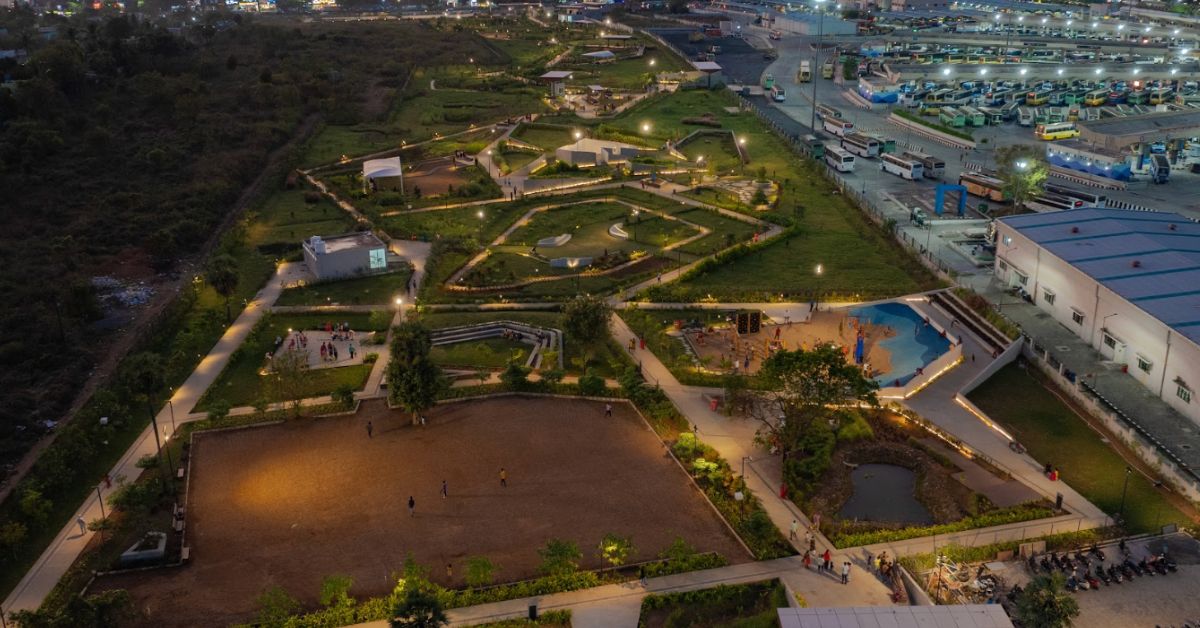
It was in this context that Sponge Collaborative, a climate-focused urban design firm, stepped in with the idea of sponge parks. In the past four years, these parks have yielded strong outcomes, especially in the city’s Porur region. This sprawling infrastructure, built across 16 acres, is climate-resilient and mitigates flood and drought risks with a restored wetland. This has improved urban safety while also creating a popular recreation space for the surrounding community.
But firstly, what are sponge parks?
The concept of ‘sponge cities’, developed by Chinese architect Kongjian Yu, fits into an innovative urban planning model that focuses on flood prevention and stormwater management via green infrastructure, as opposed to relying solely on drainage systems. Sponge parks can reduce urban flooding, water shortages, and heat island effects by essentially serving as reservoirs for capturing and absorbing excess rainwater.
Sponge Collaborative works on building sponge parks across not only India but also other countries across Central and South Asia. Founded by Saurav Kumar Biswas, Manushi Ashok Jain, and Praveen Raj in 2022, the Collaborative brings global expertise in urban development and research. After working extensively on issues that highlighted the growing risks of climate change for urban development, especially in the Indian context, the three resolved to apply their research from Harvard and Berkeley in India.

The sponge park in Porur has a network of three ponds that can filter and store 845 m3 of water, with an expanded floodable area of 2,400 m3 and overflow storage of 19,000 m3 in a wetland with a total capacity of 30,000 m3. It is also capable of handling 25-year storm events. The Collaborative has also built a second sponge park in Gopalapuram, the Kalaignar Centenary Climate Park.
How do they work?
The Collaborative’s Chennai projects show how frontier technologies can operationalise nature-based solutions within government systems.
First, they conducted geospatial diagnostics—leveraging GIS mapping, remote sensing, terrain modelling, and hydrological simulations (including HEC-RAS and SWMM)—to assess runoff pathways, storage deficits, soil infiltration rates, and downstream flood exposure. These analyses modelled rainfall intensities across 2-, 5-, 10-, and 25-year return-period storm events to quantify avoided runoff and peak discharge reductions.
At the Porur site—previously used as a parking lot and garbage dump—the design involves a cascading water management system. Stormwater is collected in a smaller forebay pond, treated biologically through vegetative filtration, and directed into an expanded and rejuvenated main pond. The park here integrates boardwalks, seating, play areas, and circulation paths without compromising hydrological performance. During heavy rainfall, water is detained within the park’s interconnected basins, reducing local flooding while improving downstream water quality.
Across the eco-wetland sponge park in Porur and biodiversity Climate Park in Gopalapuram, both 16 acres in size, more than 30 million litres of water storage capacity has been created. These parks manage approximately 90 percent of incoming runoff and have safely handled over 20 million litres during peak monsoon events.
Sponge parks not only reduce flooding but also restore groundwater levels, as soil infiltration tests have shown that they help recharge aquifers. Also, thermal imaging and surface monitoring indicate peak summer temperature reductions of 10–16°C compared to surrounding built-up areas.
As a result of these improvements, the Porur park alone has recorded more than three lakh annual visitors, demonstrating that ecological infrastructure can simultaneously serve as inclusive public space.

Challenges with water management
In Chennai, as elsewhere, urbanisation is rapidly expanding into flood-prone areas without adequate infrastructure. Chennai’s planning framework mandates the allocation of Open Space Reserves (OSR) in new developments. However, by 2022, many such sites had become underutilised, encroached, converted into dump yards, or monopolised for limited private use. Local bodies often lacked the technical and financial capacity to convert these parcels into functional public spaces. Meanwhile, the city oscillated between devastating floods and severe droughts, revealing the limitations of conventional (‘grey’) infrastructure.
Recognising this gap, the CMDA identified strategically located parcels, over 15 acres each, in Porur and near the Kilambakkam Bus Terminus. These had the potential to become multifunctional blue–green infrastructure assets. The objective was not merely beautification, but the integration of ‘blue’ spaces (water bodies) with ‘green’ spaces (public parks) to create landscapes capable of absorbing, temporarily storing, filtering, and safely releasing stormwater.
As Mishra notes, implementing such projects within government systems required sustained coordination with engineering departments responsible for estimates, tendering, and execution. Multiple design iterations and departmental vetting processes extended over a year. Introducing non-conventional engineering approaches—such as graded bioswales, vegetated detention systems, and soil-based filtration—required negotiation and conceptual alignment. The approximate capital cost was around one crore per acre. Sponge Collaborative was one of the most prominent partners for this enterprise.
Building blue–green infrastructure to manage water better
While upfront investments were higher than conventional landscaping, indirect benefits—including flood risk reduction, heat mitigation, groundwater recharge, biodiversity enhancement, and public health improvements—extend far beyond immediate financial metrics.
A critical innovation lies in Sponge Collaborative’s development of modular blue–green infrastructure prototypes that are encoded into digital workflows. These generate documentation that is straightforward to procure and tender-ready, thus bridging ecological design with public contracting norms. This systems-level innovation helps adapt nature-based concepts into formats that conventional engineering contractors can use.
Beyond Chennai, Sponge Collaborative has worked with over 20 government bodies and institutions, including the National Institute of Urban Affairs, Asian Development Bank, GIZ, World Resources Institute, and Google. The organisation has mobilised more than ₹600 crores toward climate-resilient, nature-positive infrastructure and trained over 200 municipal engineers across six states.
Its projects include lake rejuvenation (300-acre and 50-acre systems), 9 km of river restoration, 150 acres of hilly recharge landscapes, and India’s first blue economy master plan covering 100 km of coastline in Nagapattinam district. The latter has already benefited over 100,000 coastal households.
Scaling the Sponge City approach

The Chennai experience underscores a broader governance insight: comprehensive planning is essential for successful execution and maintenance. As highlighted by Mishra, projects of this scale may require a year or more in planning and an additional one to two years for implementation. Integrating blue-green infrastructure into master planning frameworks—rather than treating projects as isolated interventions—is key to citywide impact.
Sponge Collaborative is currently developing scalable geospatial workflows and diagnostic dashboards to enable hundreds of rapidly growing Indian cities to deploy sponge systems systematically. By combining hydrological modelling, geospatial analytics, modular ecological engineering, and institutional capacity building, the case of the Chennai sponge parks illustrates how frontier technologies can transform underutilised public land into resilient, multifunctional assets. This allows the simultaneous advancement of climate adaptation, public health, and equitable infrastructure—a crucial prerequisite for India’s urban growth. Further collaboration with the public sector could see radical transformations in the quality of life in city spaces.
Share Your Story Today, Shape Viksit Bharat Tomorrow
Got an idea, innovation, or experience that's making a difference? Share your story now and ignite India's transformation because your voice can drive the future forward!
Disclaimer:
Resources to Replicate This Idea
BUILD YOUR OWN INTERVENTION
Handpicked stories tailored just for you
Explore stories that inspire, inform, and ignite new ideas across tech, innovation, and real-world impact

Pilotless Cargo Flights with Zero Failures: Reimagining Diagnostic Logistics in Indian Cities
An energy-efficient autonomous aircraft combining vertical take-off with fixed-wing cruise has completed over 1,000 flights carrying diagnostic samples between hospitals,...
Read More