Retrieval-Grounded AI Advisory: Bringing Voice-First Crop Guidance to Over a Million Indian Farmers
A multilingual AI assistant combines retrieval-augmented generation, image recognition and voice technology to give smallholder farmers verified, location-specific advice in seconds. Reaching over a million users, nearly half women, it reduces crop losses and input costs.
Updated on: 23 September 2026

Sector

Solution

Technology

State of Origin
Karnataka
Disclaimer:
Features ‘as is’ submissions and neither constitutes endorsement, certification, recommendation, or validation by NITI Aayog nor makes NITI Aayog liable in any manner.
Impact Metrics
1 million+ users
with almost half being women.
5 languages supported
across input modes (text, voice and photo).
1.4 million questions
and answers in the open dataset.
India has more than 150 million farmers and a deep base of agricultural research, university expertise and government advisories. Yet smallholders often can’t get that knowledge when they need it. A fungal outbreak, a pest attack or an unexpected spell of rain can change a season’s outcome within days. Farmers typically rely on pesticide dealers, neighbours or an extension officer’s visit, and the advice that comes back is often delayed or too generic. Climate variability makes this worse, as erratic rainfall and unfamiliar pest pressures reduce the value of inherited experience.
As Digital Green India CEO Nidhi Bhasin puts it, the gap was never that information didn’t exist. It was getting it to farmers in the right language, at the right time and in a usable form.
The Intervention
FarmerChat is a free, Android-based AI agricultural assistant from Digital Green India, a non-profit that has worked with state governments and rural livelihood missions since 2008. It builds on the organisation’s earlier work: over 10,000 farmer-to-farmer learning videos, reaching around 6.5 million farmers and extension workers, most of them women.
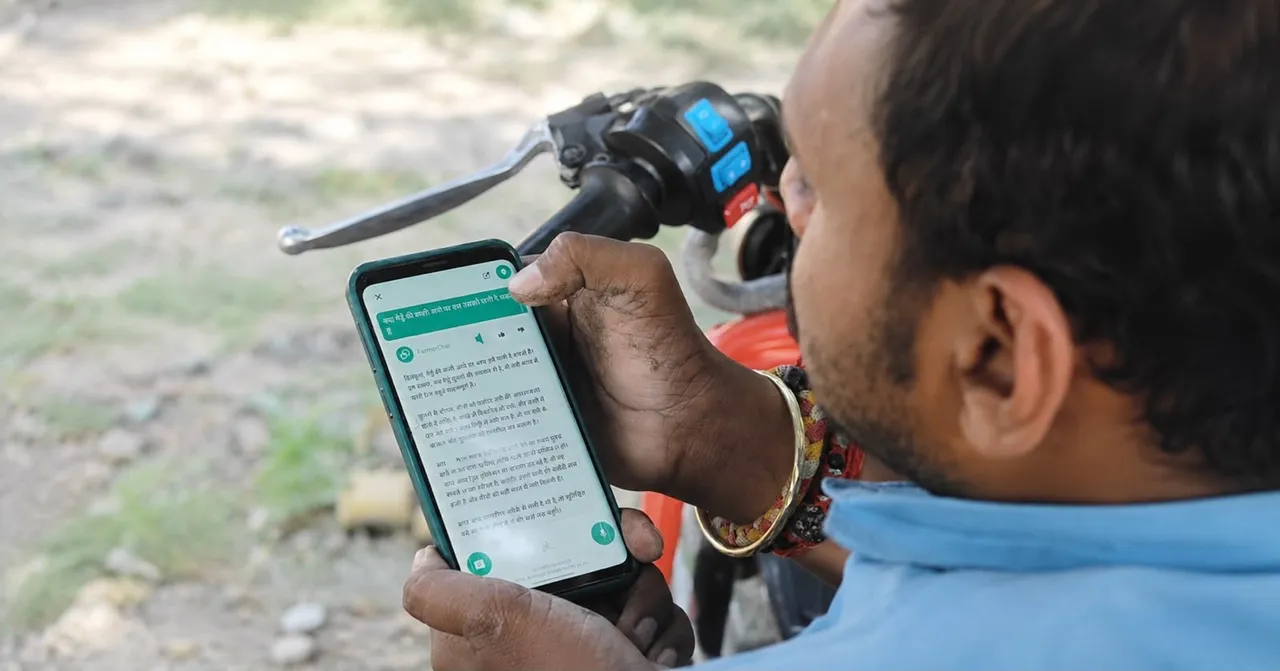
Farmers can ask a question by typing, recording a voice message or uploading a photo of an affected crop. Support currently covers English, Hindi, Marathi, Kannada and Telugu. The platform advises on crops, livestock, dairy, fisheries and climate-smart practices. It is free to farmers and funded by philanthropy and CSR partnerships.
How the Technology Works
FarmerChat is not a general-purpose chatbot, because wrong agricultural advice can destroy a crop. Several design choices keep its answers grounded:
- Context first. The system identifies the farmer’s location, crop, growth stage and local weather before answering.
- Retrieval-augmented generation (RAG). Large language models draw only on a verified knowledge base of government advisories, scientific research and Digital Green’s own farmer-led learning repository. They do not search the open internet.
- Multimodal inputs. Image recognition identifies likely diseases or pests from photographs. Speech technologies for Indian languages allow voice queries and audio replies, so literacy is not a barrier.
- Actionable output. Farmers receive chemical and organic options, exact quantities, application methods and precautions. They can ask follow-up questions until they are confident.
- Human-in-the-loop. Agronomists in different states review queries, validate responses and refine the models. In Bihar, four to six agronomists helped train a language model before release.
Digital Green also publishes open research, including benchmarks for agricultural speech recognition in low-resource languages and a dataset of 1.4 million farmer questions and answers. It reports that its voice pipeline reduces speech-recognition errors by 16–23% without changing the underlying model.
Impact
FarmerChat has reached over one million users in under two years, and almost half are women. Independent research, including a 60 Decibels study, reports the following:
- 60% of active users acted on the advice, and 83% said agricultural information had become easier to access.
- 91% reported greater confidence in farming decisions, including 96% of women users compared with 89% of men.
- Nearly three in four rated the advice highly relevant, and four in five said it gave them all the information they needed.
Digital Green also reports that the cost of getting a farmer to adopt a new practice has fallen from about $35 to under $1, with a single answer costing less than four cents. These figures come from its organisation-wide FarmerChat programme, not India alone.
Farmer accounts show the effect in practice. A Varanasi mango-nursery owner diagnosed a fungal infection from a photograph and estimates he saved around Rs 10,000 in plant losses and repeated spraying. A wheat farmer in the same district estimates savings of Rs 8,000–10,000 by applying fungicide in the right dose. A Bihar farmer postponed potato sowing on the app’s rainfall prediction and avoided a loss of nearly Rs 5,000. A Mirzapur farmer reports earning Rs 7,000–9,000 more from her wheat crop after following balanced-fertiliser and irrigation advice. These figures are self-reported estimates and should be read as indicative rather than as audited outcomes.
Relevance to Indian Agriculture
Time-sensitive decisions are the central problem in smallholder farming, and FarmerChat shortens the path from problem to action from days to seconds. Early disease detection reduces crop loss. Precise dosing cuts unnecessary pesticide and fertiliser use, which lowers costs and environmental load. Weather-aware timing advice builds climate resilience. It also complements the extension system rather than replacing it, extending the reach of scarce agricultural officers.
Alignment with India’s Development Goals
- Farmer income and livelihoods: Lower input costs, reduced losses and better yields support the goal of raising farm incomes and building a resilient rural economy.
- Digital India and linguistic inclusion: Voice-first, multilingual access brings AI to users whom text-heavy digital services often exclude, in line with the push to make digital public goods available in Indian languages.
- Women’s empowerment: Women are a large share of users, and the reported gains in confidence point to progress on gender equity in agriculture (SDG 5).
- Food security and sustainability: Better crop protection and efficient input use contribute to SDG 2 (Zero Hunger) and SDG 13 (Climate Action).
- Responsible AI: Verified knowledge bases, expert oversight and open datasets offer a model of trustworthy, accountable AI in a high-stakes sector.
Way Forward
Digital Green plans to add personalised crop calendars, government scheme discovery, market prices, credit support and market linkages, turning an advisory tool into an end-to-end agricultural ecosystem. The main challenges are expanding to more Indian languages, reaching farmers without smartphones (the app is currently Android-only), keeping funding sustainable for a free service, and maintaining advice quality at scale.
Share Your Story Today, Shape Viksit Bharat Tomorrow
Got an idea, innovation, or experience that's making a difference? Share your story now and ignite India's transformation because your voice can drive the future forward!
Disclaimer:
Features ‘as is’ submissions and neither constitutes endorsement, certification, recommendation, or validation by NITI Aayog nor makes NITI Aayog liable in any manner.
Resources to Replicate This Idea
BUILD YOUR OWN INTERVENTION
Handpicked stories tailored just for you
Explore stories that inspire, inform, and ignite new ideas across tech, innovation, and real-world impact


Pilotless Cargo Flights with Zero Failures: Reimagining Diagnostic Logistics in Indian Cities
An energy-efficient autonomous aircraft combining vertical take-off with fixed-wing cruise has completed over 1,000 flights carrying diagnostic samples between hospitals,...
Read More