
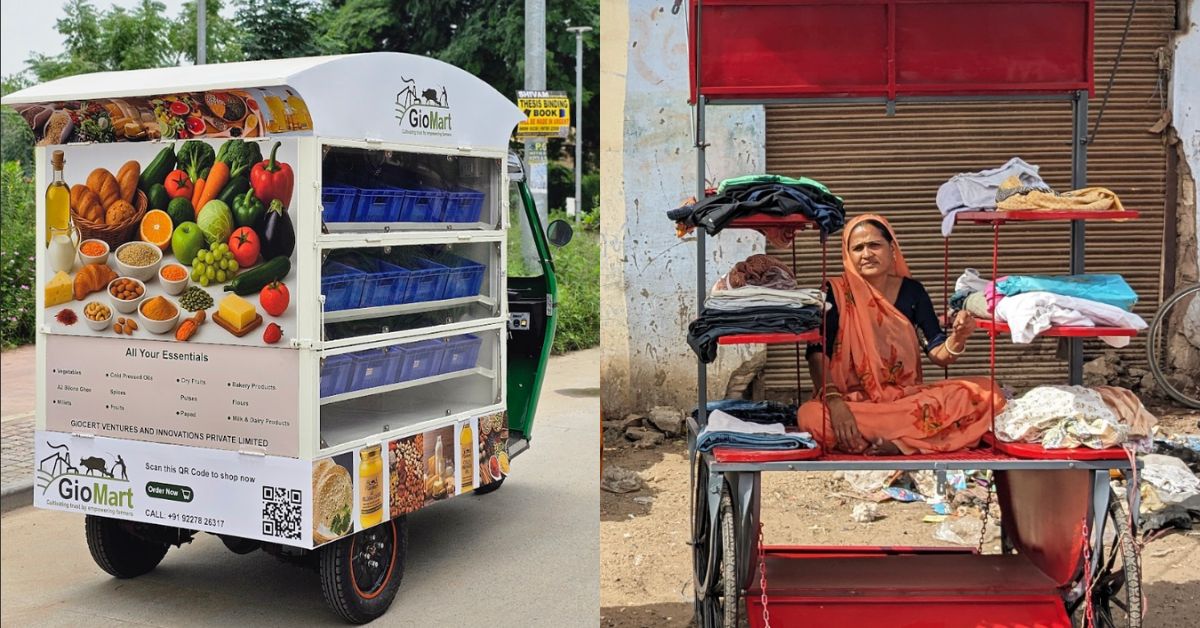
500 Vendors, Up to 90% Lower Costs: Gujarat Startup Is Rebuilding Street Vendor Economics
CIBOS Techno Solutions is transforming India’s informal food economy by equipping street vendors with energy-efficient appliances, smart food carts, and a WhatsApp-based discovery platform. By cutting operating costs by up to 97% and improving visibility, the startup is helping vendors increase incomes and build more sustainable, tech-enabled food businesses.
Updated on: 21 March 2026

Sector

Solution
Cold Storage

Technology
Solar Energy

State of Origin
Disclaimer:
Features ‘as is’ submissions and neither constitutes endorsement, certification, recommendation, or validation by NITI Aayog nor makes NITI Aayog liable in any manner.
Impact Metrics
~90% reduction
in operational energy expenses through DC-powered, solar-compatible appliances.
500+ street vendors
onboarded across India, actively using CIBOS solutions.
Zero dependency
on grid electricity for key operations, enabling true off-grid functionality.
Improved market access
for previously “invisible” vendors through WhatsApp-based discovery.
This story was submitted under our programme Frontier Voices of India. If you have an innovation that’s solving critical challenges in India, we want to hear from you. Register using this link, or write to us at frontiertech@thebetterindia.com.
Across India, millions of street vendors power the country’s informal food economy. They are the creators of neighbourhood chai stalls, roadside breakfast counters, and iconic late-night food carts that define urban life. Yet despite their cultural and economic importance, most vendors operate within a fragmented ecosystem—one with limited access to infrastructure, technology, and formal market visibility.
CIBOS Techno Solutions is attempting to change that equation.
Founded by electronics engineer Aditya Dave, the startup is developing a technology ecosystem designed specifically for street vendors. It offers deep-tech hardware, low-energy electrical appliances, and ultra-low-tech digital discovery tools that reduce costs and increase earnings for vendors for these informal food entrepreneurs. The goal is simple but ambitious: to help street vendors run better, more efficient businesses using tailored technological solutions.
The philosophy behind CIBOS — technology for the informal economy
The idea behind CIBOS was shaped by the observation that while street food is widely celebrated in India, the vast majority of vendors do not receive professional recognition or other forms of formal support.
Food bloggers, social media, and restaurant aggregators highlight the top few percent of street food vendors. However, nearly 90% of the ecosystem—like elsewhere in the informal sector—operates without visibility, new technology, or access to financial aid packages. Most government schemes target either formal enterprises or remote rural populations, leaving urban street vendors in a policy ‘grey zone’. Procuring licenses or loans is slow, and as a result, many food stalls are shut down by the authorities. This means that a major part of India’s food economy is left behind in the process of economic development.
CIBOS emerged from this gap. Rather than focusing on a single product, the company has cultivated an ecosystem that combines physical infrastructure, energy-efficient appliances, and digital visibility tools. The objective is to help street food sellers grow more financially stable and thus build stronger livelihoods.
The technology — low-energy infrastructure for mobile food businesses
CIBOS’s core innovation lies in developing energy-efficient appliances for battery-powered or off-grid street operations.
Most conventional heating and cooling appliances are built for AC-powered environments with continuous electricity supply. Standard heating devices often require 1500–2000 watts of power, making them impractical for carts or mobile vendors without grid connections. As a result, street food vendors tend to use gas or charcoal for cooking and heating. Not only does this increase pollution but it is also expensive. To address this challenge, CIBOS developed DC-powered heating and refrigeration components, including infrared electric cook stoves, off-grid cold boxes, and food carts that can be quickly set up in various venues.
Using WhatsApp to publicize street food stalls
Restaurant aggregators such as delivery platforms make it easy to find restaurants, but this is not viable for street vendors. To solve this problem, CIBOS created Laari Khojo, a digital platform that helps street vendors build an online presence. This platform lets vendors share their stall locations, send regular updates, and manage their finances. It also makes it easy for vendors to procure loans and licenses. As a customer, one only needs to open a web app to search for the food and/or food stall in mind. The interface is as detailed as those used for larger restaurants.
By avoiding lengthy setup processes and instead relying on WhatsApp, Laari Khojo platform counters the digital barriers that often exclude informal workers in the food industry.
Reducing costs and increasing revenue
CIBOS measures its impact through two primary outcomes for vendors: lower operational costs and increased revenue through visibility and infrastructure. According to CIBOS’s market research, street vendors spend about INR 60,000 per year only for infrastructure maintenance and often run at severe losses. CIBOS reduces traditional cooking costs that range from ₹3,000–₹4,000 per month to roughly ₹100–₹300 per month — a 90-97.5% cut — improving vendor profitability and financial stability. Additionally, improved carts and refrigeration systems allow vendors to store ingredients safely and operate for longer hours. In the long run, adopting such solutions could make street food not only a cultural delight but also a financially rewarding venture.
Current reach
The company remains in an early growth phase, having made pilot deployments across multiple regions, notably Indore, Bengaluru, Mumbai, and parts of Chhattisgarh. Currently, its products and services are used by around 500 vendors across India. Their clients include not only independent food sellers but also CSR projects/NGOs (e.g., SELCO Foundation and Pratham Education Foundation), franchise employees, and kiosk operators at public venues. These collaborations have enabled the real-world testing of carts, stoves, and vendor support systems in diverse settings.
In 2024, CIBOS’s work was recognized by the International Solar Alliance, winning the SolarX Startup Challenge. Such achievements are critical for early-stage ecosystem technologies as they help startups demonstrate viability and impact at the grassroots level.
Why this matters for India’s informal workforce
Street vendors are among the largest segments of India’s informal economy. They face several structural constraints including limited infrastructure, high operating costs, a lack of formal discoverability, minimal access to modern appliances, and inconsistent policy support. CIBOS attempts to tackle these barriers by building the missing infrastructure layer for mobile food entrepreneurs. The startup’s approach highlights a broader insight: enabling informal workers often requires system-level interventions, rather than single products.
Challenges in building the ecosystem
Building this kind of integrated ecosystem has presented several challenges, two of which are listed below:
1. Product positioning
Many stakeholders advised the company to focus on a single product—such as manufacturing cook stoves—rather than building a broader ecosystem. However, the founders believe that isolated solutions cannot create systemic change for vendors. Instead, they continue to pursue a multi-layer approach that integrates infrastructure, appliances, and digital platforms.
2. Deep technology development
Rather than importing components, CIBOS chose to design and manufacture key hardware components in-house, including coils and compressors. While this approach slowed early scaling, it allowed the company to develop a stronger technological foundation tailored to vendor use cases.
What is needed to scale solutions like CIBOS
Scaling innovations for the informal economy requires broader ecosystem support.
Three areas stand out:
1. Stronger policy frameworks
Clear policy recognition and support for street vendor infrastructure could accelerate innovation in the sector. Targeted policies could enable new startups and technologies to emerge around informal food ecosystems.
2. Access to vendor financing
While financing schemes exist, expanding access to affordable credit remains essential. Programs similar to small enterprise financing schemes can help vendors adopt improved infrastructure such as energy-efficient carts and appliances.
3. Institutional pilots and partnerships
Pilots supported by NGOs, foundations, and public institutions help validate new technologies in real-world settings. These partnerships allow vendors to test innovations before committing to adoption, hence building trust and demonstrating viability. This has already been noted by CIBOS, but greater publicity would be useful.
Building the future of informal food infrastructure
India’s street food sector represents both a cultural treasure and an economic engine. Yet it has historically lacked the technological and infrastructure investments seen in formal food businesses. CIBOS is attempting to change this by building tools designed specifically for the realities of the informal economy. In doing so, the company highlights a broader principle for policy and innovation alike: technology has the greatest impact when it is designed not for ideal conditions, but for the environments where people actually work.
If scaled effectively, such systems could reduce costs, increase visibility, and thus enable millions of micro-entrepreneurs to grow sustainable businesses.
Share Your Story Today, Shape Viksit Bharat Tomorrow
Got an idea, innovation, or experience that's making a difference? Share your story now and ignite India's transformation because your voice can drive the future forward!
Disclaimer:
Features ‘as is’ submissions and neither constitutes endorsement, certification, recommendation, or validation by NITI Aayog nor makes NITI Aayog liable in any manner.
Resources to Replicate This Idea
BUILD YOUR OWN INTERVENTION
Handpicked stories tailored just for you
Explore stories that inspire, inform, and ignite new ideas across tech, innovation, and real-world impact

Pilotless Cargo Flights with Zero Failures: Reimagining Diagnostic Logistics in Indian Cities
An energy-efficient autonomous aircraft combining vertical take-off with fixed-wing cruise has completed over 1,000 flights carrying diagnostic samples between hospitals,...
Read More