Using Tech to Support Labor Rooms: The AI-Powered Kits That Screened ~800,000 Pregnancies Across India
Despite making strides in preventive healthcare, India has not yet eliminated maternal and infant mortality. Pune-based startup DOTO Health is helping monitor pregnancies with AI insights to ensure healthy, safe deliveries.
Updated on: 31 August 2026

Sector

Solution

Technology
AI

State of Origin
Impact Metrics
Fewer low-weight infant deliveries
due to using kit in one tribal block.
~ 2 million monitoring sessions
held in total for mothers and infants.
Healthcare infrastructure is faced with several limitations in India. High-quality treatment and diagnosis remain expensive, making them inaccessible for most vulnerable populations. One such population includes millions of childbearing women in rural India.
Owing to inadequate care during pregnancy, many regions of India have high rates of neonatal mortality. Although nine out of ten births today happen within medical facilities, roughly 50% of all maternal and newborn deaths still take place during labor and within the following 24 hours.
Improved screening technology may have the answer to this problem. Not only would it save the lives of mothers but it would also ensure the wellbeing of the next generation of Indians. DOTO Health, founded in 2022 by Dr Shantanu Pathak, provides specialized monitoring devices that support preexisting rural health initiatives. Using AI algorithms, these devices identify complications in pregnancy early on, bringing preventive healthcare to India’s most underserved patients.
How does the innovation work?
Technology for monitoring maternal and fetal wellbeing has long existed. However, its high procurement costs and dependence on highly specific materials (e.g., thermal printer paper) make it unviable for rural settings. Moreover, interpreting the data results from monitoring can be complex, requiring additional training for health workers.
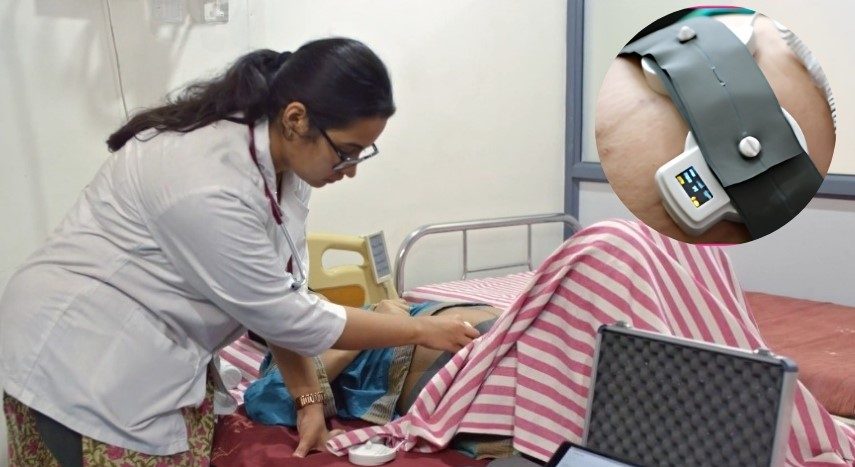
DOTO Health’s model, meanwhile, sidesteps these barriers. The FetoMax and FetoMax Twin devices, which are strapped onto the pregnant mother, quickly detect information from the fetus in real time. This information is transmitted directly to a UI-optimized digital platform, where health workers can view it and generate reports. Finally, AI models trained on a clinical dataset go through these reports, flagging any potential complications or risks to the mother or child.
The advantage of using this model is that recording routine pregnancy data becomes automated, reducing the burden on nurses and other healthcare professionals. According to Dr Pathak, it can detect a variety of life-threatening problems during pregnancy, ranging from obstructed airways to hypoxic–ischemic encephalopathy.
How does DOTO Health deploy its monitoring kits?
There are two ways in which DOTO Health brings its innovation to the patients who most require it. Firstly, it partners with frontline health workers such as ASHA and ANM staff. These workers carry kits with monitoring devices to the homes of pregnant rural women and carry out the checkups there. The resulting data is sent to midwives and nurses who will support these women during labor. Secondly, DODO Health also provides the same kits to partner hospitals, allowing them to be used in both regular checkups as well as labor rooms.
Funding for the innovation
In both use cases, public health organizations have partnered with the startup to support product dissemination. Medical institutions that collaborate with it include KEM Hospital Mumbai and St John’s Hospital, Bengaluru.
Additionally, various government grants have supported DOTO Health in product research and development, and IIT Bombay played a key role in early incubation.
Coverage in India
DOTO Health makes high-quality prenatal monitoring available at the village level, complementing existing initiatives by the Indian State such as the Village Health, Sanitation and Nutrition Days (VHSNDs). Its kits are used in almost every Indian state, mainly in the north, south, and east of the country. Around half of all the startup’s installations are in the private sector.
Impact on health sector
Using DOTO Health’s kits, medical professionals have facilitated approximately 800,000 pregnancies and held ~2 million monitoring sessions in total.
During pilot testing, in collaboration with Atlantic Philanthropies, the startup brought its kits to a tribal block in Palghar District, Maharashtra. Due to this intervention, the block is now one of the two highest performing blocks in the district in terms of maternal and newborn health. Over the three years of the intervention, there was a 90% reduction in the number of low-weight infant deliveries, indicating more healthy fetal growth. The percentage of women registering for screening in the first trimester rose from 6% to 15.8%. Around 3,000 patients received care supplemented by DOTO Health’s monitoring kits.
Potential for scaling innovation
DOTO Health recognizes that in regard to monitoring pregnancy and predicting maternal/fetal wellbeing, there is a shortage of data for AI models. The startup’s next objective is to track the birthing journey in detail and compile a dataset of 8000 cases. This database can then be used to refine AI and better detect any complications before they develop. Both the Indian government as well as the Gates Foundation are backing this initiative.
On a broader level, DOTO Health calls for a stronger standardization of conditions in labor rooms across the country. They note that while including more digital technologies is beneficial, health policymakers must also improve the physical environments and emotional support provided in labor rooms since these factors can strongly impact stress during childbirth.
To demonstrate a proof of concept for national standards, the startup and the SELCO Foundation have designed and are testing ‘Model Labor Rooms’ in five Indian states. Further support from both private and public players can polish these and ultimately secure the health of the future generations.
Share Your Story Today, Shape Viksit Bharat Tomorrow
Got an idea, innovation, or experience that's making a difference? Share your story now and ignite India's transformation because your voice can drive the future forward!
Resources to Replicate This Idea
BUILD YOUR OWN INTERVENTION
Handpicked stories tailored just for you
Explore stories that inspire, inform, and ignite new ideas across tech, innovation, and real-world impact

How AI Diagnostics Are Reaching India’s Frontline Health Workers
AffEx equips rural health workers with an AI-powered point-of-care screening kit — testing hemoglobin, blood pressure, ECG, and cardiac and...
Read More