From Data to Harvest: Brio's Tech Stack Reshaping Predictability in Indian Agriculture
Brio Hydroponics combines IoT sensors, AI-driven decision-making, and automation to bring predictability to Indian agriculture. This case study explores its soilless farming technology, nationwide scale, and role in building India’s largest hydroponic park.
Updated on: 31 July 2026

Sector

Solution

Technology
IoT

State of Origin
Disclaimer:
Features ‘as is’ submissions and neither constitutes endorsement, certification, recommendation, or validation by NITI Aayog nor makes NITI Aayog liable in any manner.
Impact Metrics
16,000+ participants
trained in hydroponics programmes.
150+ hydroponic projects
completed across corporate, government, and individual clients.
India's biggest
hydroponic park launched, located in Talod.
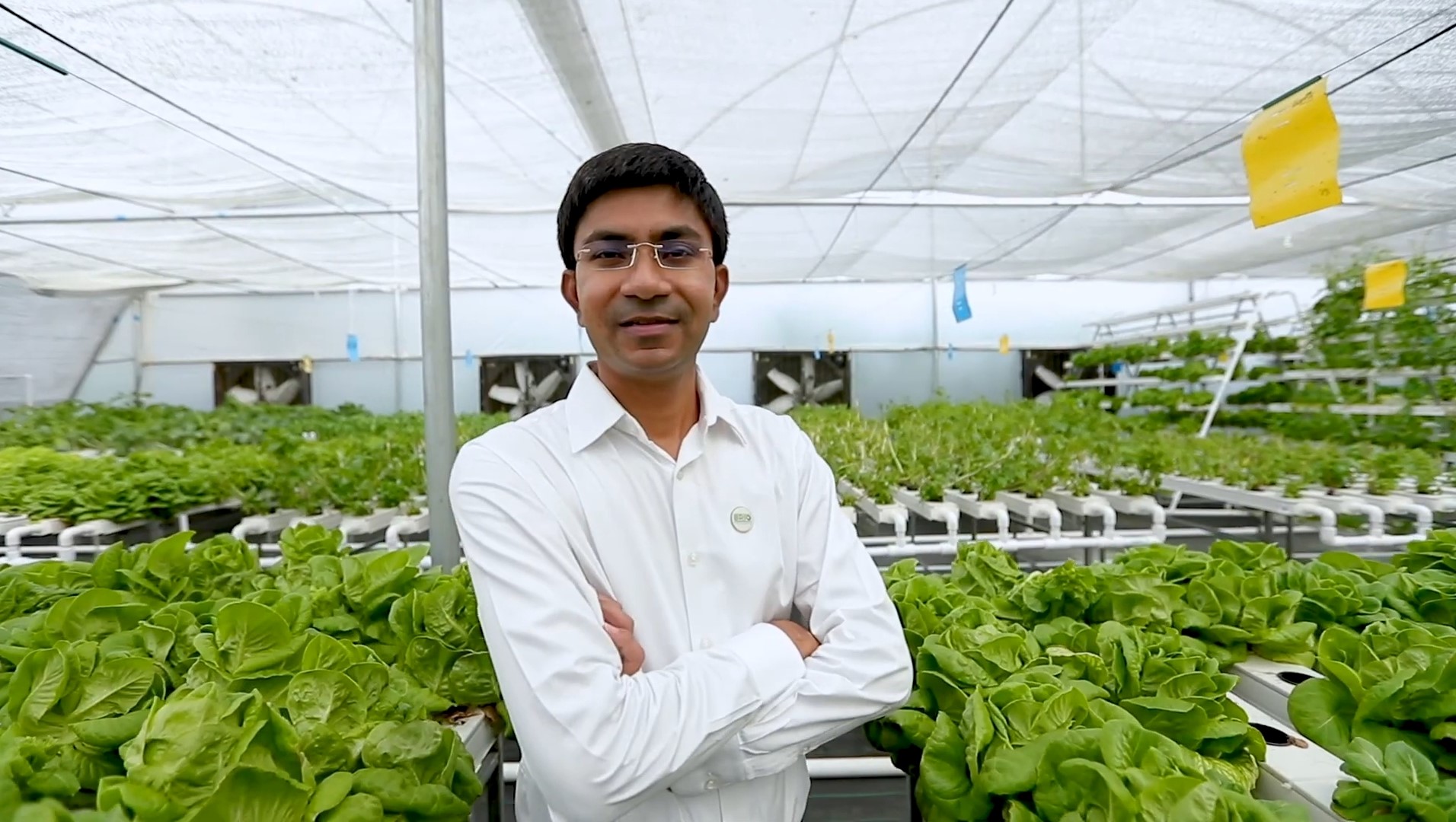
Brio Hydroponics has spent over a decade working to solve one of Indian agriculture’s oldest problems: unpredictability. Conventional, soil-based farming leaves outcomes at the mercy of weather, water availability, labor supply, and volatile market prices. Brio’s core proposition is that soilless farming, combined with sensor-driven technology, can convert this unpredictable activity into a controllable, data-backed business. Over roughly twelve years, that proposition has grown from a single training initiative into a group of four companies, more than 150 completed projects, and what is described as India’s largest hydroponic park.
What Hydroponics Solves
Hydroponics is a soilless farming method built around a precise understanding of what a plant actually needs to grow — water, nutrients, and climate conditions — rather than relying on the variability of open land and weather. Because the technique controls these inputs directly, it removes several constraints that limit conventional farming: it does not depend on whether land is fertile or barren, and it can be applied to a wide range of crops, including horticulture, leafy greens, medicinal plants, grains, and pulses. The trade-off is that it demands more capital, more technical skill, and a genuine business mindset rather than a traditional farming mindset. Brio’s approach has been to treat hydroponics not simply as a farming technique but as an infrastructure layer — connecting land, cultivation, and eventually B2B market access — that can be replicated across regions.
Technology as a Tool, Not a Product
A recurring principle in how Brio operates its systems is that technology is a tool for building confidence and predictability, not a product to be sold on its own. Three layers make up the stack:
- IoT sensors monitor climate and plant conditions continuously, effectively flagging issues before visible symptoms appear on the plant itself.
- AI analyzes the resulting data to sharpen and speed up decision-making, allowing production planning, quality control, and year-round cultivation without dependence on chemical intervention.
- Automation handles the repetitive, recurring tasks within a grow cycle, applying the precision that IoT and AI data make possible.
The underlying philosophy is prevention over cure: because a curative response to a plant health issue is costly and often too late, the goal is to use data to anticipate problems rather than react to them. This also marks a shift in how decisions get made — from relying primarily on farming experience to combining that experience with real-time data, treating data itself as a critical input alongside traditional know-how.
Building the Market Through Training
When Brio began explaining hydroponics to corporates, colleges, students, and individual farmers over a decade ago, the concept was largely unfamiliar in India. To close that gap, Brio launched what it describes as the country’s first commercial hydroponic training program, delivered both online and offline. That training function has since scaled substantially, reaching more than 16,000 participants to date. Early client-facing projects were modest — in the range of ₹10–12 lakh — and have since scaled to projects valued at ₹5 crore and ₹10 crore, reflecting growing confidence from corporate, government, and individual clients alike.
Scale and Geographic Reach
Brio’s project portfolio spans more than 150 engagements across corporate captive projects, R&D collaborations, government-linked initiatives, and individual client work. Domestically, activity has extended across states including Assam, Madhya Pradesh, Rajasthan, Gujarat, Maharashtra, Tamil Nadu, and Karnataka, often in partnership with state government bodies and institutions. Internationally, Brio has delivered work in the Maldives, Singapore, Oman, Saudi Arabia, the UAE, and parts of Africa including Uganda. The group now operates as four companies, having grown from a single training-led offering into a broader ecosystem business.
Flagship Achievement: An End-to-End Hydroponic Park
The clearest expression of Brio’s ecosystem approach is a large-scale hydroponic park launched in Talod, described as India’s biggest facility of its kind. The park is built to cover the full value chain — from land and cultivation infrastructure through to B2B market access — rather than isolated growing operations. Brio has stated an intention to replicate this integrated model in additional locations going forward.
Reshaping Who Farms
Alongside the technical and infrastructure work, Brio has pushed a deliberate shift in perception: farming reframed not as a fallback occupation but as a viable, technology-enabled career choice — for people with no inherited farmland as well as those with agricultural backgrounds. Public campaigns promoting the idea that “anybody can be an agripreneur” have contributed to drawing IT professionals and investors into agriculture as a chosen career path rather than a default one.
Policy Direction and Outstanding Needs
On government support, the view is that existing schemes cover open farming well — irrigation, automation, and tractor subsidies among them — but soilless farming requires a more deliberate support structure. Because capital expenditure is the single biggest barrier for individual farmers entering hydroponics, industry-backed handholding, documented case studies, and phased trust-building are seen as necessary to help both traditional farmers and non-farming entrepreneurs scale into the space. Broader asks include dedicated funds, subsidies, and university and industry partnerships aimed specifically at soilless and climate-controlled farming.
The Larger Goal
Brio frames its long-term aim as shifting Indian agriculture’s focus from pure production volume toward precision, food safety, nutritional quality, and predictable demand-supply balance. With India’s large youth population positioned as a resource rather than a constraint, the ambition is to embed technology-enabled farming as a mainstream career track — positioning hydroponics not as a niche technique but as a structural contribution to national food security.
Share Your Story Today, Shape Viksit Bharat Tomorrow
Got an idea, innovation, or experience that's making a difference? Share your story now and ignite India's transformation because your voice can drive the future forward!
Disclaimer:
Features ‘as is’ submissions and neither constitutes endorsement, certification, recommendation, or validation by NITI Aayog nor makes NITI Aayog liable in any manner.
Resources to Replicate This Idea
BUILD YOUR OWN INTERVENTION
Handpicked stories tailored just for you
Explore stories that inspire, inform, and ignite new ideas across tech, innovation, and real-world impact

Frontier GaN Technology: Scaling India’s Semiconductor Ambitions Through Indigenous Innovation
Gallium Nitride (GaN) is emerging as a frontier semiconductor technology with the potential to transform India’s defence, telecommunications and power...
Read More