From Peel to Field: How Fasal Amrit is Helping 120,000 Indian Farmers Fight Water Scarcity+
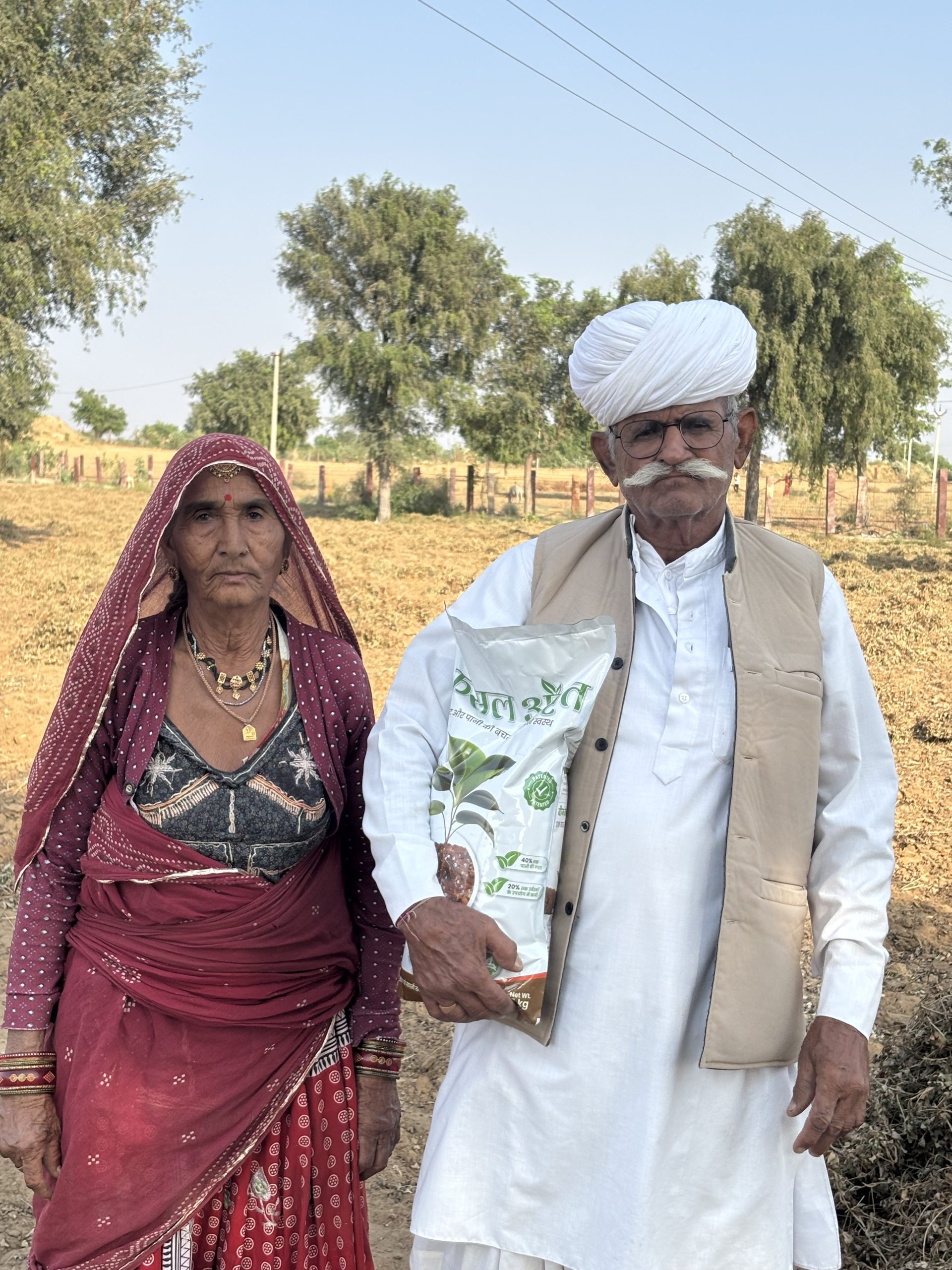
EF Polymer manufactures Fasal Amrit, a biodegradable superabsorbent polymer made from orange and banana peels. Mixed into soil, it retains excess water and helps crops survive dry spells, addressing water scarcity for over 120,000 Indian farmers.
Updated on: 31 July 2026

Sector

Solution

Technology

State of Origin
Impact Metrics
105 billion litres
of water have been saved to date, at scale.
Over 120,000 farmers
have been reached by EF Polymer to date.
5 to 6 additional days
of soil moisture retention can be gained using Fasal Amrit.
"Per Drop More Crop" (PMKSY)
is one government initiative Fasal Amrit's goals align with.
The agrarian heritage of India can hardly be overestimated. From being on the brink of a widespread famine sixty years ago to being a consistent net food exporter today, the journey has been noteworthy.
However, the agricultural industry is plagued with several problems. Low productivity has remained a constant issue — the sector contributes to only 17-18% of India’s GDP, despite employing over 40% of its population.
Another major problem is its heightened vulnerability to climate change, worsened by the fact that about half of India’s total cropped land is rainfed and thus highly exposed to monsoon variability. Just this year, data from the India Meteorological Department (IMD) shows that 397 of India’s 741 districts recorded below-normal rainfall as of mid-July. This shortfall is especially acute across the Gangetic plains, including parts of Uttar Pradesh, Bihar and Jharkhand.
Seeds of a solution
The accelerating rate of climate change may have turned monsoon variability and seasonal water scarcity into frequently heard terms, but the phenomena themselves are nothing new. Narayan Lal Gurjar and Puran Rajput, who grew up in the same small village, recall one of the driest spells they witnessed there, over a decade and a half ago. The entire village’s maize crop failed that year. This prompted them to go about looking for solutions that could minimize the devastating effects of rainfall variability.
They realized that soil, depending on its kind, can retain only so much water — the rest either escapes from the surface or goes quite deep into the soil — and for only so long. During irregular monsoon rains, soil has no water left to support the crop. As Narayan and Puran searched for solutions, they came across Superabsorbent Polymers (SAPs) — eventually developing what is now called Fasal Amrit.
When mixed with soil while it is being ploughed, either by hand or by using seed drilling machines, Fasal Amrit ends up absorbing the excess water that the soil itself doesn’t. To keep it completely organic, as opposed to synthetic SAPs that were available in the market, the founders experimented with several fruit peels, ultimately finding more alignment and success with orange and banana peels, which now serve as raw materials for the product. It comes in powder or granular form and can maintain moisture for as much as five to six additional days after soil loses its water.
Arriving at this formulation, however, was far from straightforward.
Given their limited experience, the founders sought external support in 2016-17. As part of the Maharana Pratap University of Agriculture and Technology, Narayan led R&D, seeking frequent guidance from its professors. Access to laboratories to perform experiments was another major hurdle — the university’s laboratory was not fully incubated, and access was also slow to obtain. This compelled them to perform whatever experiments possible in their own kitchens.
Almost three years later, the founders went to Japan under the Startup Accelerator Program which provided an excellent framework and facilities to learn organic chemistry and polymer sciences, helping them arrive at the final formulation for the product.
When the time came to begin manufacturing, the COVID-19 pandemic hit. Instead of investing in their own manufacturing infrastructure, the founders outsourced some parts of the manufacturing process — juice manufacturing companies were tapped for procuring fruit peels in dry powder form and pectin processing was also outsourced. Polymerization was undertaken in-house.
Reaching the final consumers proved to be challenging. Initially supported by Tata Trust, The Gates Foundation and Social Alpha, they started demonstrating the product to farmers in the region of Bundelkhand, Rajasthan. With the help of small district level NGOs, they received good results and started expanding.
Fasal Amrit’s early scaling relied on pitching events and government grants like PRISM and iStart, before moving on to equity funding. EF Polymer raised around 18 million USD in Series B funding last year. The company is also looking to expand into several non-agricultural industries where SAP technology can be utilised — sanitation, hygiene, cosmetic grade. Geographically, EF Polymer operates across the country, with a particular stronghold in UP and Rajasthan. Their team is also spread out in Japan, US and Europe.
Every drop counts
EF Polymer underlines a few assumptions it holds in evaluating impact. Assuming first-time users use Fasal Amrit on half an acre of land while regular customers are willing to use it across several, an average of one acre per farmer is taken — equivalent to 5 kilograms of product, the standard dose for that area.
Since the company primarily works with distributors and B2B partners, it also assumes that only 60 to 70 percent of the sold product gets used by farmers, while the rest remains within the channels. As such, the company estimates it has reached approximately 120,000 so far, with over 50,000 reached in the previous financial year itself.
EF Polymer also conducted a study to determine the amount of water that Fasal Amrit can save per acre of land. While water conservation varies depending on the type of soil and crop, they estimate that an average of 100,000 litres of water can be conserved per acre by using their product. At scale, the company estimates it has helped save over 105,000 million litres of water to date.
The Way Forward
While innovations like Fasal Amrit do their part in improving agriculture in India along the lines of sustainability and resilience to climate variability — goals that align with government projects such as “Per Drop More Crop” and National Mission for Sustainable Agriculture — the co-founder also impresses upon the need for strict government regulation on how much water is being utilised by different parties in the agricultural industry.
Share Your Story Today, Shape Viksit Bharat Tomorrow
Got an idea, innovation, or experience that's making a difference? Share your story now and ignite India's transformation because your voice can drive the future forward!
Resources to Replicate This Idea
BUILD YOUR OWN INTERVENTION
Handpicked stories tailored just for you
Explore stories that inspire, inform, and ignite new ideas across tech, innovation, and real-world impact

Safe Access: India’s Community-Verified Digital Locator for HIV Prevention Services
Safe Access is a free, community-driven Indian platform that helps people locate verified PrEP and PEP providers nearby. By mapping...
Read More