Measure the Milk, Fix the Chain: How Digital Traceability Is Lifting India’s Small Farmers
By linking IoT devices, cloud data and AI from cow to carton, a Bengaluru startup traces India’s fragmented milk supply, raising yields and incomes, extending credit and insurance to smallholders, and cutting emissions, with disease surveillance next.
Updated on: 28 October 2026

Sector

Solution

Technology

State of Origin
Disclaimer:
Features ‘as is’ submissions and neither constitutes endorsement, certification, recommendation, or validation by NITI Aayog nor makes NITI Aayog liable in any manner.
Impact Metrics
16 million litres
of milk processed everyday.
3.5 million farmers
reached across 42,000 villages in India.
Raising yield per animal
from 5 to 12 litres a day cuts emissions per litre by more than half.
India produces about a quarter of the world’s milk, yet roughly three-quarters of it moves through the unorganised sector. It passes through local agents and informal channels, with little traceability and a real risk of adulteration.
The chain behind it is vast and fragmented. About 80 million small-holder farming families, together keeping some 300 million cattle, pour milk twice a day into village collection centres. From there it goes to chilling points, then processing plants, then retailers. A failure at any one link, such as an unchilled can or a mis-weighed delivery, degrades the whole chain.
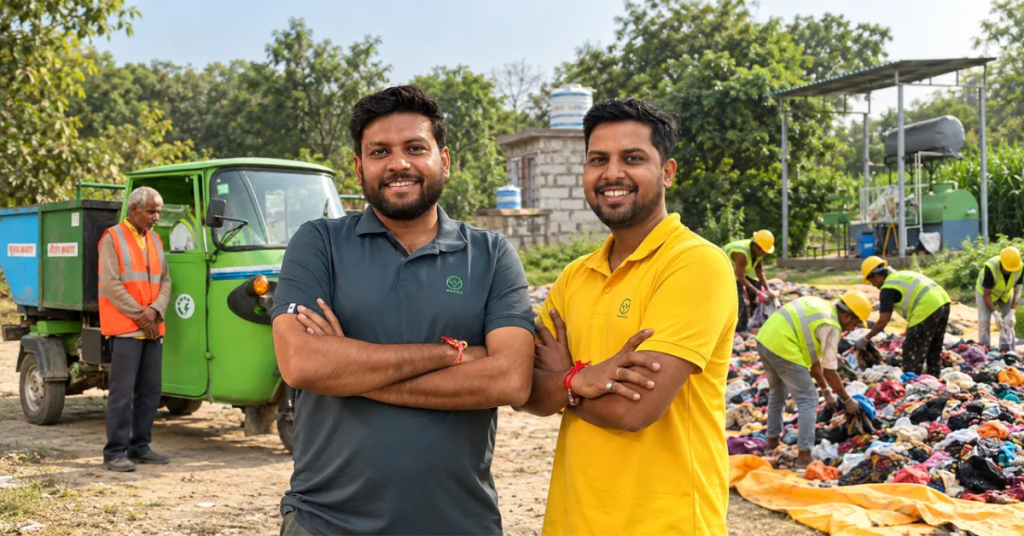
Bengaluru-based Stellapps, incubated at IIT Madras, has spent more than 15 years digitising that chain. Co-founders Ranjith Mukundan and Ravishankar Shiroor aim to solve for three things: productivity, quality and traceability. The company’s approach rests on a simple premise: you cannot fix what you do not measure, and the weakest unmeasured link sets the quality of everything downstream.
The technology: Three layers
Stellapps leverages deep-tech IoT, Cloud, and AI to elevate the traditional practices. Different solution covers different points in the supply chain
- mooON device is a leg-worn wearable, which Mukundan likens to “a Fitbit for cattle”. It tracks activity and health and flags heat so insemination can be timed correctly. It pairs with a herd-management app that records around 150 parameters on each animal’s health, breeding, feed and milk output.
- smartAMCU sits at the village collection centre. It weighs each farmer’s milk, tests it, grades it against a rate chart and records the transaction, so payment reflects quality.
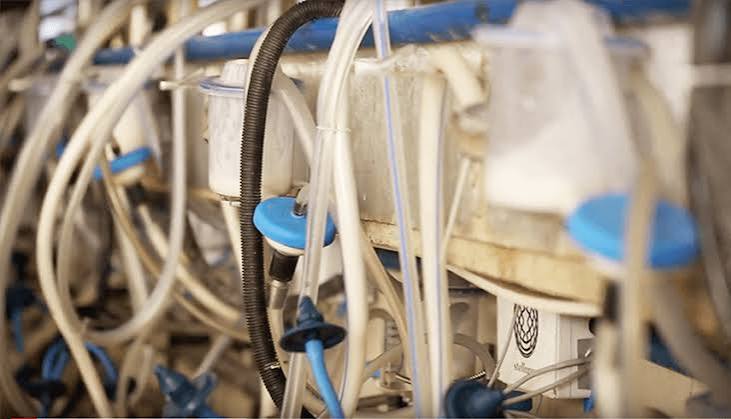
- smartCC at chilling centres flags mismatches between quantity and quality ConTrak monitors temperature, volume, power and cleaning cycles at bulk milk coolers.
Every handoff generates data, and the data is linked by identity. A cow ID maps to a farmer ID, then to a can ID, a collection centre ID, a bulk cooler ID, a tanker ID and a silo ID etc. This lets the company trace every litre of milk back to its source.
The technology stack has been licensed to over 500 dairy processors, including cooperatives such as Amul, Saras, Nandini, Sudha & affiliated unions and private players such as ITC, Varun Beverages, Heritage etc and. Stellapps says it digitises about 16 million litres a day across 42,000 villages, 3.5 million farmers. Stellapps holds seven patent filings, four of them granted.
A layer of applied AI sits on top.
- mooKYC identifies cattle from muzzle-print biometrics, like a fingerprint. Ear tags are easily swapped, which feeds insurance fraud. Stellapps says muzzle-based verification can settle claims in under 48 hours, against 30-plus days for physical inspection.
- mooScore builds an alternative credit score from daily milk volumes, quality and cash flow, a data trail few smallholders otherwise have. Over 60% of its lending customers are new to credit.
On the ground: supply chain as a service
Stellapps found that selling technology to farmers did not work, and around 2011 it switched to selling to dairies. It later built its own supply chain, branded mooMark, and offers it to FMCG and e-commerce brands as Supply chain as service. Rather than each brand building its own procurement and processing, several brands share one traceable back end. Because Stellapps keeps the full mapping from cow to plant, each brand can still tell its own sourcing story.
Milk is bought directly from farmers rather than through agents. It undergoes tests beyond routine fat and protein checks, including antibiotics, aflatoxin and melamine. A QR code on the pack lets a consumer see the villages, the farmers and the tests behind that batch. mooMark currently has a deployed capacity of 3.6 lakhs liters of milk per day in 4 states and 2 state of the art manufacturing units in South and North, with customers across paneer, curd, ghee and high-protein products.
The third layer keeps farmers engaged with financial services and input services. Through mooPay, farmers receive direct digital payments and access loans and cattle insurance. The farm intervention teams with veterinarians and technicians advise on feed, breeding and hygiene, and the company aims to move farmers from hobby-scale keeping to running a dairy as a business. Women are central: in Eastern Uttar Pradesh, every village service provider is a woman.
Impact
A March 2025 survey of 432 farmers in three states, commissioned by investor Omnivore, found an average 15% rise in milk yield. It also found annual cattle healthcare spending falling from ₹7,459 to ₹4,890, a drop of 34.4%. Some 62% had been with Stellapps for over two years, and about 80% rated its services positively. Among farmers who had taken dairy loans, 112 of 122 borrowed from Stellapps. These are self-reported answers from telephone interviews.
The most rigorous evidence comes from Eastern Uttar Pradesh, where Mathematica evaluated a Gates Foundation-backed programme from 2020 to 2023. When Stellapps entered, the area had no organised dairy. The programme planned to reach 400 villages and instead reached 681, and registered 37,000 farmers against a target of 16,000. Mathematica found a 35% increase in total milk production and a 33% increase in farmer profitability, and every farmer was paid directly into a bank account. The return was $3.45 in dairy profit for every dollar spent. Women made up 84% of participating farmers and 76% of borrowers.
Mukundan also points to a best-case cohort of the most progressive farmers. Over 36 months, one such farmer went from 3.5 to 30 litres a day, and daily income rose from ₹150 to ₹1,500. These farmers followed every recommendation, so the figures show what is possible rather than what is typical.
There is a climate dividend as well. Raising yield per animal from 5 to 12 litres a day means fewer cattle for the same milk, and Stellapps calculates that cuts emissions per litre by more than half. Its tech-plus-solar cooling model also reduces diesel use for chilling, from 3.42 to 1.52 litres per 1,000 litres chilled. The mooON app was one of four tools featured in a UN Climate and Clean Air Coalition report presented at COP29.
What comes next
Two research collaborations extend the same infrastructure. With Penn State and ICAR-NIVEDI, Stellapps is piloting milk-based disease surveillance. Daily pooled-milk samples are screened for signals of foot-and-mouth disease, brucellosis and other infections. Because milk is traceable down to village and farmer, an alert can be narrowed to the cohort of animals involved, ideally before symptoms appear. A separate project with Cornell and BAIF is measuring breed-specific greenhouse-gas emissions in Indian cattle, work that could eventually support a carbon-credit framework for dairy.
Challenges remain. Cooperatives, which handle about half of India’s milk, tend to adopt technology slowly. Stellapps also competes for engineering talent in Bengaluru and for capital against better-funded global players such as New Zealand’s Halter. Its bet is that the same data layer that traces milk can also underpin credit, insurance, disease control and carbon accounting for the smallholders who make up the sector.
Share Your Story Today, Shape Viksit Bharat Tomorrow
Got an idea, innovation, or experience that's making a difference? Share your story now and ignite India's transformation because your voice can drive the future forward!
Disclaimer:
Features ‘as is’ submissions and neither constitutes endorsement, certification, recommendation, or validation by NITI Aayog nor makes NITI Aayog liable in any manner.
Resources to Replicate This Idea
BUILD YOUR OWN INTERVENTION
Handpicked stories tailored just for you
Explore stories that inspire, inform, and ignite new ideas across tech, innovation, and real-world impact

How AI and Satellite Innovation Are Transforming Agriculture for 15 Lakh Farmers Across Haryana
From satellite imagery and AI-powered analytics to drone mapping, frontier technologies are transforming how India monitors crop health, predicts yields...
Read More