How AI Could Transform Breast Cancer Treatment at Scale
As breast cancer becomes the most common cancer among Indian women, this tech uses AI and protein biomarkers to predict recurrence risk and guide chemotherapy decisions. Already used by 1500+ doctors across five countries, the test is making precision oncology more affordable and accessible.
Updated on: 29 June 2026

Sector

Solution

Technology

State of Origin
Disclaimer:
Features ‘as is’ submissions and neither constitutes endorsement, certification, recommendation, or validation by NITI Aayog nor makes NITI Aayog liable in any manner.
Impact Metrics
1500+ doctors
using CanAssist Breast across India, Sri Lanka, Bangladesh, Turkey, and the UAE.
12000+ patients helped
with AI-driven recurrence risk assessment to help guide personalised breast cancer treatment decisions.
70% tested patients
spared chemotherapy after being classified as low risk for cancer recurrence.
4–5X cheaper
than imported genomic assays.
Studies indicate that breast cancer has recently made its way up the list (from position four during the 1990s to one) of being the most common form of cancer (among women) in the country. The future seems bleak with epidemiological studies indicating that the global burden of breast cancer is expected to cross almost 2 million by the year 2030.
To this end, we turn our gaze to patients diagnosed with breast cancer, which, like every disease, has varying forms of severity. In the case of breast cancer, the severity level is a marker of future chemotherapy requirement following the removal of the tumour, and the chance of the cancer returning.
In this scenario, what would really help is a cost-effective, accurate, and simple-to-perform prognostic test that would help determine which early-stage breast cancer patients genuinely need chemotherapy and who can safely avoid it. And, a PhD alumnus from IISc (Indian Institute of Science), Manjiri Bakre’s CanAssist Breast (CAB) priced around Rs 65,000 helps with this prognosis.
The combination of biomarkers was patented globally; the impact of the test stands at over 1500 doctors who are currently using it across India, Sri Lanka, Bangladesh, Turkey and the UAE.
A cost-effective alternative to genomic assays
The technology behind CanAssist Breast (CAB) lies at the intersection of cancer biology, pathology, and artificial intelligence. Developed by Bengaluru-based oncology company OncoStem, the test is designed as a cost-effective alternative to expensive genomic assays used to predict the likelihood of breast cancer recurrence and determine whether a patient truly requires chemotherapy.
Unlike many international tests that analyse gene expression, CAB focuses on the interactions between proteins that influence a tumour’s ability to spread.
Following two years of research, the OncoStem team developed an AI-driven algorithm capable of identifying patterns and recurrence risks from multiple biological variables.
Manjiri explains that every pathology department looks at three biomarkers — estrogen receptor (ER), progesterone receptor (PR), and HER2/neu receptor — present on the breast cancer cells.
The test is designed for patients whose tumours are positive for estrogen receptor (ER) and progesterone receptor (PR) but negative for the HER2/neu receptor. The presence of ER and PR means patients can benefit from endocrine therapy, a targeted hormonal treatment administered orally. Meanwhile, the absence of the HER2/neu receptor generally indicates a less aggressive form of cancer. Patients whose tumours are HER2-positive are typically not eligible for the test, as these cancers tend to be more aggressive and are usually treated with anti-HER2 therapy in combination with chemotherapy.
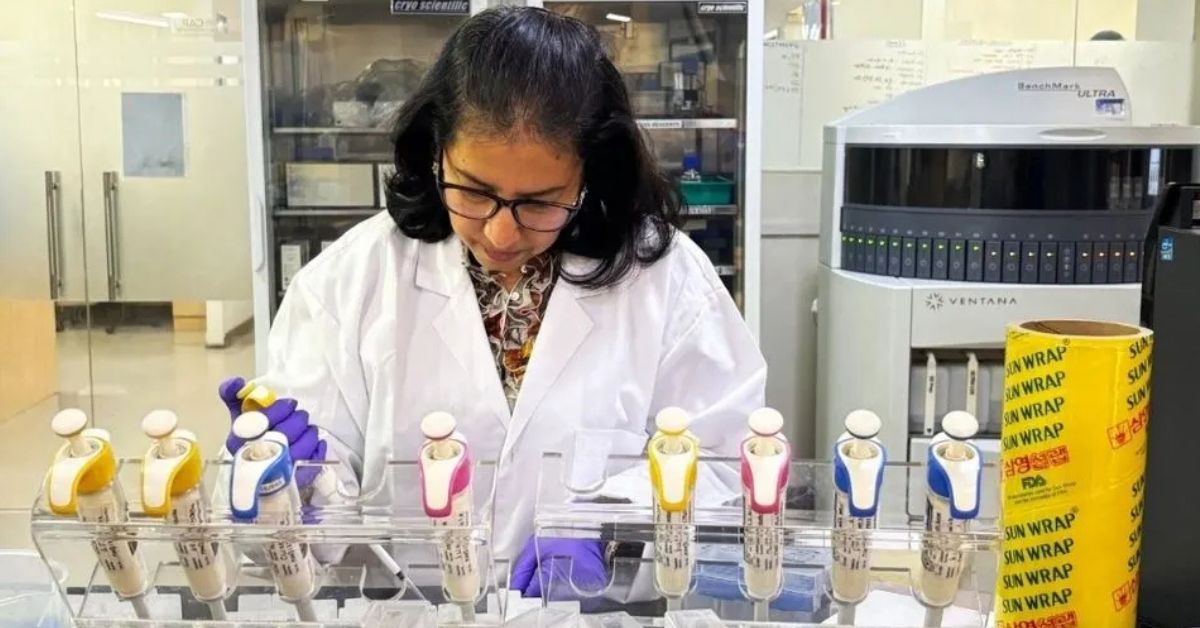
The test begins with tumour tissue removed during surgery. Scientists analyse five protein biomarkers through immunohistochemistry and combine these findings with clinical parameters such as tumour size, tumour grade, and lymph node status. These inputs are then processed by the proprietary AI algorithm, which generates a recurrence risk score between 1 and 100. Based on this score, patients are categorised as either low risk or high risk for cancer recurrence over the next five years.
By integrating biomarker science with artificial intelligence, CAB transforms complex tumour biology into a clinically actionable decision-making tool, enabling oncologists to make more precise and personalised treatment recommendations.
Bringing precision oncology within reach
The significance of CanAssist Breast (CAB) becomes clearer when viewed against India’s growing breast cancer burden. Breast cancer is now the most commonly diagnosed cancer among Indian women. As incidence rates continue to rise, healthcare systems face mounting pressure to deliver timely, accurate, and affordable treatment.
This is where CAB’s potential extends beyond individual patient care. By using artificial intelligence to identify which early-stage breast cancer patients are genuinely at high risk of recurrence, the test helps oncologists make more precise treatment decisions. Patients who are unlikely to benefit from chemotherapy can avoid unnecessary treatment, while those at higher risk can be prioritised for aggressive intervention.
At a healthcare system’s level, this has important implications for scalability. Affordable prognostic testing can reduce overtreatment, optimise the use of oncology resources, and lower treatment costs for both patients and hospitals. Because CAB is significantly less expensive than imported alternatives and has a shorter turnaround time, it can be adopted more widely across India’s healthcare ecosystem, including smaller cities and regional cancer centres.
As cancer cases continue to rise, technologies like CAB demonstrate how AI-powered diagnostics can help make precision medicine more accessible, enabling healthcare systems to deliver better outcomes at scale while improving the efficiency of cancer care.

Share Your Story Today, Shape Viksit Bharat Tomorrow
Got an idea, innovation, or experience that's making a difference? Share your story now and ignite India's transformation because your voice can drive the future forward!
Disclaimer:
Features ‘as is’ submissions and neither constitutes endorsement, certification, recommendation, or validation by NITI Aayog nor makes NITI Aayog liable in any manner.
Resources to Replicate This Idea
BUILD YOUR OWN INTERVENTION
Handpicked stories tailored just for you
Explore stories that inspire, inform, and ignite new ideas across tech, innovation, and real-world impact


Turning Chemistry Into Code: The Technology Making Complex Diagnostics Faster and More Precise
Algorithmic Biologics is turning chemistry into code, using programmable DNA molecules to simplify complex diagnostic testing. Its technology could enable...
Read More