
Monitoring 2.3 Billion Litres Daily: The Tech Powering Smarter Urban Water Systems
Using robotics, drones, AI analytics and real-time monitoring can help Indian cities detect leaks, monitor wastewater flows, reduce manual scavenging, and improve flood resilience across billions of litres of urban water infrastructure daily.
Updated on: 18 May 2026

Sector
Urban Development

Solution

Technology
AI

State of Origin
Disclaimer:
Features ‘as is’ submissions and neither constitutes endorsement, certification, recommendation, or validation by NITI Aayog nor makes NITI Aayog liable in any manner.
Impact Metrics
2.3 billion+ litres
of daily urban discharge monitored through AquaGrid.
800 million+ litres
of daily wastewater reuse impact enabled.
20.5 million people
covered under water-borne disease monitoring systems.
100,000+ acres of farmland
analysed for crop patterns and water requirements.
In most Indian cities, water infrastructure remains largely invisible until it fails. A leaking pipeline can disrupt supply to thousands of homes for weeks. Untreated sewage quietly enters lakes and rivers through stormwater drains. Flood backflows overwhelm ageing drainage systems during heavy rains. And when underground networks clog, human workers are still sent into hazardous sewers despite the practice being outlawed.
For decades, urban water management in India has depended on fragmented maps, manual inspections, and reactive maintenance. But a growing category of infrastructure technology startups is attempting to change that by turning buried water systems into digitised, monitorable networks.
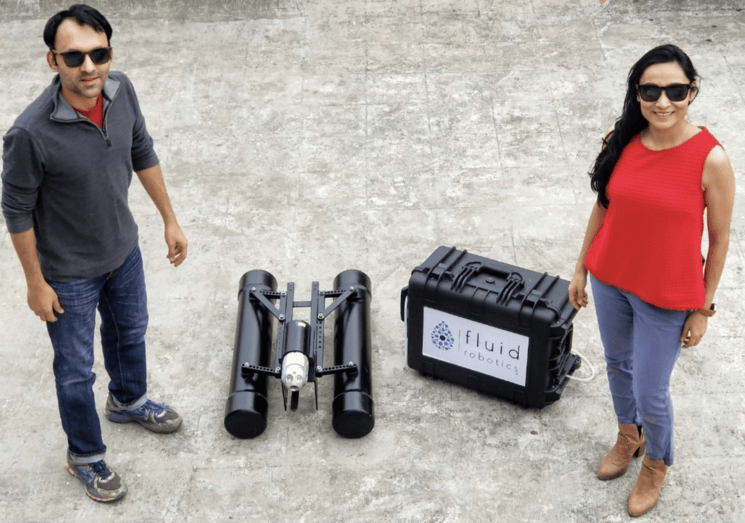
One such company is Fluid Robotics, which uses robotics, drones, AI-driven analytics, and sensor networks to map and monitor underground water and wastewater infrastructure across Indian cities.
Today, the company’s platform, AquaGrid, monitors more than 2.3 billion litres of daily urban discharge and supports wastewater reuse systems impacting over 800 million litres per day — positioning urban water infrastructure not merely as a civic utility problem, but as a data and automation challenge.
From Manual Detection to Digital Infrastructure Intelligence
The company’s origins lie in a deceptively ordinary problem.
In 2014, co-founder Asim Bhalerao visited his parents in Mumbai and noticed recurring water shutdown notices in their housing society. Conversations with engineers revealed that municipal teams were struggling to locate leaks in a two-kilometre underground pipeline using outdated techniques.
Without reliable underground maps, workers often relied on guesswork and manual excavation. Leak detection involved sounding rods and surface-level inspections — a slow and imprecise process for dense urban environments.
That experience eventually led Asim and co-founder Nidhi Jain to relocate from the United States to India and build technologies specifically designed for large-scale urban water infrastructure management.
Rather than treating water systems as isolated civil engineering assets, the company approached them as continuously monitorable networks capable of generating real-time operational data.
Robots Inside Drains, Drones Above Cities
Fluid Robotics’ core technology stack combines underground robotic systems, drone-based mapping, AI-powered analytics, and hydraulic modelling.
Its robotic inspection systems travel through underground pipelines and drainage networks to identify structural faults, blockages, leak points, and operational failures. The systems digitise underground assets that are otherwise undocumented or poorly mapped in many Indian cities.
Above ground, drones generate high-resolution topographical maps of settlements, roads, pipelines, stormwater drains, and water bodies. These maps are then layered with sensor data and AI models to identify pollution pathways, untreated sewage outfalls, and flood vulnerabilities.
The company also deploys wastewater flow sensors inside drainage systems to measure discharge volumes and identify anomalies in real time.
Together, these systems form the basis of AquaGrid — a digital infrastructure intelligence platform designed for urban water management.
The scale at which the platform now operates is significant:
- Over 2.3 billion litres of daily urban discharge monitored
- More than 800 million litres of wastewater reuse impact
- Nearly 900 million litres of daily flood and tidal backflows monitored
- Waterborne disease monitoring coverage for over 20.5 million people
- Infrastructure rehabilitation decision-making accelerated by up to 10 times
The model reflects a broader shift underway in urban infrastructure governance: replacing periodic surveys and static engineering reports with continuously updated infrastructure intelligence systems.
Rehabilitating Urban Water Bodies Through Data
One of the company’s notable projects involved the rejuvenation of the Powai and Mithi river systems in Mumbai.
Working alongside engineering consultants and municipal authorities, Fluid Robotics used drone surveys and robotic inspections to identify untreated sewage entering lakes and drains through hidden outfalls and damaged infrastructure.
The project exposed a common problem in Indian cities: infrastructure records often exist only as outdated paper maps, making accurate planning difficult during restoration and rehabilitation efforts.
By combining drone-generated topography with underground robotic inspection data, the team identified pollution sources linked to nearby residential and commercial areas. AI models were then used to process large volumes of pipeline inspection footage far faster than traditional manual review systems.
This reduced the time required to assess infrastructure conditions and prioritise rehabilitation work.
The same approach has also been extended to flood management systems, where monitoring tidal backflows and stormwater networks is becoming increasingly critical for climate-resilient urban planning.
Using AI to Understand Water Use in Agriculture
Beyond cities, the company has also applied AI-driven mapping systems in agriculture.
In Maharashtra’s Satara district, Fluid Robotics worked with irrigation authorities to analyse crop patterns and regional water requirements across nearly 100,000 acres of farmland.
Using drone imagery and AI models trained for crop and water-source identification, the company generated large-scale assessments of water distribution and unaccounted water loss within irrigation systems.
Such systems are increasingly important as states attempt to improve irrigation efficiency while responding to growing water stress and erratic rainfall patterns linked to climate change.
Replacing Hazardous Human Labour
The impact of these technologies extends beyond operational efficiency.
India officially prohibited manual scavenging in 1993, yet sanitation workers continue to enter septic tanks and sewer lines under hazardous conditions. Exposure to toxic gases and untreated sewage still causes fatalities every year.
By deploying robotic systems inside drains and nallahs, Fluid Robotics estimates that it has prevented more than 5,600 hours of manual scavenging work.
The intervention highlights a critical dimension of infrastructure automation often overlooked in technology discussions: worker safety.
In sectors where hazardous labour persists because of poor infrastructure visibility and lack of mechanisation, robotics is increasingly functioning not just as an efficiency tool, but as a public health intervention.
Building the Digital Layer for Water Infrastructure
India’s urban water systems are under mounting pressure from rapid urbanisation, ageing infrastructure, climate-linked flooding, and rising wastewater generation.
Much of this infrastructure remains physically buried and operationally invisible. Cities often lack accurate maps of drainage systems, real-time monitoring capability, or predictive maintenance systems.
Companies like Fluid Robotics are attempting to build that missing digital layer.
The significance of such technologies lies not only in detecting leaks or monitoring sewage flows, but in transforming water infrastructure into continuously measurable systems capable of supporting faster rehabilitation, pollution control, flood management, and safer sanitation practices.
As cities expand and climate risks intensify, infrastructure intelligence may become as critical to urban resilience as the pipelines themselves.
Share Your Story Today, Shape Viksit Bharat Tomorrow
Got an idea, innovation, or experience that's making a difference? Share your story now and ignite India's transformation because your voice can drive the future forward!
Disclaimer:
Features ‘as is’ submissions and neither constitutes endorsement, certification, recommendation, or validation by NITI Aayog nor makes NITI Aayog liable in any manner.
Resources to Replicate This Idea
BUILD YOUR OWN INTERVENTION
Handpicked stories tailored just for you
Explore stories that inspire, inform, and ignite new ideas across tech, innovation, and real-world impact


18,000+ Datasets, 2.5 Million Documents: How Frontier AI Is Making Public Data Accessible to India
FACTLY’s frontier AI projects, Dataful, Tagore AI, and GoPie, are transforming how India accesses, understands, and uses public data. With...
Read More