
Bioelectrochemical Wetland System Cuts Freshwater Demand by 90% at Campus Dhobi Ghats
Researchers have developed a constructed wetland–microbial fuel cell system that uses plants, filtration layers, and electrogenic microbes to treat laundry wastewater, generate bioelectricity, and recycle up to 1,000 litres of greywater daily while reducing freshwater demand by 90%.
Updated on: 08 May 2026

Sector

Solution

Technology

State of Origin
Disclaimer:
Features ‘as is’ submissions and neither constitutes endorsement, certification, recommendation, or validation by NITI Aayog nor makes NITI Aayog liable in any manner.
Impact Metrics
500-1000 litres
of laundry wastewater recycled into reusable greywater daily.
85-90% reduction
in freshwater demand at the campus dhobi ghat.
Generates bio-electricity
through electrogenic microbial activity, producing over 1 volt in laboratory conditions and approximately 600 millivolts under field conditions.
300 litres
of detergent-rich wastewater treated within a 24-hour operational cycle.
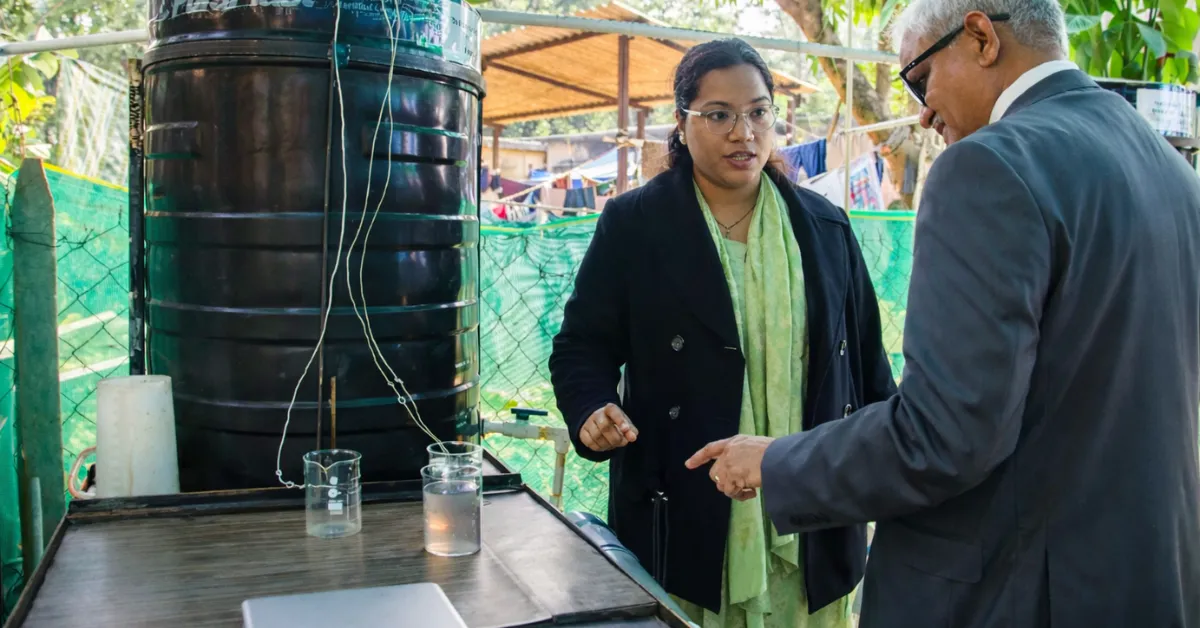
At the campus dhobi ghat of National Institute of Technology Rourkela, researchers have developed a decentralised wastewater treatment system that combines wetland ecology, microbial engineering, and bioelectrochemical processes to recycle detergent-rich laundry wastewater into reusable greywater. Led by Prof Kasturi Dutta and researcher Divyani Kumari, the project addresses a growing but often overlooked source of pollution: laundry wastewater loaded with surfactants, phosphates, sulphates, and organic contaminants.
The idea gained urgency during the COVID-19 pandemic, when handwashing and laundry loads surged across households, hospitals, and institutions. While most people viewed increased washing as a public health necessity, Prof Dutta began focusing on the environmental impact of the resulting wastewater streams. Reports documenting a sharp rise in surfactants entering drainage systems prompted her team to explore whether laundry wastewater could be treated and reused locally instead of being discharged untreated.

From Wastewater Research to Campus Deployment
The roots of the project go back to Prof Dutta’s postdoctoral research in Taiwan, where she worked on municipal wastewater treatment systems and bioenergy-generating reactors. That experience shaped her interest in technologies capable of simultaneously treating waste and recovering useful resources. After joining NIT Rourkela in 2015, she began exploring how decentralised treatment systems could address everyday water challenges in Indian institutions and communities.
In 2023, the opportunity to implement the concept arrived through CSR funding from the Higher Education Financing Agency (HEFA). The team selected the campus dhobi ghat as a pilot site because of its consistent wastewater generation and recurring water scarcity issues during summer months. The dhobi facility uses roughly 1,400 litres of water daily, much of which previously flowed directly into drains after use. By intercepting and treating this wastewater stream, the researchers aimed to reduce freshwater demand while demonstrating a practical circular water reuse model.
The Core Technology: A CW-MFC Hybrid System
The resulting system integrates a constructed wetland with a microbial fuel cell, creating what is known as a CW-MFC system. Constructed wetlands are engineered ecosystems designed to mimic the purification mechanisms of natural wetlands. Wastewater flows slowly through layered filtration media and plant-root zones, where suspended solids are trapped, pollutants are absorbed, and microbial communities degrade organic contaminants.
The microbial fuel cell component adds a bioelectrochemical layer to the process by using electrogenic bacteria capable of generating small amounts of electricity while consuming pollutants. Together, the two systems create a hybrid treatment model where biological purification and bioelectricity generation occur simultaneously.
System Architecture and Design
Physically, the pilot installation consists of an underground wastewater collection tank connected to two cylindrical treatment units and a treated-water storage tank. Wastewater from the dhobi ghat first enters the collection chamber before being pumped into the CW-MFC units. Each treatment chamber is vertically layered with graphite chunks at the base, followed by gravel, sand, and soil layers, with wetland plants growing at the surface.
The treatment units together can process around 300 litres of wastewater within a 24-hour operational cycle, while the overall system enables the reuse of between 500 and 1,000 litres of greywater daily. The wastewater collection tank itself can store up to 1,000 litres at a time.
How the Microbial Fuel Cell Generates Bioelectricity
The graphite base layer forms the anode region of the microbial fuel cell. This lower zone contains very little oxygen, creating favourable conditions for electrogenic microbes. As these bacteria metabolise organic compounds present in detergent-rich wastewater, they release electrons as part of their natural metabolic activity.
These electrons travel through conductive wiring toward the oxygen-rich cathode region, producing a small electrical current in the process. The movement of electrons effectively converts biochemical energy into bioelectricity while simultaneously accelerating pollutant degradation.
Under laboratory conditions, the system generated electrical outputs exceeding 1 volt. In real-world campus conditions, the average output measures approximately 600 millivolts. The voltage fluctuates seasonally because microbial activity is temperature dependent. During winter, when temperatures in Rourkela fall between 3°C and 10°C, microbial metabolism slows, reducing electricity generation rates.
The Role of Plants and Filtration Layers

The constructed wetland portion of the system plays an equally critical role in purification. Gravel and sand layers physically filter suspended particles from the wastewater stream, while soil layers support microbial biofilms responsible for breaking down detergent compounds.
On the surface, the researchers planted Canna species because of their resilience in waterlogged and polluted environments. These wetland plants absorb nutrients and contaminants through their root systems while also oxygenating upper sections of the treatment chamber, helping sustain aerobic microbial activity.
The entire setup functions as a controlled artificial wetland ecosystem where physical filtration, microbial degradation, phytoremediation, and bioelectrochemical reactions work together inside compact treatment tanks.
Hydraulic Retention Time and Treatment Efficiency
The system currently operates with a hydraulic retention time of 48 hours, meaning wastewater remains inside the treatment chambers for two days before being released into the treated-water storage tank. This duration allows sufficient contact between wastewater, microbes, filtration media, and plant roots for effective purification.
Ongoing research now focuses on optimising retention times by testing shorter treatment cycles ranging from 24 hours to as low as 2 hours without compromising treatment quality. Seasonal monitoring is also underway to understand long-term system stability under varying climatic conditions.
Performance monitoring has shown that the system reduces surfactant concentration and Chemical Oxygen Demand (COD) to approximately:
1\ \text{ppm}
These levels fall within the permissible reuse standards established by the Bureau of Indian Standards (BIS). The treated water remains classified as greywater and is therefore non-potable, but it is suitable for washing clothes, floor cleaning, gardening, and other utility purposes.
Impact on Freshwater Consumption
At present, the system supports the daily water needs of approximately 15 to 20 individuals associated with the campus dhobi operations. By recycling wastewater directly back into washing activities, the system reduces freshwater demand by an estimated 85–90%, depending on seasonal evaporation and operational conditions.
A pipeline now connects the treated-water storage tank back to the laundry area, creating a closed-loop reuse cycle within the facility. During summer months, when water shortages are common, the recycled water significantly reduces pressure on freshwater supplies.
Low-Cost Decentralised Infrastructure
One of the project’s strongest advantages is its affordability and operational simplicity. The complete installation, including the underground collection infrastructure, cost approximately Rs 2 lakh. The treatment units themselves, comprising the layered CW-MFC chambers and electrodes, cost roughly Rs 30,000.
Unlike centralised wastewater treatment plants that require extensive infrastructure and skilled operators, this decentralised system can be managed by a trained caretaker responsible for batch water loading, treated-water release, plant maintenance, and overflow monitoring.
The researchers view the project as an intermediate-scale demonstration bridging the gap between laboratory prototypes and large municipal wastewater facilities. Many wastewater technologies fail during scale-up because systems validated under controlled laboratory conditions become difficult to replicate in real operational environments. By deploying a medium-scale working model under variable weather and usage conditions, the NIT Rourkela team aims to demonstrate a more realistic pathway toward scalable decentralised water reuse systems.
The Road Ahead
Although no municipal authority has formally adopted the technology yet, discussions are underway within the campus regarding similar installations in student hostels and institutional utility spaces. The research team also intends to pursue additional government and private-sector grants after the current HEFA-supported funding cycle concludes in 2026.
Beyond the technical performance metrics, the project demonstrates how decentralised ecological engineering systems can address water stress using low-energy, nature-inspired infrastructure. Instead of relying on chemically intensive or energy-heavy treatment processes, the CW-MFC model leverages microbial metabolism, plant-root interactions, and passive filtration to create a low-cost circular water system located directly at the point of wastewater generation.
In a country increasingly shaped by freshwater scarcity, the project offers a practical example of how biological systems and environmental engineering can converge to reduce resource consumption, recycle wastewater locally, and build resilient decentralised infrastructure. On one university campus in Rourkela, a system powered by plants, microbes, and bioelectrochemical reactions is already converting laundry wastewater from a drainage burden into a reusable resource.
Share Your Story Today, Shape Viksit Bharat Tomorrow
Got an idea, innovation, or experience that's making a difference? Share your story now and ignite India's transformation because your voice can drive the future forward!
Disclaimer:
Features ‘as is’ submissions and neither constitutes endorsement, certification, recommendation, or validation by NITI Aayog nor makes NITI Aayog liable in any manner.
Resources to Replicate This Idea
BUILD YOUR OWN INTERVENTION
Handpicked stories tailored just for you
Explore stories that inspire, inform, and ignite new ideas across tech, innovation, and real-world impact


Powering India’s Digital Future Through AI, Semiconductor Innovation, and Human-Centred Governance
NagpurAI Infrastructure Labs is building an indigenous frontier-tech ecosystem spanning AI computing, semiconductor design, and aerospace manufacturing. Through its AP-DGI...
Read More