How Open-Source Climate Tech Is Reinventing Waste, Fuel, and Cooking Energy
Through open-source biomass technologies, a researcher is helping communities convert waste into fuel and biochar while reducing irrigation needs, lowering smoke emissions, and building resilient multi-fuel cooking ecosystems.
Updated on: 07 May 2026

Sector

Solution
Climate Action

Technology
Solar Energy

State of Origin
Disclaimer:
Features ‘as is’ submissions and neither constitutes endorsement, certification, recommendation, or validation by NITI Aayog nor makes NITI Aayog liable in any manner.
Impact Metrics
~ 1.2 lakh+ biomass steam
cookstoves deployed across India through NGOs, local fabricators, and implementation partners.
40-50% lower
irrigation or watering requirements due to improved soil moisture retention.
8 Indian states
and their communities have been impacted with Dr Karve's technologies and training interventions.
As a child growing up in Phaltan, Maharashtra, Dr Priyadarshini Karve frequently watched sugarcane residue being burned after harvest. The smoke-filled air that blanketed nearby villages sparked a question that would eventually define her career: could agricultural waste become a useful energy resource instead of an environmental burden?
Over the last 25 years, Dr Karve has developed a portfolio of decentralised climate technologies that convert biomass waste into fuel, soil enhancers, and clean cooking energy systems. Through Samuchit Enviro Tech, she has focused on low-cost engineering solutions rooted in biomass gasification, carbon sequestration, thermal efficiency, and renewable cooking systems.
Today, her technologies are being used across urban waste management projects, agricultural applications, and clean-energy interventions in multiple Indian states.
Engineering Biomass Into Fuel
Dr Karve’s early research began in the late 1990s at the Appropriate Rural Technology Institute (ARTI), where she explored methods to convert sugarcane residue and agricultural waste into high-efficiency fuel.
At the centre of her work was biomass gasification — a thermochemical process that partially burns organic matter under a controlled oxygen supply. Unlike open burning, where biomass combusts completely and releases smoke and greenhouse gases, gasification carefully regulates airflow to separate volatile gases from solid carbon.
The process works in stages:
- Biomass is ignited in a low-oxygen chamber.
- Heat drives out volatile gases from the material.
- These gases combust separately, generating additional heat.
- The remaining solid carbon forms char or biochar.
The resulting product contains concentrated carbon with significantly higher combustion efficiency than raw biomass.
Using this principle, Dr Karve developed compressed biochar briquettes made from sugarcane waste. These briquettes burned cleaner than traditional biomass fuels and generated substantially lower indoor smoke emissions.
However, adoption barriers emerged quickly. Producing briquettes required decentralised labour networks for biomass collection, charring, grinding, and compression. At the same time, rural households were increasingly transitioning toward LPG, which was seen as a symbol of modernity and convenience.
Rather than abandoning the technology, Dr Karve shifted focus toward improving the engineering design and expanding the use cases of biochar itself.
The Science Behind the Samuchit Transflasher Kiln
In 2004, Dr Karve collaborated with researchers at the UK Biochar Research Centre at the The University of Edinburgh, where she deepened her work on carbonisation systems and biochar applications.
This eventually led to the development of the Samuchit Transflasher Kiln — a portable biomass carbonisation unit designed for decentralised waste processing.
The kiln operates on a natural draught top-lit updraft gasification mechanism.
Technically, the system uses:
- Double-walled metal chambers
- Strategically placed primary and secondary air inlets
- Controlled oxygen flow
- Layered heat transfer through biomass stacks
When dry leaves or agricultural waste are ignited from the top, the upper layer begins combusting first. Heat gradually propagates downward, driving pyrolysis in the lower layers.
Instead of allowing unrestricted combustion, the kiln controls oxygen availability so that much of the biomass converts into stable carbon rather than ash.
The volatile gases released during pyrolysis burn above the biomass bed, producing additional heat while minimising visible smoke.
This design achieves three engineering goals simultaneously:
- Waste volume reduction
- Clean thermal conversion
- Carbon retention in char form
The kiln’s foldable modular structure also addressed practical deployment challenges in urban India, where seasonal storage space is limited.
Initially designed for household garden waste, the kilns later found applications in:
- Crop residue management
- Forestry waste processing
- Invasive species removal projects
- Urban leaf litter management
In Karnataka, forest restoration initiatives now use these kilns to process invasive biomass removed from forest ecosystems. The resulting biochar is returned to forest soil, creating a closed-loop carbon cycle.
Biochar as a Soil Engineering Material
While biochar began as a fuel innovation, its agricultural applications have become increasingly important in climate mitigation.
Biochar functions less like fertiliser and more like a soil structural modifier.
At the microscopic level, biochar contains a porous carbon matrix with extremely high surface area. These pores:
- Improve water retention
- Increase microbial habitation zones
- Enhance nutrient holding capacity
- Improve soil aeration
Because the carbon structure is chemically stable, it decomposes very slowly, allowing carbon to remain trapped in the soil for long durations.
Field applications conducted by partner organisations working with Dr Karve have shown moisture retention improvements significant enough to reduce irrigation frequency by nearly 40–50 percent in some contexts.
In water-stressed regions, this effectively turns biochar into a passive water management technology.
Dr Karve, however, strongly advocates decentralised biochar systems over industrial-scale carbon removal models.
Large centralised biochar factories often require transporting agricultural residue over long distances, which increases fuel consumption and operational emissions. Her approach instead relies on portable low-energy kilns that travel directly to biomass sites.
The philosophy is fundamentally distributed:
convert waste where it is generated, use the char locally, and minimise transport energy.
Reinventing Thermal Efficiency in Cooking
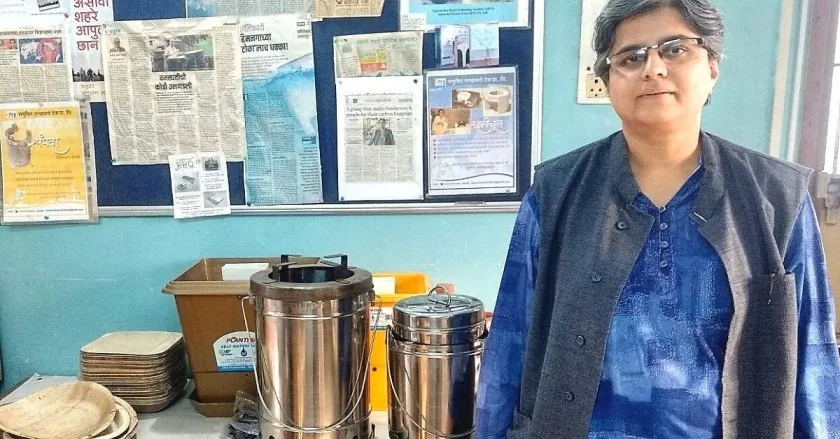
Another major technological intervention from Samuchit Enviro Tech has been its biomass-based steam cooking stove.
The stove was engineered around retained-heat cooking and steam-assisted thermal transfer.
Traditional biomass stoves lose substantial energy through incomplete combustion and heat dissipation. Dr Karve’s design instead optimises:
- Airflow regulation
- Heat containment
- Steam circulation
- Fuel combustion duration
Using only around 100 grams of charcoal or biochar briquettes, the stove can cook an entire meal for four people.
The combustion phase lasts roughly 30 minutes, after which residual heat and steam trapped within the insulated cooking chamber continue the cooking process without additional fuel input.
This dramatically improves fuel efficiency compared to traditional firewood systems.
The stove also addresses a major public health issue: indoor air pollution caused by incomplete biomass combustion.
By using processed biomass fuel and controlled combustion pathways, the system produces far lower smoke exposure than conventional chulhas.
By 2022, an estimated 60,000 units had been distributed through NGOs and community implementation partners. Dr Karve estimates that deployment may now exceed 1.2 lakh units through continued local manufacturing and training programmes.
Open-Source Climate Technology
One of the most distinctive aspects of Dr Karve’s work is her commitment to open-source engineering.
Rather than patenting designs, Samuchit encourages NGOs and local communities to work with regional fabricators to build stoves and kilns independently.
The idea is to decentralise not only energy production, but also technology manufacturing itself.
This model has enabled projects across Maharashtra, Karnataka, Tamil Nadu, Andhra Pradesh, Rajasthan, West Bengal, Assam, and Uttarakhand, often through partnerships with NGOs, donor agencies, and environmental organisations.
Building Multi-Fuel Urban Kitchens
Recent LPG shortages and supply disruptions have brought renewed attention to Dr Karve’s long-standing argument: urban kitchens should not depend on a single fuel source.
Her current work increasingly focuses on hybrid cooking energy ecosystems that combine:
- LPG
- Solar cooking
- Biogas systems
- Pellet stoves
- Biochar-based cookstoves
- Electric cooking devices
She has also been engaging architects and urban planners to rethink kitchen infrastructure itself.
Much like modern apartments now routinely include washing machine provisions, Dr Karve argues future kitchens should be designed with dedicated space and ventilation for multiple renewable cooking systems.
To accelerate adoption, she and fellow practitioners have revived “Cooking for Climate” demonstration events that introduce urban residents to alternative clean cooking technologies and train users in operating decentralised fuel systems.
Alongside deployment work, she also runs climate education programmes focused on carbon accounting and works with CLEAN (Clean Energy Access Network), a national network promoting decentralised renewable energy systems.
Across all these interventions, the core engineering philosophy remains consistent: climate technologies must be modular, decentralised, low-resource, and designed around local realities rather than centralised infrastructure.
Share Your Story Today, Shape Viksit Bharat Tomorrow
Got an idea, innovation, or experience that's making a difference? Share your story now and ignite India's transformation because your voice can drive the future forward!
Disclaimer:
Features ‘as is’ submissions and neither constitutes endorsement, certification, recommendation, or validation by NITI Aayog nor makes NITI Aayog liable in any manner.
Resources to Replicate This Idea
BUILD YOUR OWN INTERVENTION
Handpicked stories tailored just for you
Explore stories that inspire, inform, and ignite new ideas across tech, innovation, and real-world impact

Pilotless Cargo Flights with Zero Failures: Reimagining Diagnostic Logistics in Indian Cities
An energy-efficient autonomous aircraft combining vertical take-off with fixed-wing cruise has completed over 1,000 flights carrying diagnostic samples between hospitals,...
Read More