With 20-Year Lifespans, Why ZincGel Batteries Could Power the Future of Clean Energy
Offgrid Energy Labs, a Gurugram-based deep-tech startup, is developing ZincGel batteries to solve long-duration energy storage challenges in renewable energy. Using abundant materials like zinc and bromine, the company offers a safer, cost-effective alternative to lithium-ion batteries, improving grid reliability, supporting industrial energy needs, and strengthening India’s clean energy transition.
Updated on: 20 March 2026

Sector

Solution
Climate Action

Technology

State of Origin
Disclaimer:
Impact Metrics
7000+ discharge cycles
per battery, equating to about 20 years of life.
Stable performance
across temperature, discharge, and stress conditions.
90% round-trip efficiency
equating to minimal energy loss.
10 MW facility
under construction in the UK.
This story was submitted under our programme Frontier Voices of India. If you have an innovation that’s solving critical challenges in India, we want to hear from you. Register using this link, or write to us at frontiertech@thebetterindia.com.
As renewable energy expands across the world, questions arise about how to store that energy safely, affordably, and for long periods. While solar and wind generation continue to grow, energy storage systems often rely on lithium-ion batteries that face concerns around fire risk, degradation, and recycling complexity, as well as limited availability of materials. This slows industrialization and comes with an inherent risk of supply uncertainty.
In Gurugram, deep-tech startup Offgrid Energy Labs is tackling this problem by revisiting a more easily available, long-lasting, and efficient material: zinc.
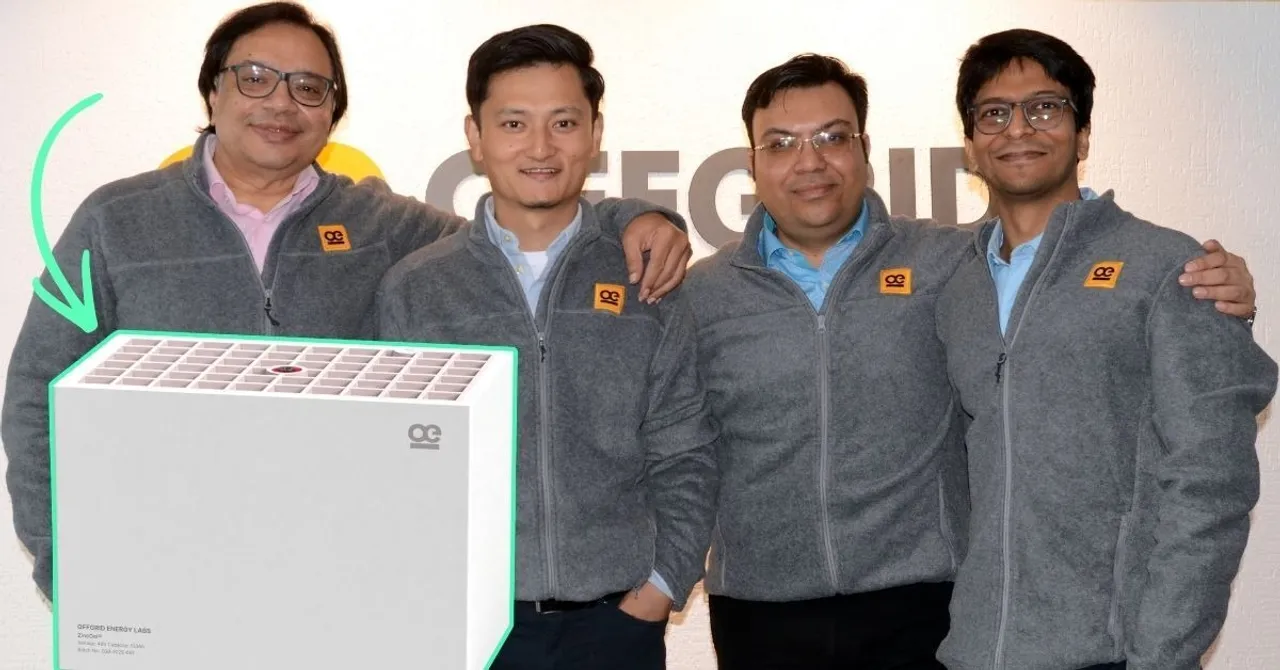
Founded in 2018 by Rishi Srivastava, Tejas Kusurkar, Brindan Tulachan, and Ankur Agarwal, this company is building next-generation stationary batteries designed for long-duration energy storage. Offgrid presents an efficient solution that can make a world of difference, both for remote regions as well as the leading industries in India.
The technology — ZincGel battery architecture
/filters:format(webp)/english-betterindia/media/media_files/2026/02/25/offgrid-energy-labs-2026-02-25-13-19-30.png)
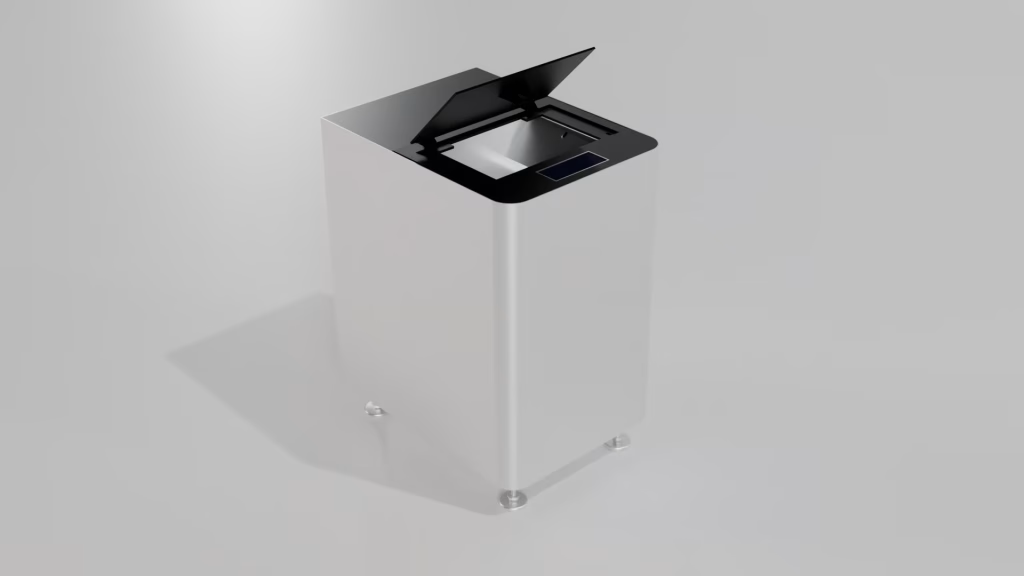
Offgrid’s core innovation is ZincGel, a zinc-bromide battery system engineered specifically for stationary energy storage applications such as buildings, industries, microgrids, and renewable power infrastructure.
The system uses three widely available materials—zinc, bromine, and carbon—in addition to plastic. Unlike the scarce materials used in lithium-ion systems, these materials are abundant and globally distributed. Bromine can be extracted from the sea anywhere, and zinc is mined ~900 times more than lithium, reducing geopolitical supply risks. What is more, India is one of the largest producers of zinc worldwide. This means that ZincGel batteries can be easily manufactured and utilized for a wide range of use cases in the country.
The key advancement lies in Offgrid’s proprietary electrolyte design, which stabilises the internal electrochemical reactions within the battery. This redesign improves efficiency while maintaining the inherent safety advantages of aqueous zinc chemistry. As a result, ZincGel batteries achieve around 90% round-trip efficiency, placing them in the same performance range as lithium-ion batteries while avoiding many of their safety challenges — for instance, they have a much lower risk of fire.
Built for infrastructure-scale reliability
ZincGel batteries are engineered for daily deep-cycling energy storage, which is essential for renewable power systems that charge during the day and discharge at night. They come with a 100% depth of discharge (DoD) capability, meaning that their entire battery capacity can be tapped into during a discharge cycle. A single battery can take over 7,000 charge–discharge cycles without efficiency loss. This equates to about two decades of operational life. Moreover, the battery performance is stable regardless of the discharge, temperature, and puncture conditions.
These batteries have undergone safety and performance testing aligned with international protocols such as UL 9540A and UL 1973, standards commonly used to evaluate large-scale energy storage systems. Because their materials are easier to recover and process, ZincGel batteries also support improved recyclability and circular-economy compatibility compared to conventional lithium systems.
Validation, manufacturing, and partnerships
/filters:format(webp)/english-betterindia/media/media_files/2026/02/25/offgrid-energy-labs-2026-02-25-13-21-58.png)
Since 2019, Offgrid Energy Labs has built a growing business portfolio with 61 global IP assets, including more than 20 granted patents related to electrode design, electrolyte chemistry, and system architecture. The company’s validation milestones include independent testing by Intertek that confirmed battery lifecycle durability and safety, pilot validation through a shell-supported program (2022), and field trials with major commercial partners such as Shell India.
To move toward commercial deployment, the company is establishing its first 10 MW pilot manufacturing facility in the United Kingdom, expected to become operational in 2026. The facility will refine production processes before scaling manufacturing globally. This project has already received a major investment from Ankur Capital and Archean Chemical Industries, a leading bromide manufacturer.
Impact and potential for application
The ZincGel system has been designed for energy scenarios where safety, durability, and predictable costs are more important than compact size or high energy density. This suggests that it can thrive in renewable energy storage (solar and wind), rural and remote microgrids, industrial energy backup, grid-scale power storage, and power for telecom towers.
If successfully scaled, zinc-based storage technologies like ZincGel could strengthen renewable energy infrastructure by improving reliability while reducing dependence on critical lithium supply chains. Its long battery life, highly efficient discharge capability, and easily available materials make it lucrative for rapidly developing economies such as India.
Share Your Story Today, Shape Viksit Bharat Tomorrow
Got an idea, innovation, or experience that's making a difference? Share your story now and ignite India's transformation because your voice can drive the future forward!
Disclaimer:
Resources to Replicate This Idea
BUILD YOUR OWN INTERVENTION
Handpicked stories tailored just for you
Explore stories that inspire, inform, and ignite new ideas across tech, innovation, and real-world impact

How AI Diagnostics Are Reaching India’s Frontline Health Workers
AffEx equips rural health workers with an AI-powered point-of-care screening kit — testing hemoglobin, blood pressure, ECG, and cardiac and...
Read More